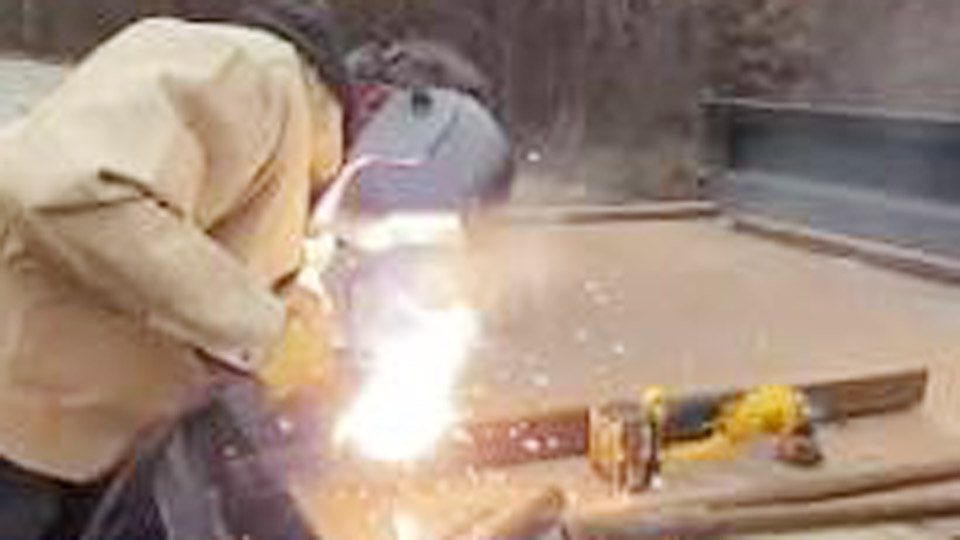
Welders frequently encounter a dense plume of metallic particles and reactive gases right at the arc, often without realizing how quickly concentrations build in the breathing zone.
Understanding the health risks of welding is essential because even short daily exposures accumulate into measurable declines in lung function, neurological performance, and cancer probability over a career.
Professional and hobby welders who select processes, base metals, and controls based on exposure data make better decisions that protect respiratory capacity, neurological health, and long-term viability on the job.
Image by @theperryco
Respiratory Hazards from Welding Fumes
Welding fumes consist of fine particles (mostly <1 μm) of metal oxides that reach the alveoli. Composition varies sharply by process and material: mild steel produces primarily iron oxide with manganese; stainless steel adds hexavalent chromium (Cr(VI)) and nickel; galvanized surfaces release zinc oxide.
Particle Size, Deposition, and Clearance Mechanisms
Particles in the 0.1–1.0 μm range deposit most efficiently in the alveolar region. Macrophages engulf them, but high daily loads overwhelm clearance.
Iron oxide accumulation leads to siderosis (welder’s lung), visible on X-rays as small opacities, generally benign but indicative of heavy exposure. Manganese and other metals trigger oxidative stress and inflammation beyond simple overload.
Studies show welders experience accelerated FEV1 decline, on the order of 50–150 mL more per decade than non-welders in some cohorts, with greater effects in those welding stainless or using flux-cored processes.
Acute Respiratory Effects and Metal Fume Fever
Metal fume fever, common after welding galvanized steel or high-zinc alloys, appears 4–12 hours post-exposure with flu-like symptoms: fever, chills, muscle aches, metallic taste, and dry cough.
Symptoms usually resolve in 24–48 hours but recur with re-exposure. Zinc oxide is the classic trigger, though copper, magnesium, and cadmium produce similar responses.
Ozone and nitrogen oxides from the arc cause mucous membrane irritation and, at higher levels, chemical pneumonitis or pulmonary edema. Ozone forms readily in TIG and MIG on aluminum; levels above 0.3 ppm produce noticeable discomfort.
Chronic Respiratory Conditions
Long-term exposure correlates with chronic bronchitis, occupational asthma (especially with stainless steel due to Cr and Ni), and increased pneumonia severity. Some evidence links welding fumes to faster COPD progression, particularly in smokers, though smoking confounds many studies.
IARC classifies welding fumes as Group 1 carcinogens, with sufficient evidence for lung cancer and limited evidence for kidney cancer.
Meta-analyses report relative risks for lung cancer around 1.3–1.4 for welders versus non-welders, persisting after smoking adjustment in better studies. Stainless steel welding shows particular concern due to Cr(VI).
Neurological and Systemic Effects of Key Metals
Manganese in fumes from certain electrodes and wires poses a distinct risk. Chronic overexposure produces manganism, with Parkinson-like symptoms: tremor, bradykinesia, gait disturbances, and cognitive changes.
Effects appear reversible early but become permanent with continued exposure. Welders in automotive or heavy fabrication with poor ventilation show elevated blood and urine manganese and subtle motor deficits.
Other Metal-Specific Toxicities
- Chromium (VI): Highly toxic and carcinogenic; causes nasal septum perforation, asthma, and lung cancer. OSHA PEL is 5 μg/m³.
- Nickel: Sensitizer linked to dermatitis and respiratory irritation; contributes to cancer risk.
- Cadmium: From plated steels; causes severe pulmonary edema and kidney damage.
- Lead: From older painted surfaces or certain alloys; neurotoxic and affects blood.
Carbon monoxide from incomplete combustion or CO2 shielding reduces oxygen delivery, exacerbating fatigue and cardiovascular strain.
Radiation Hazards: UV, IR, and Visible Light
The welding arc emits intense UV radiation, causing arc eye (photokeratitis) with delayed onset of severe pain, tearing, and light sensitivity. Chronic UV exposure raises skin cancer risk, particularly on neck and arms. IR radiation contributes to cataracts over decades.
Proper helmets with auto-darkening filters (shade 8–13 depending on process and amperage) and full-coverage clothing are non-negotiable. Bystanders need curtains or barriers.
Noise-Induced Hearing Loss in Welding Environments
Arc gouging, plasma cutting, and grinding produce noise often exceeding 100 dB. Chronic exposure without protection leads to permanent threshold shifts, typically in higher frequencies first. Combined with ototoxic metals or CO, damage accelerates.
Hearing conservation programs with fitted plugs or muffs (NRR 25–30+) and annual audiometry are standard for professionals.
Reproductive, Cardiovascular, and Other Effects
Some studies suggest associations with reduced fertility or adverse reproductive outcomes, but data remain inconsistent due to confounders. Cardiovascular strain arises from CO, particulate matter, and chronic inflammation. Gastrointestinal irritation and skin conditions (dermatitis from Cr/Ni) also occur.
Exposure Assessment and Regulatory Limits
No single PEL exists for total welding fume because composition varies. OSHA regulates individual components (e.g., iron oxide 5 mg/m³, manganese 0.02 mg/m³ respirable). NIOSH recommends keeping total fumes as low as feasible. Real-time monitoring or personal sampling in the breathing zone provides the most relevant data for decision-making.
Typical Exposure Ranges (examples from field studies):
- Mild steel MIG: 1–10 mg/m³ total fume
- Stainless FCAW: higher Cr(VI) fractions
- Confined space without ventilation: rapidly exceeds limits
Engineering Controls: Ventilation Strategies
Local exhaust ventilation (LEV) with movable hoods positioned 4–6 inches from the arc achieves capture velocities of 100 fpm and dramatically reduces exposure. For fixed setups, downdraft tables or push-pull systems work well.
General dilution ventilation at 2,000 cfm per welder is the minimum in open areas but insufficient alone for high-fume processes.
In confined spaces, continuous monitoring for oxygen, CO, and flammables is required, with supplied-air respirators when ventilation cannot keep levels safe.
Administrative and PPE Controls
- Rotate tasks to limit daily fume dose.
- Use low-fume consumables and optimized parameters (lower voltage/current where possible).
- Respirators: Powered air-purifying (PAPR) with TH3 or P100 filters offer high protection; half-face with P100 for lighter tasks. Fit-testing and clean-shaven policies matter for tight-fitting models.
- Medical surveillance: Baseline and periodic spirometry, especially for those with >10 years exposure.
Process selection influences risk: TIG on aluminum produces ozone but less particulate than SMAW; pulsed MIG reduces fume generation compared to spray transfer.
Process-Specific Risk Profiles
Mild Steel GMAW/GMAW-P: Moderate fume; manganese primary concern. Good LEV usually sufficient.
Stainless Steel Processes: High Cr(VI) risk. Prioritize LEV + supplementary RPE; consider lower-Cr filler where feasible.
Aluminum TIG/MIG: Ozone dominant; UV intense. Good shielding gas coverage and ventilation critical.
Flux-Cored and SMAW: Highest fume generation; strong local exhaust essential.
Cutting and Gouging: High noise, particulates, and potential coatings (lead, cadmium). Full containment and extraction needed.
Monitoring and Health Surveillance Programs
Track personal exposures periodically, especially when changing materials or processes. Spirometry every 1–2 years detects early declines. Blood/urine metals for manganese, chromium, etc., in high-risk settings. Vaccination against pneumococcal pneumonia is recommended in some jurisdictions due to elevated infection risk.
Real-World Decision Framework for Welders
Evaluate every job by asking: What metals and coatings are involved? What process parameters minimize fume (e.g., short-circuit vs. globular transfer)? Is LEV positioned optimally and functioning?
Does the setup require RPE? Documenting these choices builds a defensible exposure history and guides upgrades like on-gun extraction systems, which capture fume at the torch for MIG/FCAW.
Performance-Based Takeaway
Welders who consistently maintain breathing-zone fume below 1–2 mg/m³ through layered controls (LEV first, then optimized parameters, then RPE) show minimal long-term lung function loss in longitudinal data.
The advanced insight is that fume generation rate scales nonlinearly with current and arc voltage—small reductions in heat input or arc time compound into major exposure savings over thousands of hours, preserving both health metrics and productivity.
FAQ
How long does it take for welding fumes to cause permanent lung damage?
Cumulative dose matters more than single days. Measurable FEV1 declines appear after 10+ years of high exposure; earlier changes occur with poor controls. Consistent LEV and RPE delay or prevent progression.
Does welding stainless steel pose higher cancer risk than mild steel?
Yes, primarily due to Cr(VI) and nickel. Relative lung cancer risk is similar in broad meta-analyses, but stainless processes demand stricter Cr(VI) controls per OSHA.
Can a good respirator fully replace ventilation?
No. Engineering controls (LEV) are primary; respirators supplement when LEV cannot achieve safe levels, especially in confined spaces or high-production work.
What blood tests monitor welding exposure?
Manganese (whole blood), chromium (urine), and lead (blood) are useful. Consult occupational medicine for interpretation against baselines and exposure history.