Many welders encounter hydrogen-induced cracking or inconsistent mechanical properties when switching to structural work or thicker materials.
Selecting the right low-hydrogen electrode becomes critical for code-compliant welds that deliver 70,000 psi tensile strength without defects.
Understanding 7018 welding rod specifications directly addresses these challenges, providing the chemical composition, operating parameters, and performance data needed for reliable results on carbon and low-alloy steels.
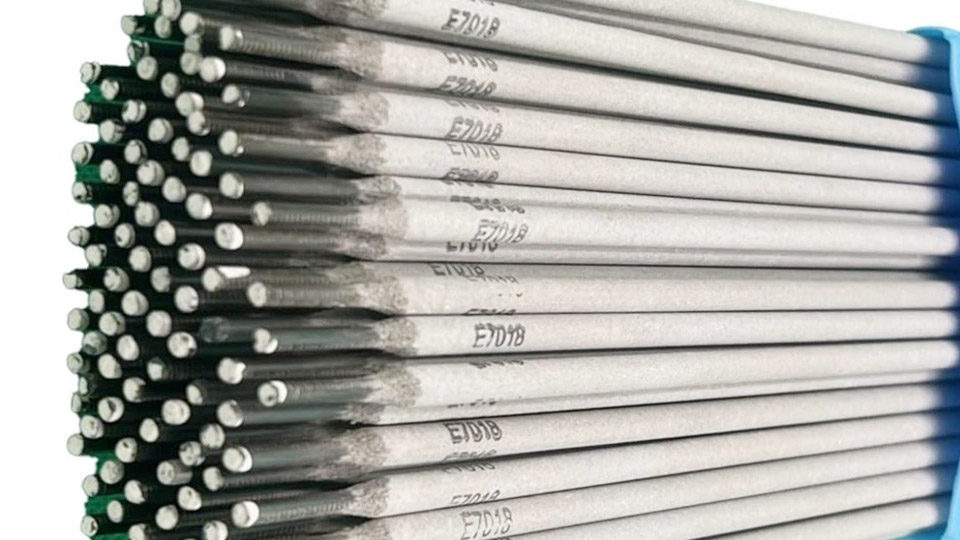
Image by capitolironworksdc
AWS Classification and Electrode Designation
Breaking Down the E7018 Code
The AWS A5.1 classification E7018 breaks down as follows:
- E: Electrode for shielded metal arc welding (SMAW).
- 70: Minimum tensile strength of 70,000 psi (483 MPa) in the as-welded condition.
- 1: Usable in all positions (flat, horizontal, vertical, overhead).
- 8: Low-hydrogen potassium coating with iron powder, suitable for AC or DCEP (DC electrode positive).
Supplementary designators refine performance further. H4 or H8 indicates maximum diffusible hydrogen levels (4 or 8 ml/100g weld metal). The “R” suffix denotes moisture resistance after exposure testing. E7018-1 variants offer enhanced low-temperature impact toughness (20 ft-lb at -50°F versus -20°F for standard E7018).
Chemical Composition Limits
AWS specifications set strict limits to ensure weld metal quality and compatibility:
| Element | AWS Max (%) | Typical Weld Metal (%) |
|---|---|---|
| Carbon (C) | 0.15 | 0.04–0.08 |
| Manganese (Mn) | 1.60 | 0.87–1.50 |
| Silicon (Si) | 0.75 | 0.38–0.61 |
| Phosphorus (P) | 0.035 | 0.012–0.019 |
| Sulfur (S) | 0.035 | 0.009–0.015 |
| Chromium (Cr) | 0.20 | ≤0.05 |
| Nickel (Ni) | 0.30 | ≤0.04 |
| Molybdenum (Mo) | 0.30 | ≤0.01 |
| Vanadium (V) | 0.08 | ≤0.01 |
Combined Mn + Ni + Cr + Mo + V must not exceed 1.75%. These levels provide deoxidation, strength, and toughness while minimizing cracking risk.
Mechanical Properties and Performance Data
Tensile and Yield Strength
Standard E7018 deposits deliver:
- Tensile Strength: 70,000 psi minimum (typically 72,000–86,000 psi).
- Yield Strength: 58,000 psi minimum (often 65,000–72,000 psi).
- Elongation in 2″: 22% minimum (commonly 24–31%).
E7018-1 electrodes improve low-temperature performance with Charpy V-notch impacts often exceeding 47J at -50°C, making them suitable for pressure vessels and structural steel in cold environments.
Diffusible Hydrogen and Crack Resistance
Low-hydrogen coatings limit diffusible hydrogen to prevent delayed cracking in restrained joints or higher-strength steels. H4R variants maintain performance even after humidity exposure, critical for field work.
Available Diameters and Deposition Characteristics
Size Selection Guide
Common diameters and typical applications:
- 3/32″ (2.4 mm): Thin materials, root passes, precision work (up to 1/4″ thick).
- 1/8″ (3.2 mm): General fabrication, most common for structural steel (1/4″–3/8″).
- 5/32″ (4.0 mm): Higher deposition on thicker plates.
- 3/16″ (4.8 mm) and larger: Heavy plate, flat/horizontal positions.
Iron powder in the coating boosts deposition rates compared to non-iron-powder low-hydrogen rods, often allowing higher travel speeds while maintaining X-ray quality welds with easy slag release.
Amperage, Polarity, and Arc Settings
Recommended Parameters
Optimal settings vary by diameter, position, and joint type. Use DCEP (reverse polarity) for best arc stability and penetration on most applications. AC works on compatible machines but may produce slightly more spatter.
Typical flat-position ranges (DCEP/AC):
- 3/32″: 70–110 A
- 1/8″: 90–150 A (120–140 A common)
- 5/32″: 130–220 A
- 3/16″: 200–300 A
- 1/4″: 250–350+ A
Adjust downward 10–20% for vertical/uphill and overhead. Maintain a short arc length (electrode nearly touching the puddle in flat positions) to minimize porosity. Drag technique with a 10–15° trailing angle works best.
Voltage and Travel Speed
Arc voltage typically runs 22–28 V depending on machine and settings. Aim for bead width 2.5–3 times core wire diameter to avoid slag inclusions.
Welding Positions and Technique Considerations
All-Position Capability
The “1” designation confirms usability in all positions, but performance peaks in flat and horizontal. Vertical uphill requires tighter control of the puddle and slight weaving. Overhead demands lower amperage and precise arc length to prevent undercut or slag runoff.
Medium penetration profile fills joints effectively without excessive burn-through on prepared edges, unlike deeper-digging cellulose rods.
Material Compatibility and Applications
Suitable Base Metals
E7018 excels on mild carbon steels, low-alloy steels (up to ~70 ksi yield), and some free-machining grades. Common uses include:
- Structural steel (bridges, buildings).
- Pressure vessels and piping.
- Heavy equipment fabrication.
- Shipbuilding and offshore platforms.
- Repair of cast steels.
It performs best on clean or lightly scaled surfaces. Manganese and silicon aid deoxidation, but heavy mill scale or rust benefits from prior cleaning.
Thickness Range
Effective from thin sheet (with smaller diameters) to heavy plate over 1 inch, especially in multi-pass applications.
Comparison with Other Common Electrodes
7018 vs 6010/6011
6010/6011 provide deep penetration and work on dirty metal with cellulose coatings but higher hydrogen levels and lower tensile strength (60 ksi). Use 7018 for strength-critical or crack-sensitive joints; reserve 6010/6011 for root passes or field repairs on unprepared surfaces.
7018 vs 6013/7014
6013 offers easy arc for thin materials and beginners but shallower penetration and lower strength. 7014 provides higher deposition but lacks the low-hydrogen benefits and toughness of 7018. Choose 7018 when code requirements or mechanical properties demand it.
Storage, Handling, and Reconditioning
Moisture Management
Low-hydrogen electrodes ship in hermetically sealed containers. Once opened, expose them minimally. Store in holding ovens at 225–300°F (107–149°C) to maintain low moisture.
Re-drying Procedures
If exposed:
- Less than 1 week ambient (no water contact): Re-dry 1–2 hours at 650–750°F (340–400°C).
- Heavier exposure or wet rods: Follow manufacturer guidelines, often up to 800°F. Spread electrodes for even heating. Avoid repeated cycles that degrade coating.
Use dry gloves and quivers for field transport. Never store with cellulosic rods (6010/6011) in the same oven.
Advanced Specifications: Variants and Standards Compliance
E7018-1 and Specialized Versions
The “-1” suffix enhances impact properties for low-temperature service. H4R moisture-resistant versions suit jobsites with variable humidity. Some formulations optimize for specific approvals (ABS, DNV, ASME).
X-Ray Quality and Inspection
Properly used 7018 produces dense, porosity-free deposits meeting stringent radiographic standards when parameters stay within limits and storage is controlled.
Choosing the Right 7018 Rod for Your Project
Match diameter to thickness and position, verify H-designator against hydrogen cracking risk, and confirm storage compliance with applicable codes.
For critical structural or pressure work, prioritize fresh or properly re-dried H4/H4R electrodes run on DCEP with tight parameters. This delivers consistent 70 ksi+ welds with excellent toughness and minimal post-weld cleanup.
In multi-pass thick-section welding, interpass temperature control (typically 300–500°F max) combined with 7018’s low hydrogen allows higher productivity without compromising toughness—balancing heat input for optimal microstructure in the heat-affected zone.
FAQ
What does the H4 or H8 mean on 7018 rods?
H4 or H8 specifies maximum diffusible hydrogen (4 or 8 ml/100g). Lower values reduce cracking risk in restrained or higher-strength joints. H4R adds moisture resistance.
Can 7018 rods be used on AC welders?
Yes, many 7018 electrodes run well on AC, though DCEP provides superior arc stability and bead appearance. Test settings on scrap first.
How long can 7018 rods stay out of the oven?
Typically 4–8 hours depending on humidity and manufacturer rating (H4R longer). Exceeding limits requires re-drying before critical use.
Is 7018 suitable for root passes?
It works but many prefer 6010/6011 for open-root pipe due to deeper penetration. 7018 excels on fill and cap passes for strength and toughness.