Many welders struggle with inconsistent beads, porosity, or weak joints in oxy-acetylene welding because they rely on guesswork or outdated rules of thumb for gas pressures.
The right Oxy Acetylene Welding Pressure Settings Chart delivers the exact regulator outputs needed for clean fusion, proper penetration, and minimal distortion across material thicknesses.
These settings directly control flame temperature, heat input, and gas efficiency—critical factors that separate professional-quality welds from frustrating rework.
I’ll discuss manufacturer-aligned charts, real decision-making data, flame adjustment techniques, and application-specific parameters for DIY enthusiasts, students, and professionals.
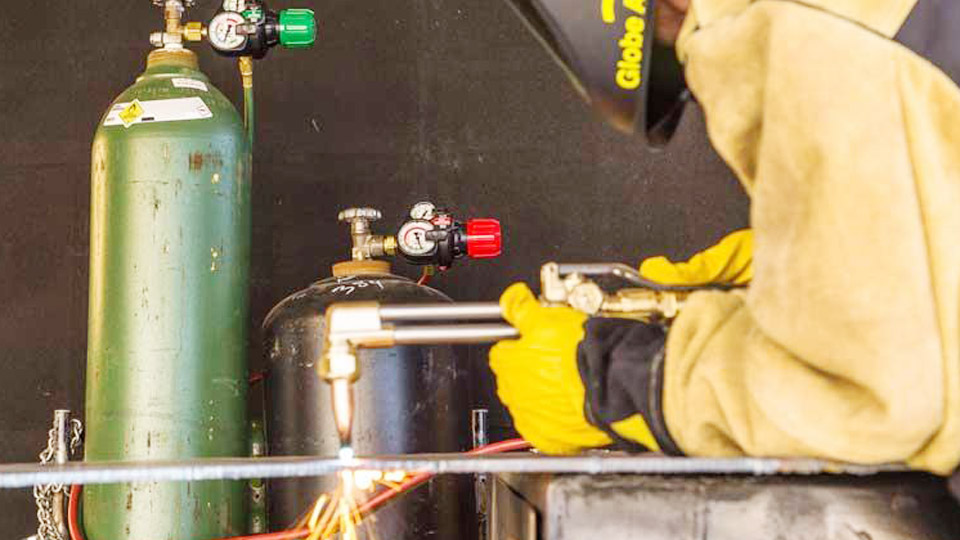
Image by thefabricator
Understanding Regulator Pressures in Oxy-Acetylene Welding
Oxy-acetylene welding (OAW) uses regulated line pressures from cylinders to create a controlled flame at the torch tip. Unlike cutting, welding demands lower and more balanced pressures to avoid turbulence or oxidation while maintaining a stable pool.
Key distinctions:
- Cylinder pressures (high): Oxygen up to 2,200–2,500 psi; acetylene 200–300 psi (dissolved in acetone).
- Working/line pressures (low): What you set on regulators, typically 2–15 psi acetylene and 5–25+ psi oxygen depending on tip and thickness.
Acetylene line pressure must never exceed 15 psi to prevent decomposition and explosion risk. Most welding uses 5–10 psi acetylene.
Why Pressures Matter More Than Tip Size Alone
Pressure determines gas velocity and volume through the tip orifice. Too low causes a lazy flame with insufficient heat; too high creates a harsh, noisy flame that pushes the molten pool or introduces oxides. Correct settings produce a neutral flame with a sharp inner cone and quiet operation.
Standard Oxy Acetylene Welding Pressure Settings Chart
Use these as starting points. Always consult your specific torch and tip manufacturer charts, as orifice sizes vary (e.g., Victor, Harris, Smith). Pressures are measured at the regulator with typical 25 ft 3/8″ hose.
Welding Tips (Mild Steel) – Approximate Settings
| Metal Thickness | Tip Size (Example) | Oxygen (psi) | Acetylene (psi) | Filler Rod Diameter |
|---|---|---|---|---|
| Up to 1/32″ | 000 | 5–8 | 3–5 | 1/16″ |
| 1/16″ | 00 | 8–12 | 5 | 1/16″–3/32″ |
| 1/8″ | 0–1 | 10–15 | 5 | 3/32″ |
| 1/4″ | 2–3 | 12–20 | 5–7 | 1/8″ |
| 3/8″–1/2″ | 4–5 | 15–25 | 5–8 | 3/16″ |
Notes:
- For many small welding tips, equal pressures around 5–7 psi on both gases work well for neutral flame.
- Increase oxygen slightly (1–3 psi more) if needed for pool control on thicker sections.
- Always fine-tune with torch valves after initial regulator settings.
Cutting vs. Welding Pressures (Common Confusion)
Welding pressures stay low and balanced. Cutting uses higher oxygen (20–50+ psi) for the cutting jet while preheat remains modest.
Example Cutting Settings (Acetylene):
| Thickness | Tip Size | Cutting O2 (psi) | Preheat O2 (psi) | Acetylene (psi) |
|---|---|---|---|---|
| 1/8″ | 000 | 20–25 | 3–5 | 3–5 |
| 1/4″ | 00 | 20–30 | 3–5 | 3–5 |
| 1/2″ | 0 | 30–35 | 3–6 | 3–5 |
| 1″ | 2 | 35–45 | 4–9 | 3–6 |
Preheat acetylene stays low; excess causes carbon buildup.
Selecting and Matching Tips for Your Application
Tip Sizing Factors
Tip size (orifice) pairs with material thickness and desired heat input. Larger orifices need higher pressures for proper gas flow without backpressure issues.
- Smaller tips (000–1): Thin sheet, precision work, low heat to avoid burn-through.
- Medium (2–5): General fabrication, 1/8″ to 3/8″ plate.
- Larger tips: Require bigger torches and hoses for volume; flashback arrestors may need 10–25% higher pressures.
Orifice Drill Size Reference
Manufacturers often list drill sizes (e.g., #56 for thin material). Match to your chart—do not interchange tips across brands without verification.
Flame Types and Pressure Adjustments
Pressure settings enable flame chemistry control by balancing gas volumes at the torch valves.
Neutral Flame (Most Welding Applications)
Equal oxygen and acetylene volumes (roughly 1:1 to 1.15:1). Sharp inner cone, featherless outer envelope. Ideal for mild steel—minimal chemical effect on the weld pool.
Carburizing (Reducing) Flame
Slight excess acetylene (feather appears around inner cone). Used for high-carbon steels or when deoxidizing is needed. Too much carbon can cause hard, brittle welds.
Oxidizing Flame
Excess oxygen (hissing, shorter cone). Hotter but introduces oxides. Suitable for copper alloys; avoid on steel as it causes porosity and weak joints.
Adjustment Sequence
- Set regulators to chart values with torch valves closed.
- Open acetylene torch valve slightly, light, and adjust for soot-free flame.
- Slowly add oxygen until inner cone is sharp and neutral (no feather, no hiss).
- Fine-tune with torch valves; recheck regulators if major changes occur.
Filler Rod Selection and Feed Techniques
Common Rods for Steel:
- RG45 (R45): General-purpose, low-carbon, excellent ductility and machinability for mild steel up to 1/4″. No flux needed in many cases.
- RG60 (R60): Higher strength for low-alloy steels.
Rod diameter: Typically 1/2 to equal base metal thickness. Dip rod into leading edge of pool at 30–45° angle while maintaining neutral flame. Move torch in small circles or “figure-8” for even fusion on thicker material.
Technique Variations by Thickness
- Thin sheet (<1/8″): Forehand (push) technique, fast travel, minimal rod.
- Medium plate: Forehand or slight side angle for better penetration.
- Build-up or multi-pass: Ensure interpass cleaning; maintain consistent heat.
Material-Specific Pressure and Technique Considerations
Mild Steel
Neutral flame, standard chart settings. Excellent for automotive, farm repairs, and structural tack welds.
Stainless and Alloy Steels
Slightly carburizing flame to prevent carbon loss. Lower overall heat; use smaller tips. Flux may be required.
Cast Iron
Carburizing flame, preheat entire casting to 500–1200°F (depending on size) to avoid cracking. Slow cooling critical. Specialized rods/flux.
Aluminum and Copper
Oxidizing flame for copper; special fluxes and rods for aluminum. Lower pressures due to high thermal conductivity—risk of melt-through is high.
Brazing vs. Fusion Welding Pressures
Brazing uses even lower settings (3–5 psi acetylene, 5–10 psi oxygen) with bronze rods. Focus on capillary action without melting base metal.
Troubleshooting Pressure-Related Weld Defects
- Popping or backfire: Insufficient gas flow or incorrect pressures. Increase slightly or clean tip.
- Porous welds: Oxidizing flame—add more acetylene or reduce oxygen.
- Excessive spatter or oxidation: Harsh high-pressure flame. Lower settings.
- Lack of penetration: Too low pressure/heat. Use larger tip or increase slightly.
- Burn-through on thin metal: Overly high pressure or slow travel. Drop to smaller tip.
Monitor cylinder contents—low acetylene causes unstable flame. Never withdraw acetylene faster than 1/7 cylinder capacity per hour without manifolding.
Advanced Setup and Equipment Factors
Hose Length and Diameter Impact
Longer hoses cause pressure drop. Measure at torch inlet if possible for critical work. Use 3/8″ hoses for larger tips.
Regulator Maintenance
Creeping regulators or dirty seats distort settings. Test for leaks with soapy water. Use flashback arrestors and check valves.
Torch Types
Equal-pressure torches (common) vs. injector types (draw acetylene via oxygen venturi)—settings differ slightly.
Real-World Decision Framework
Match settings to job priorities:
- Speed and efficiency: Slightly higher pressures within safe range.
- Precision and appearance: Lower pressures, smaller tip, neutral flame.
- Thick sections: Larger tip, balanced increase in both gases.
- Portability/field work: Conservative settings to conserve gas.
Always test on scrap of identical material and thickness.
Performance Takeaway
Mastering your Oxy Acetylene Welding Pressure Settings Chart transforms this classic process into a precise, versatile tool that still outperforms many modern methods for certain repairs and thin materials. The difference appears in bead contour, fusion quality, and distortion control—outcomes determined by seconds of regulator adjustment and flame observation.
Professionals recognize that consistent neutral flame delivery at correct pressures enables welds with mechanical properties rivaling the base metal, especially when combined with proper filler selection and travel technique. This level of control keeps oxy-acetylene relevant for high-integrity work where arc processes fall short.
FAQ
What is the standard oxy acetylene pressure for welding 1/8″ steel?
Typically 5 psi acetylene and 10–15 psi oxygen with a size 0 or 1 tip. Fine-tune to achieve a neutral flame with stable pool.
Can I use the same pressures for cutting and welding?
No. Welding requires lower, balanced pressures. Cutting needs high cutting oxygen (20–45+ psi) for the jet while preheat stays low.
Why does my flame keep changing even with steady regulator settings?
Common causes include low cylinder pressure, hose leaks, dirty tip, or improper torch valve balance. Re-set regulators with flow, then adjust at torch.
How do I know if my pressures are creating a carburizing flame?
A feather around the inner cone indicates excess acetylene. Reduce acetylene or add oxygen until the feather disappears for neutral chemistry.