Many welders encounter porosity, lack of fusion, or excessive spatter when welding mild steel with mill scale, light rust, or surface contaminants using standard MIG wire.
ER70S-6 MIG wire specifications address these issues directly through its higher levels of deoxidizers (manganese and silicon), enabling reliable welds on less-than-perfect material without extensive prep.
Understanding these specs helps select the right diameter, gas, parameters, and technique for strong, clean results across DIY projects, fabrication, and professional work.
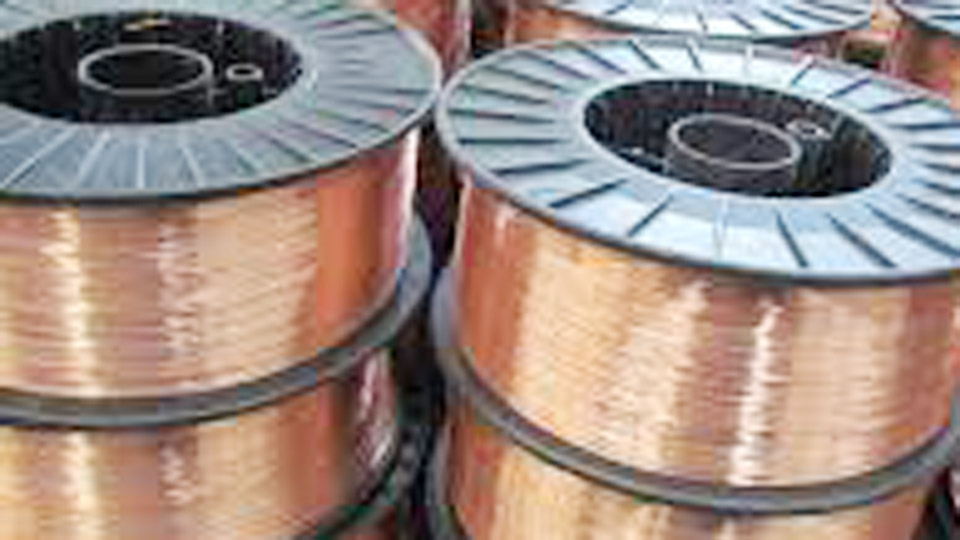
Image by katariyasteel
Chemical Composition and AWS Classification
ER70S-6 is classified under AWS A5.18 as a solid carbon steel electrode (ER) for gas metal arc welding (GMAW/MIG) and gas tungsten arc welding (GTAW/TIG). The “70” indicates a minimum tensile strength of 70,000 psi in the weld metal. The “S” denotes solid wire, and “6” specifies the chemical composition with elevated deoxidizers.
Nominal Composition (Weight %):
- Carbon (C): 0.06–0.15%
- Manganese (Mn): 1.40–1.85%
- Silicon (Si): 0.80–1.15%
- Phosphorus (P): 0.025% max
- Sulfur (S): 0.035% max
- Copper (Cu): 0.50% max
- Chromium (Cr), Nickel (Ni), Molybdenum (Mo), Vanadium (V): 0.15% max each (or lower)
These higher Mn and Si levels distinguish ER70S-6 from lower-deoxidizer wires. They react with oxygen in the weld pool to form slag that floats out, reducing porosity risk on contaminated surfaces. Typical deposited chemistry often shows Mn around 1.4–1.7% and Si around 0.8–1.0%, depending on shielding gas.
Mechanical Properties of Weld Metal
Properties vary slightly with shielding gas due to differences in oxidation and cooling rates:
- Tensile Strength: 80,000–90,000 psi (typically higher with Ar/CO₂ mixes)
- Yield Strength: 65,000–75,000 psi
- Elongation in 2″: 25–29%
- Reduction of Area: 55–70%
- Charpy V-Notch Impact (at -20°F / -29°C): 20–50+ ft-lbs, often better with argon-rich gases
Higher argon blends (e.g., 75–95% Ar) generally yield slightly higher tensile and better toughness due to less oxidation. These values exceed minimum AWS requirements, supporting structural applications on steels like ASTM A36, A515, A516, and A572.
Key Differences: ER70S-6 vs. ER70S-3 and Other Variants
Welders often debate ER70S-6 versus ER70S-3. ER70S-6 contains significantly higher Mn (1.40–1.85% vs. 0.90–1.40%) and Si (0.80–1.15% vs. 0.45–0.70%). This gives ER70S-6 superior tolerance for mill scale, light rust, or oil, producing a more fluid puddle with better wetting and toe fusion.
ER70S-3 performs well on clean base metal with stiffer puddle control, suiting thin sheet or precise multi-pass work where minimal fluidity is preferred. ER70S-6 excels in general fabrication with moderate contamination and offers smoother beads with less post-weld cleanup in many cases.
ER70S-2 adds even more deoxidizers (including Zr, Al, Ti) for heavily contaminated surfaces but may introduce more slag in certain GTAW setups.
Practical Decision Matrix:
- Clean, thin material (<1/8″): Consider ER70S-3 for tighter control.
- Moderate scale/rust, thicker plate, or high-speed welding: Choose ER70S-6.
- Heavily dirty or root passes: Evaluate ER70S-2 or flux-cored alternatives.
Available Diameters and Packaging
Common diameters include:
- 0.023″ (0.6 mm) — Thin sheet, low heat input, short-circuit transfer.
- 0.030″ (0.8 mm) — Versatile for 16–10 gauge.
- 0.035″ (0.9 mm) — Most popular all-around for hobbyists and pros.
- 0.045″ (1.2 mm) — Higher deposition for thicker material (>1/4″).
- Larger (1/16″, 3/32″, etc.) — Heavy plate, primarily flat/horizontal.
Packaging ranges from 2 lb spools for hobbyists to 33–44 lb spools, 500+ lb drums for production. Copper-coated versions improve conductivity and feedability; bare or bronze finishes reduce flaking in some setups.
Shielding Gas Selection and Effects
Shielding gas choice significantly impacts arc stability, bead shape, spatter, and mechanical properties:
100% CO₂: Lowest cost, deep penetration, good for thicker material. Higher spatter and slightly lower mechanicals due to more oxidation.
75% Ar / 25% CO₂: Balanced, popular “universal” mix. Smooth arc, good wetting, reduced spatter, excellent bead appearance.
90–95% Ar / Balance CO₂ or 98% Ar / 2% O₂: Spray transfer, minimal spatter, best fluidity and appearance. Slightly higher tensile values.
Flow rates typically 20–35 CFH, adjusted for nozzle size, drafts, and CTWD (contact tip to work distance, often 3/8–3/4″). Higher argon supports spray or pulsed modes for cleaner results.
Recommended Welding Parameters by Diameter
Parameters depend on transfer mode (short-circuit, globular, spray), position, thickness, and gas. Always fine-tune on test coupons.
Short-Circuit Transfer (Common for thin/out-of-position):
- 0.035″ wire: 140–220 amps, 16–22V, suitable for 1/8″ and thinner.
- Adjust wire feed speed (WFS) to stabilize arc without burn-back or stubbing.
Spray Transfer (Flat/horizontal, thicker material):
- 0.035″: 180–300+ amps, 24–28V.
- 0.045″: 200–375 amps, 24–30V.
Polarity is always DCEP (electrode positive). CTWD of 1/2–3/4″ is standard; longer for spray to reduce current. Reduce parameters 10–15% for vertical/overhead. Pulse MIG expands the sweet spot for all-position work with smaller diameters.
Thickness and Wire Diameter Guidelines
Match wire to material:
- <1/8″ (thin sheet): 0.023–0.030″, low voltage/short-circuit.
- 1/8–1/4″: 0.030–0.035″.
- >1/4″: 0.035–0.045″ for efficiency.
Higher deposition with larger wire reduces passes but demands more power and heat management.
Welding Positions and Technique Considerations
ER70S-6 supports all positions (F, H, V, OH) with appropriate parameters, though larger diameters (>0.045″) favor flat/horizontal. Smaller wires provide better control out-of-position due to lower heat input and faster freeze times.
The fluid puddle from high Si aids wetting but requires technique to manage in vertical-up (push or weave) or overhead (smaller puddle, faster travel). Maintain consistent travel speed to avoid undercut or rollover. Forehand (push) technique often yields flatter beads with better shielding coverage.
Applications and Real-World Performance
ER70S-6 shines in structural steel, automotive repair, farm equipment, pressure vessels, pipe fabrication, railcars, and general manufacturing. It handles multi-pass welds effectively on A36 and similar steels, even with some scale.
In practice, it delivers low spatter in optimized setups, smooth beads with excellent tie-in, and reduced porosity risk. High-speed robotic welding benefits from its feedability and arc stability. For manual welding, it forgives minor surface issues that would cause problems with lower-deoxidizer wires.
Storage, Handling, and Troubleshooting
Store wire in dry conditions to prevent moisture absorption, which can cause hydrogen issues or feeding problems. Use proper drive rolls (V or U groove for solid wire) and keep contact tips clean. Common issues like excessive spatter often trace to voltage/WFS mismatch or gas coverage rather than the wire itself. Porosity points to contamination or shielding problems.
FAQ
What is the main advantage of ER70S-6 over ER70S-3?
Higher manganese and silicon content provides better deoxidation, allowing reliable welds on mildly rusty or scaled steel with improved puddle fluidity and bead appearance.
Can ER70S-6 be used with 100% CO2?
Yes. It performs well, though argon mixes reduce spatter and improve mechanical properties and appearance. Increase voltage slightly with pure CO2 for stability.
What diameter ER70S-6 is best for hobby MIG welders?
0.030″ or 0.035″ offers the best versatility for most home/shop thicknesses and machines up to 200–250 amps.
Is ER70S-6 suitable for TIG welding?
Yes, as filler rod. It works on clean to moderately contaminated carbon steel, providing good fluidity, though GTAW typically requires cleaner surfaces than MIG.
Final Thoughts
ER70S-6 MIG wire specifications deliver a versatile, forgiving filler that balances deposition, arc performance, and weld quality for real-world mild steel applications. Selecting the right diameter, gas, and parameters based on material condition and position maximizes its strengths—fluid wetting on imperfect surfaces without sacrificing mechanical integrity.
For demanding fabrication, pair it with pulsed spray or optimized argon mixes to push productivity while maintaining pro-level bead quality and toughness. This wire remains a go-to choice precisely because it performs when base metal prep is less than ideal.