Assembly teams often face a practical dilemma: how to lock a circuit board, metal bracket, or second plastic component onto a thermoplastic housing without screws that loosen, adhesives that require cure time, or vibration that risks damaging sensitive electronics. What is heat staking & how does it work answers that need directly.
Heat staking reforms a molded plastic boss under controlled heat and pressure into a permanent mechanical head that captures the mating part. The joint becomes part of the original material rather than an added fastener.
Correct temperature, force, dwell, and cooling determine whether the head forms cleanly or produces stringing, voids, or weak retention. Understanding the process prevents under-formed heads that fail pull tests and overheated material that scorches or sticks to the tip.
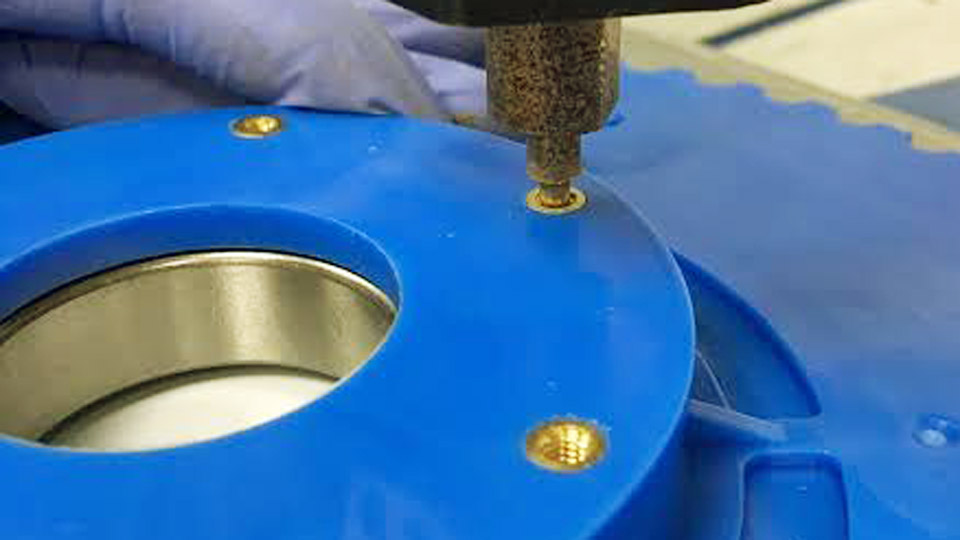
Image by isonmoulding
How the Heat Staking Cycle Actually Forms the Joint
Heat staking relies on three sequential phases that must stay synchronized: heat transfer into the boss, plastic flow under pressure, and solidification under load.
Contact Heating and Softening Phase
A temperature-controlled tip (often brass or aluminum with a non-stick coating) descends onto the exposed boss that already protrudes through the hole in the mating component. Heat conducts into the thermoplastic until the surface reaches the softening or melt range of that specific resin.
Contact time is short—typically 1–3 seconds for most amorphous materials—so only the upper portion of the boss softens. Excess heat travels down the boss and can mark the opposite face or warp thin walls.
Forming Under Controlled Force
Once the plastic flows, the tip continues its downward travel and reshapes the softened volume into the cavity geometry of the tip. Force is low and precise; too much pressure before full softening collapses the boss or extrudes material sideways as flash.
The volume of plastic displaced must equal the volume required to form the finished head. Insufficient boss height leaves a thin, incomplete head; excess height folds material and traps air.
Cooling Under Pressure Before Retract
The tip remains in place while the plastic solidifies. Active cooling (forced air through the tip or conduction into a cooled tip) shortens this phase to a few seconds.
Retracting the tip while the plastic is still molten produces stringing, cratering, or partial head lift. Proper cooling locks the head geometry and maximizes retention strength.
Choosing the Right Stake Head Profile for Load and Cosmetics
Tip geometry dictates the finished head shape and therefore the joint’s load capacity and appearance.
Dome and High-Profile Heads
A concave tip forms a rounded mushroom head. This profile distributes clamp force evenly and tolerates modest variation in boss height. It is the default choice for most structural stakes up to about 6 mm diameter where the head can sit above the surface.
Flush and Low-Profile Heads
A flat or shallow tip compresses the plastic into a disc that sits level with or slightly below the surrounding surface. Use this when the assembly must slide into a housing or when visual flushness is required. Holding force is still high in shear and clamp, but the thinner head has lower pull-out resistance than a full dome.
Hollow and Tubular Heads
A tubular tip reforms only the outer wall of a hollow boss, leaving the center open. Less material is melted, sink marks on the opposite face are reduced, and the resulting annular head still provides strong 360-degree retention. Hollow designs suit larger-diameter bosses (typically >4 mm OD) and cosmetic surfaces.
Knurled or Textured Heads
The tip face carries a pattern that imprints texture into the reformed plastic. The texture raises resistance to rotational torque, useful when the captured component may experience twist during service or secondary assembly steps.
Boss Geometry Rules That Prevent Weak Joints
Most heat-staking failures originate in the molded boss rather than in machine settings.
Height-to-Diameter Ratio
Boss height above the mating surface should be 1.5 to 2.0 times the boss diameter for a standard dome head. Shorter bosses lack enough volume to form a full head; taller bosses buckle or fold under the tip. For hollow bosses the wall thickness must remain at least 1 mm to avoid collapse.
Hole Clearance and Lead-In
The hole in the captured component needs controlled clearance plus a small chamfer or lead-in so the reforming plastic can flow outward cleanly. Excessively tight holes restrict flow and produce incomplete heads; oversized holes reduce the overlap area and lower retention.
Spacing, Draft, and Base Fillet
Adjacent bosses require a minimum center-to-center distance of roughly two diameters to prevent thermal interaction. Sidewall draft of 0.5–1° aids mold release without affecting staking. A small fillet (0.25–0.5 mm) at the boss base reduces stress concentration that can initiate cracks under load or during cooling.
Material-Specific Temperature and Process Windows
Temperature is set by the polymer, not by a universal chart. Amorphous resins soften gradually; semicrystalline resins flow only near a sharp melt point.
Amorphous Resins – Wider Process Window
ABS typically forms clean heads with tip temperatures in the 200–230 °C range. Polycarbonate and PC/ABS require higher settings, commonly 260–300 °C. These materials forgive small temperature deviations but will string or brown if overheated.
Semicrystalline Resins – Narrower Control
Nylon (PA) stakes reliably in the 240–280 °C band once dried; residual moisture flashes to steam and creates bubbles in the head. Polypropylene runs cooler (roughly 180–230 °C) but produces a more flexible head with lower absolute holding force. Acetal (POM) has a tight window near 180–210 °C and releases formaldehyde if overheated, requiring ventilation.
Glass-Filled and Filled Grades
Glass or mineral fillers do not melt with the resin matrix. The resulting head is often matte, fibrous, and lower in strength. Increasing temperature or dwell can improve flow, but many engineers switch to hollow or flared tip designs or reconsider the joining method when glass content exceeds 20–30 %.
| Plastic | Typical Tip Start Range (°C) | Softening Behavior | Key Constraint |
|---|---|---|---|
| ABS | 200–230 | Gradual (amorphous) | Wide, forgiving window |
| Polycarbonate | 260–300 | Gradual (amorphous) | Strings if overheated |
| Nylon (PA) | 240–280 | Sharp (semicrystalline) | Must be dry |
| Polypropylene | 180–230 | Sharp (semicrystalline) | Head remains relatively soft |
| Acetal (POM) | 180–210 | Sharp (semicrystalline) | Narrow window, off-gassing |
When Heat Staking Outperforms Screws, Adhesives, or Ultrasonic Methods
Heat staking eliminates consumable fasteners and cure time while joining dissimilar materials (plastic to metal or PCB) without high-frequency vibration.
Advantages Over Mechanical Fasteners
No inventory of screws or inserts, no risk of torque variation or vibration loosening, and a flush or controlled-height joint. Cycle times of 2–5 seconds per stake (or simultaneous multi-head staking) support high-volume production.
Comparison with Ultrasonic Staking
Ultrasonic methods generate heat through high-frequency vibration and are often faster per stake. Heat staking avoids vibration-induced micro-cracks in brittle components or delicate electronics and handles larger bosses or metal-to-plastic combinations more readily. Equipment cost is typically lower.
Limitations That Dictate Alternative Methods
Thermoset plastics cannot be restaked because they do not soften. Joints that require repeated disassembly need threaded inserts or screws. Pure tensile pull-out loading is weaker than clamp or shear loading; redesign the load path or switch methods if pull-out is the dominant stress.
Process Control Variables That Determine Joint Strength
Consistent results depend on closed-loop control of temperature, force, position, and cooling rather than open-loop timers alone.
Energy or Position Feedback Versus Fixed Timers
Modern systems deliver a programmed energy amount or stop at a precise depth rather than relying solely on time. Ambient temperature shifts, resin lot variation, or tip wear change the heat required; energy-based control compensates automatically.
Multi-Head Tooling and Cycle Time
Parts with four to eight bosses can be staked in one stroke. Fixture design must locate the part accurately so every boss contacts its tip at the same moment. Uneven contact produces mixed head quality within a single cycle.
Inspection Metrics
Pull or push testing establishes minimum retention force. Visual criteria include full head diameter, absence of voids or stringing, and consistent height. Cross-sectioning reveals internal voids or incomplete flow that external inspection misses.
Wrapping Up
Selecting heat staking requires matching boss volume to tip cavity, material softening range to tip temperature, and joint load direction to head profile. When those three decisions align, the reformed head delivers permanent retention without secondary fasteners or adhesives.
Advanced production cells further improve consistency by logging force, temperature, and position on every cycle, enabling statistical process control and rapid detection of tip wear or material drift before defective assemblies leave the station.
FAQs
What temperature is used for heat staking ABS?
Most ABS grades form clean heads with tip temperatures between 200–230 °C. Validate with a short pull-test series because specific grades and filler content shift the exact window.
Can heat staking join plastic to metal or circuit boards?
Yes. The plastic boss is reformed over the metal or PCB hole, creating a mechanical clamp without vibration or adhesives. Clearance and keep-out zones on the board must be designed accordingly.
How strong is a heat-staked joint?
Strength is high in clamp and shear when the head is fully formed. Straight tensile pull-out resistance is lower by design; load the joint in the preferred directions or increase head diameter and overlap for higher retention.
Does heat staking work on glass-filled plastics?
It is possible but produces rougher, lower-strength heads because the fibers do not flow. Hollow or flared tip designs and increased temperature/dwell help; many engineers prefer alternative joining methods above roughly 30 % glass content.