Many welders and fabricators end up with cracked edges or soft spots after attempting to harden a blade, spring, or tool because the quench medium does not match the steel’s hardenability.
How to harden steel with oil solves this by providing a controlled cooling rate that forms martensite without the severe thermal shock of water. Oil quenching delivers intermediate severity—fast enough for medium- and high-carbon alloy steels yet gentle enough to limit distortion and cracking on complex shapes.
Correct austenitizing temperature, oil selection, agitation, and immediate tempering determine whether the part reaches target hardness or fails in service. The difference between a usable 58–62 HRC edge and a brittle or soft component rests on those measurable parameters.
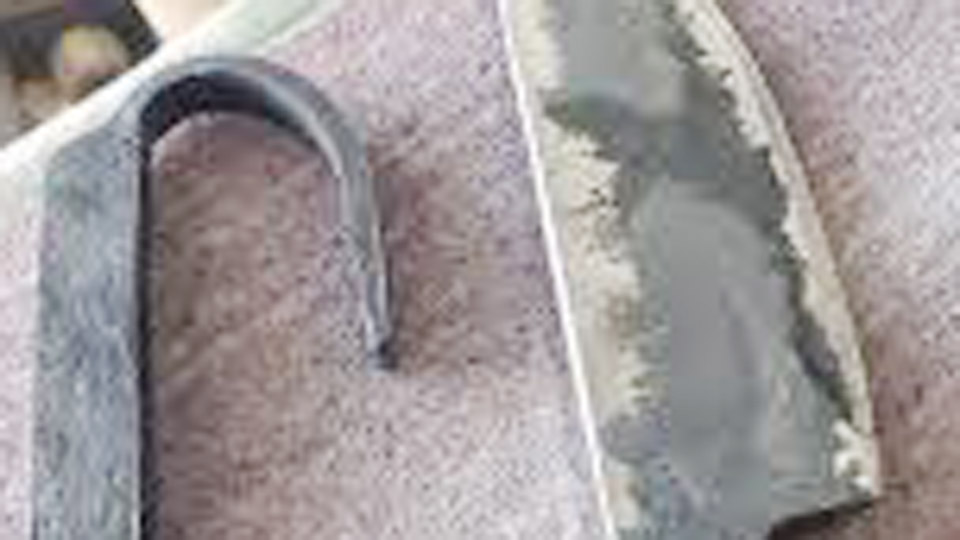
Image by fb/Traditional Tinderbox Flint & Steel Admiration Society
Which Steels Respond Reliably to Oil Quenching
Not every steel hardens fully in oil. Hardenability—the ability to form martensite at a given cooling rate—dictates the choice.
Oil-Hardening Tool Steels and Medium-Alloy Grades
O1 tool steel is designed for oil. Typical composition includes roughly 0.90 % carbon, 1.0–1.4 % manganese, 0.50 % chromium, and 0.50 % tungsten. Austenitize at 1450–1500 °F (788–816 °C), quench in warm agitated oil, and temper. It reaches the low-60s HRC range with good dimensional stability.
5160 (0.56–0.64 % C, 0.70–0.90 % Cr) and 4140 also harden reliably in oil because alloying elements slow pearlite formation. These grades tolerate moderate section sizes without requiring water severity.
High-Carbon Steels That Need Faster Oil
1095 and similar shallow-hardening steels (high carbon, low alloy) demand a fast quench oil such as Parks 50. Standard motor oil or slow vegetable oil often leaves the core soft on sections thicker than about ¼ inch.
Water-hardening grades (W1, pure high-carbon) generally require water or brine; forcing them into ordinary oil produces incomplete hardening.
Steels That Should Not Be Oil Quenched for Full Hardness
Low-carbon steels below approximately 0.30–0.35 % carbon lack sufficient carbon for meaningful martensite hardness. Air-hardening grades (A2, D2) are intended for slower cooling and can over-harden or crack if forced into oil without process adjustment. Always verify the manufacturer’s recommended quench medium for the specific heat or alloy.
Austenitizing Temperatures and Soak Times That Produce Full Hardness
The steel must be fully austenitic before the quench. Incomplete transformation leaves soft ferrite or pearlite.
Critical Temperature Targets by Grade
For O1 the practical window is 1450–1500 °F. The lower end favors toughness and dimensional control; the upper end maximizes carbide dissolution for higher hardness. 1095 typically austenitizes at 1475–1500 °F with a short soak once temperature is equalized.
5160 and 4140 often run 1500–1550 °F or slightly higher depending on section. Overheating past the recommended range coarsens grain and reduces toughness without adding useful hardness.
Soak Time Scaled to Section Thickness
A common shop rule is 5–15 minutes per inch of thickness after the part reaches temperature, or roughly 30 minutes for the first inch plus 15 minutes for each additional inch on larger sections. Thin knife edges need only a few minutes at temperature; thick dies require full equalization.
Non-magnetic behavior (Curie point near 1414–1420 °F for many carbon steels) confirms the surface has crossed the critical range, but a thermocouple or calibrated pyrometer is required for accuracy on critical work.
Selecting and Preparing the Quench Oil
Oil cooling rate is governed by viscosity, temperature, and agitation. The wrong combination produces soft spots or excessive cracking risk.
Commercial Fast and Medium Oils Versus Shop Substitutes
Parks 50 is a fast oil suited to shallow-hardening steels such as 1095; it performs well near room temperature to about 100 °F. Parks AAA and similar medium oils suit O1, 5160, and 4140 and are typically used at 120–150 °F.
Used motor oil and canola oil function as moderate-speed substitutes for medium-hardenability steels when commercial product is unavailable, but they generate more smoke, sludge faster, and provide less consistent cooling curves.
Flash point of any oil should remain well above operating temperature—minimum 350 °F is a practical safety floor.
Oil Bath Temperature and Volume
Maintain oil between 90–150 °F for most conventional quench oils. Cold oil raises viscosity and prolongs the vapor-blanket stage, risking soft spots. Excessively hot oil reduces quench severity.
Use at least 1 gallon of oil per pound of steel so the bath temperature rise stays modest. Agitation—manual movement of the part or mechanical stirring—breaks the vapor blanket and equalizes cooling.
Executing the Oil Quench Without Soft Spots or Cracks
Transfer time and motion control the metallurgical outcome.
Transfer and Immersion Technique
Move the part from the heat source to the oil in the shortest practical time—ideally under a few seconds for thin sections. Immerse fully and keep the part moving in a figure-eight or up-and-down pattern for the first 10–20 seconds.
This disrupts the insulating vapor layer. Continue agitation until the part cools below roughly 400–500 °F, then slow the motion.
When to Remove the Part from the Oil
Withdraw the workpiece while it is still warm—typically 125–200 °F. Allowing the part to cool fully in the oil increases residual stress and the chance of delayed cracking. Immediate transfer to the tempering furnace while the part remains warm is standard practice for oil-hardening steels.
Tempering Immediately After Oil Quenching
As-quenched martensite is hard but brittle. Tempering converts it to tempered martensite and relieves quench stresses.
Temperature Ranges for Target Hardness
For O1 and similar tool steels, tempering at 300–400 °F retains hardness near 60–63 HRC for cutting edges. 400–500 °F drops hardness into the upper 50s while improving toughness. Higher ranges (600–800 °F) further increase toughness at the expense of hardness and are used for springs or impact tools.
Double tempering (two cycles with intermediate cooling) is preferred for critical parts to ensure complete transformation of retained austenite.
Timing and Stress Relief Priority
Temper as soon as the part reaches the removal temperature from the oil. Leaving fully hardened steel at room temperature overnight raises the risk of quench cracking, especially on parts with sharp corners or abrupt section changes. A minimum temper of 300 °F for one to two hours is common shop practice even when higher hardness is desired.
Measuring Success and Adjusting the Process
Hardness testing and visual inspection close the loop.
Hardness Targets and Common Defects
As-quenched O1 typically reaches 63–65 HRC before tempering. After a 400 °F temper it usually settles in the 60–62 HRC range. Soft spots indicate incomplete austenitizing, insufficient agitation, or an oil that is too slow for the steel’s hardenability.
Cracks often trace to overheating, sharp internal corners, or delayed tempering. Scale or decarburization on the surface reduces effective hardness and should be minimized by controlled atmosphere or protective coatings when possible.
Process Adjustments for Different Section Sizes
Thin sections cool faster and may require slightly lower austenitizing temperatures or faster oils to avoid overheating. Thick sections benefit from longer soaks and vigorous agitation.
Interrupted quenching (oil to a specific intermediate temperature then air cooling) is sometimes used on large or complex parts to reduce residual stress while still forming martensite.
Wrapping Up
Matching steel grade to oil severity, holding precise austenitizing temperature, agitating the quench, and tempering without delay produce consistent hardness with minimal distortion.
On high-restraint or critical-tooling work, record actual furnace readings, oil bath temperature, and Rockwell results for each heat so subsequent runs can be adjusted to the same metallurgical window rather than relying on color or feel alone.
FAQs
What temperature do I heat steel to before oil quenching?
Most oil-hardening grades such as O1 austenitize at 1450–1500 °F. Confirm the exact range for your specific steel and soak long enough for the core to equalize.
Can I use motor oil or canola oil to harden steel?
Yes for medium-hardenability steels like 5160 or O1 when commercial quench oil is unavailable. Warm the oil to approximately 120 °F and agitate vigorously. Fast commercial oils are preferred for shallow-hardening steels such as 1095.
How soon after oil quenching should I temper the steel?
Temper immediately while the part is still warm (above roughly 125 °F). Delaying increases the risk of quench cracking from residual stresses.
What hardness can I expect after oil hardening and tempering O1?
As-quenched hardness is typically 63–65 HRC. After tempering at 350–400 °F the working hardness usually settles in the 60–62 HRC range for cutting tools.