Spring steel that snaps under load or feels dead after fabrication usually failed during heat treatment, not design. Incorrect austenitizing temperature, the wrong quench, or tempering that prioritizes hardness over toughness leaves the steel either brittle or too soft for cyclic stress.
Learning how to harden and temper spring steel correctly determines whether a leaf spring, coil, or flat spring delivers the expected fatigue life and load capacity.
The process locks in a martensitic structure through controlled heating and rapid cooling, then deliberately softens it just enough to restore toughness while retaining elastic strength.
For DIY welders, fabricators, and professionals working with 1095, 5160, or similar grades, precise temperatures and media choices separate reliable performance from premature failure under repeated flexing.
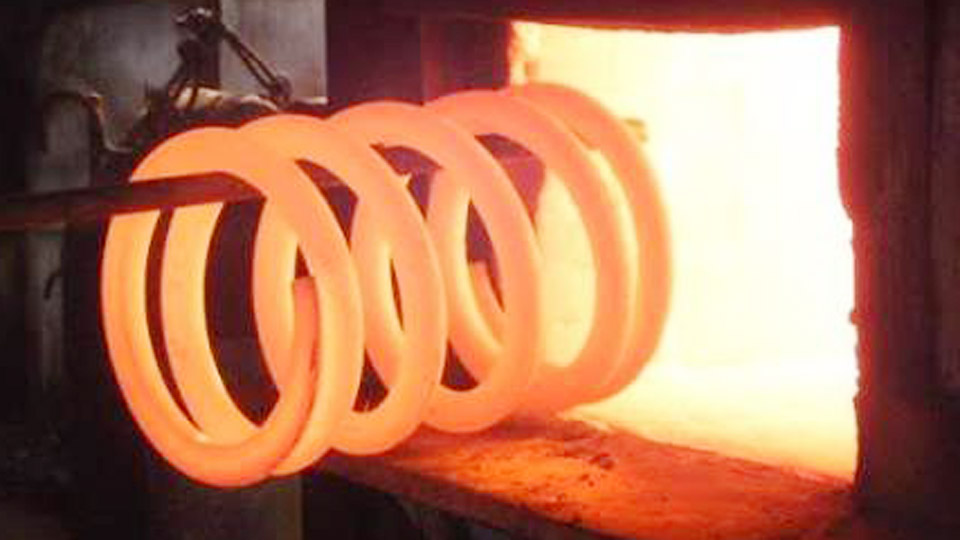
Image by cfjrsb
Identifying Which Spring Steel You Are Actually Treating
Not every high-carbon steel responds the same way. Grade selection dictates every subsequent temperature and quench decision.
High-Carbon Grades Versus Alloy Spring Steels
Plain high-carbon steels such as 1075, 1080, and 1095 rely almost entirely on carbon content for hardenability. They reach high as-quenched hardness but have shallower hardening depth and higher cracking risk on thicker sections.
Alloy grades such as 5160 (chromium-vanadium) and 9260 gain hardenability from chromium and vanadium, allowing oil quenching with lower distortion and better toughness retention at higher tempering temperatures.
5160 commonly serves automotive leaf springs; 1095 appears more often in thinner flat springs or knife blades repurposed from spring stock.
Matching Grade to Expected Stress Cycle
Leaf springs and heavy coil springs favor 5160 or similar alloys because they tolerate higher tempering temperatures while still holding 44–50 HRC. Thin flat springs or high-stress clock springs often use 1095 tempered into the 40–48 HRC range.
Confirm the grade by composition or supplier data before setting any furnace temperature; unmarked scrap requires testing or conservative assumptions that favor oil quenching and moderate tempering.
Setting the Correct Austenitizing Temperature for Full Hardness
Austenitizing dissolves carbides and produces the face-centered cubic structure that transforms into martensite on quenching. Temperature and soak time control grain size and final hardness potential.
Critical Ranges for 1095 and Similar Carbon Grades
Most high-carbon spring steels austenitize between 1450 °F and 1600 °F (790–870 °C). A practical working window for 1095 sits near 1475–1525 °F. Soak long enough for the core to equalize—typically 5–15 minutes for thin stock up to ¼ inch, longer for heavier sections.
Overheating coarsens grains and increases retained austenite; underheating leaves undissolved carbides and soft spots after quench.
5160 and Chrome-Vanadium Alloy Windows
5160 hardens effectively at 1525–1560 °F (830–850 °C), with many practitioners targeting approximately 1540 °F. Soak times scale with thickness: 5–10 minutes for sections under 5 mm, up to 30 minutes for thicker stock.
The chromium content improves hardenability, so full hardness is achievable with oil rather than water even on moderately thick parts. Protect the surface with anti-scale compound or foil wrap when possible to limit decarburization.
Selecting the Quench Medium That Balances Hardness and Integrity
Rapid cooling transforms austenite into martensite. The medium determines cooling rate, residual stress, and cracking probability.
Oil Quench as the Default for Most Spring Steels
Oil provides a controlled cooling rate that hardens alloy grades fully while limiting thermal shock. Fast quench oils such as Parks 50 or commercial quenching oils preheated to roughly 120 °F work well for both 1095 and 5160.
Agitate the part or the bath to break the vapor blanket and ensure uniform cooling. Oil is the standard choice for leaf springs, coil springs, and most flat spring stock thicker than about 1/16 inch.
When Water or Brine Becomes Necessary
Thin high-carbon sections sometimes require water or light brine to achieve full hardness because their hardenability is lower. The risk of cracking and distortion rises sharply.
Use water only on simple geometries under controlled conditions and accept that subsequent tempering must address the higher residual stress. Never quench complex or thick alloy spring sections in water if oil is available.
Tempering to the Hardness Range That Produces Spring Behavior
As-quenched martensite is hard but brittle. Tempering converts it to tempered martensite, trading some hardness for toughness and fatigue resistance.
Target Hardness Windows for Different Spring Types
Spring applications rarely use maximum hardness. Leaf and heavy coil springs commonly target 44–50 HRC. Flat springs and lighter coils often run 40–48 HRC. These ranges deliver the elastic limit and endurance needed for cyclic loading.
Knife blades made from the same stock temper lower (350–450 °F) to retain 58–60 HRC for edge holding; that hardness is unsuitable for springs.
Temperature and Time Combinations That Deliver Fatigue Life
High-carbon grades such as 1095 temper effectively between 700 °F and 900 °F (370–480 °C). Alloy grades such as 5160 accept 700–1000 °F (370–540 °C). For typical leaf-spring temper, 800–900 °F produces approximately 48 HRC with good toughness.
Hold at temperature for a minimum of one hour per inch of thickness, or at least one full hour for thin stock. Double tempering—cool to room temperature between cycles—relieves residual stresses more thoroughly and transforms retained austenite.
| Steel Grade | Austenitize (°F) | Quench | Typical Spring Temper (°F) | Resulting HRC Range |
|---|---|---|---|---|
| 1095 | 1475–1525 | Oil (or water thin) | 700–900 | 40–48 |
| 5160 | 1525–1560 | Oil | 800–950 | 44–50 |
| 9260 | 1525–1580 | Oil | 800–980 | 44–52 |
Controlling Soak Times and Sequence to Avoid Soft Centers or Distortion
Uniform temperature through the cross-section is mandatory. Thin stock equalizes quickly; thick sections need longer soaks or staged heating.
Pre-Hardening Normalization for Grain Control
Normalize once or twice before final hardening by heating to roughly 1600 °F and air cooling. This refines grain size, reduces residual forging stresses, and improves response to the subsequent quench. Skip normalization only on already refined commercial spring stock of known history.
Post-Quench Handling Before Temper
Clean scale and oil residue after quenching. Temper as soon as practical; leaving fully hardened steel for extended periods risks cracking from residual stress, especially in high-carbon grades. Straighten any distortion while the steel is still warm if possible, or accept that final grinding will be required after tempering.
Verifying Results Without Laboratory Equipment
Hardness testing with a Rockwell tester confirms the process. File testing or careful bending of sample coupons provides workshop-level feedback. A properly tempered spring returns to its original shape after deflection without permanent set or cracking.
Soft spots indicate incomplete austenitizing or insufficient quench severity; excessive brittleness points to under-tempering or an overly aggressive quench.
Decision Framework for Choosing Temperatures and Media on the Shop Floor
Select the grade first, then lock austenitizing temperature to the published range for that alloy. Default to oil quench unless the section is thin and high-carbon. Temper to the mid-to-upper range of the spring window rather than maximum hardness.
Double-temper and verify hardness on a witness sample of identical thickness. These choices produce the combination of elastic strength and toughness that defines functional spring steel.
Wrapping Up
When the austenitizing temperature, quench severity, and tempering temperature are matched to both the steel grade and the intended stress cycle, the finished spring delivers predictable load capacity and fatigue life.
Advanced practitioners further refine results by tracking interpass cooling rates during multi-piece batches and by using controlled-atmosphere furnaces or anti-scale coatings to preserve surface carbon, ensuring the outer fibers that experience the highest bending stress retain full hardness potential.
FAQs
What temperature should I use to harden 5160 spring steel?
Austenitize 5160 between 1525 °F and 1560 °F, with 1540 °F as a reliable target for most sections. Soak according to thickness, then quench in oil.
Is oil or water better for quenching spring steel?
Oil is the preferred medium for the majority of spring steels, including 5160 and thicker 1095. It reduces cracking and distortion while still producing full hardness on alloy grades.
What hardness should tempered spring steel reach?
Most functional springs target 40–50 HRC after tempering. Leaf springs commonly finish near 44–48 HRC; higher hardness sacrifices the toughness needed for cyclic loading.
How long should I temper spring steel?
Hold at tempering temperature for at least one hour per inch of thickness, with a one-hour minimum for thin stock. Double tempering with a cool-down between cycles improves stress relief.