Breaker trips, underrated generators, and unexpected power bills all stem from the same gap: most welders know output amps but ignore actual welding machine wattage consumption. Input power—not the output rating—determines whether a 120 V circuit holds, how large a generator must be, and what the electricity cost will be over a shift.
Modern inverter machines convert line power more efficiently than older transformers, yet duty cycle, process, and arc voltage still create wide swings in real draw.
Understanding the numbers prevents both equipment damage and wasted energy while letting you size circuits and generators correctly from the start.
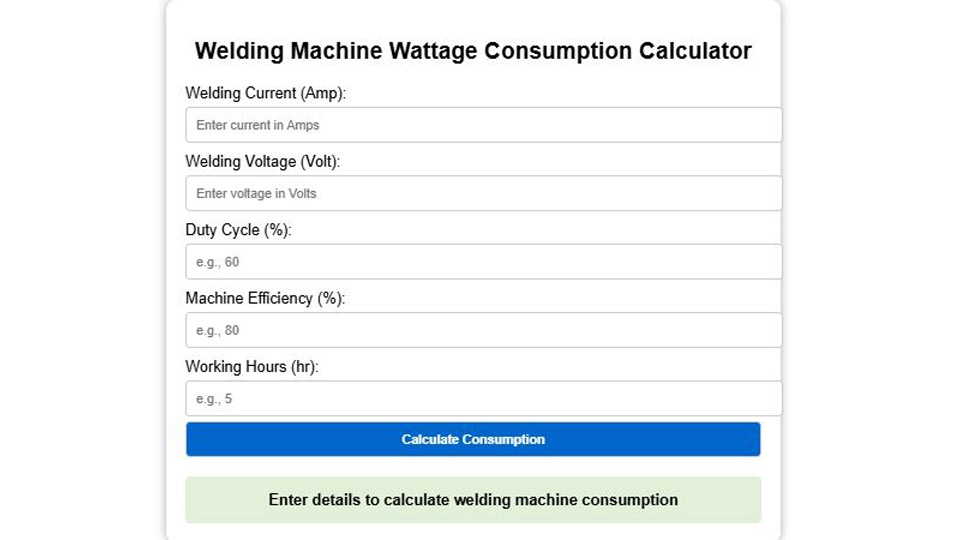
Welding Machine Wattage Consumption Calculator
How Input Power Relates to Output Amperage and Voltage
Output amps at the electrode or torch do not equal the current drawn from the wall. The machine converts higher-voltage, lower-current input into the low-voltage, high-current arc required for welding.
Calculating True Input Wattage from Nameplate Data
Input power in watts equals input voltage multiplied by input amperage. A 240 V machine drawing 30 A consumes 7,200 W at that moment. Manufacturers list both maximum input amps (I1max) and effective input amps (I1eff).
Use the effective value for continuous or average loading and the maximum value when sizing breakers and generators for peak demand.
Arc voltage also matters: a 200 A MIG process at 25 V produces 5,000 W of arc power; at 85 % machine efficiency the input requirement rises to roughly 5,900 W.
Efficiency Differences Between Inverter and Transformer Machines
Inverter power sources typically convert 85–92 % of input power into usable arc power. Transformer-based machines often operate at 70–80 % efficiency, converting a larger fraction of energy into heat.
For the same 200 A / 25 V output, an 85 % efficient inverter draws about 5.9 kW while a 75 % efficient transformer may draw 6.7 kW or more. That difference compounds over long production runs and directly affects both electricity cost and thermal stress on the machine.
Typical Wattage Ranges by Process and Machine Class
Real consumption varies with process, material thickness, and duty cycle. The figures below reflect common shop settings rather than absolute maximum ratings.
120 V Hobby and Light-Duty Machines
Most 120 V MIG or multi-process units rated 90–140 A output draw 15–20 A input, producing 1,800–2,400 W while welding. At a realistic 25–30 % duty cycle the average power over a work hour falls to roughly 500–700 W.
These machines stay within standard 15 A or 20 A household circuits when used intermittently, but continuous high-output welding will trip breakers.
240 V Mid-Range Fabrication Machines
A typical 180–250 A inverter MIG or stick machine on 240 V draws 30–50 A at rated output, equating to 7,200–12,000 W. At 40 % duty cycle the average hourly consumption sits between 2.9 and 4.8 kWh.
TIG processes at lower average amperage often consume less—commonly 6,000–8,400 W during arc-on time—because operators run shorter duty cycles and lower currents for precision work.
Industrial Three-Phase and High-Output Units
Machines rated 300 A and above on three-phase power frequently list 15–25 kW input at full load. Duty cycles of 60 % or higher raise average consumption into the 9–15 kWh range per hour of shop time.
These units require dedicated feeders and correctly sized transformers; undersized supply wiring produces voltage drop that forces the machine to draw still higher current to maintain output.
Duty Cycle and Its Direct Effect on Average Power Draw
Nameplate wattage describes the peak. Actual energy use depends on how long the arc stays on within each 10-minute rating period.
Converting Rated Watts into Hourly kWh
Multiply peak input power by the decimal duty cycle to obtain average power, then convert to kilowatt-hours. A machine drawing 9,600 W at 40 % duty cycle averages 3.84 kW. Over one hour of intermittent welding it consumes 3.84 kWh.
Idle or cooling periods still draw 50–300 W for fans and controls; modern machines meeting efficiency regulations keep idle draw under 50 W.
Process-Specific Duty Factors in Real Shops
MIG short-circuit transfer on fabrication work often runs 35–45 % arc-on time. Stick welding with frequent electrode changes and slag removal typically stays at 25–40 %. Precision TIG work may drop to 20–30 %. These practical factors, not the machine’s maximum duty-cycle rating, determine monthly electricity totals.
Generator and Circuit Sizing Based on Actual Wattage
Undersized supply is the most common field failure mode once the correct wattage is known.
Minimum Running and Surge Requirements
Add 20–30 % headroom to calculated running watts for generator sizing. A machine that draws 7,200 W continuous needs a generator capable of at least 9,000–10,000 starting watts and 7,500–8,000 continuous watts.
Inverter generators with clean power output handle modern electronic welders more reliably than older units with high harmonic distortion.
Single-Phase Versus Three-Phase Supply Decisions
Single-phase 240 V circuits limit practical continuous input to roughly 40–50 A before wire and breaker costs rise sharply. Three-phase supply reduces line current for the same power and improves efficiency on larger machines.
When both options exist, three-phase almost always lowers long-term operating cost and voltage-drop problems on long cable runs.
Electricity Cost Calculation for Shop Planning
Convert wattage into dollars with a short, repeatable method.
Step-by-Step Cost per Hour Formula
- Determine input watts at the planned welding setting.
- Multiply by expected duty-cycle fraction.
- Divide by 1,000 to obtain average kW.
- Multiply by local electricity rate ($/kWh).
At $0.12/kWh a 240 V machine averaging 4 kW costs $0.48 per hour of shop time. Rates of $0.20–0.30/kWh in high-cost regions push the same machine past $1.00 per hour.
Comparing Processes for Long-Run Economy
Lower average amperage and higher deposition efficiency reduce total energy per joint. Inverter MIG on clean steel often finishes a given length of weld with less total kWh than stick on the same joint because of higher travel speed and less idle time. TIG remains more expensive per foot when precision demands long arc-on periods at moderate current.
Machine Selection Decisions That Control Long-Term Wattage
Choosing the right power source and voltage class has larger impact than any single operating technique.
When 120 V Is Sufficient and When It Is Not
Sheet-metal and light repair work under 1/8 in stay practical on 120 V. Once material thickness routinely exceeds 3/16 in or continuous runs become common, 240 V input reduces both current draw and I²R losses in the supply wiring. The same output power at higher voltage draws half the amperage, cutting heat in cables and connectors.
Inverter Efficiency as a Purchase Criterion
Machines listing power-source efficiency above 85 % and idle power under 50 W repay the higher purchase price through lower electricity use and reduced cooling demand. On multi-shift operations the annual difference between an 80 % efficient unit and a 90 % efficient unit can exceed several hundred dollars per machine.
Matching circuit capacity, generator size, and process choice to measured input wattage eliminates the two most frequent power-related failures: thermal shutdown from voltage drop and unexpected operating costs.
Advanced operators further reduce consumption by selecting the lowest practical amperage that still achieves full fusion and by minimizing idle time through efficient joint sequencing and fixture design.
FAQs
How many watts does a typical MIG welder use?
A 120 V hobby MIG draws 1,800–2,400 W while welding. A 240 V 180–250 A machine draws 7,200–12,000 W at rated output; average consumption falls with duty cycle.
How do I calculate welding machine electricity cost per hour?
Multiply input volts by input amps, adjust for duty cycle, divide by 1,000, then multiply by your kWh rate. Example: 240 V × 40 A × 0.40 duty cycle = 3.84 kWh × $0.12 = $0.46 per hour.
What size generator do I need for a 200 amp welder?
Plan for 8,000–10,000 continuous watts and 10,000–13,000 starting watts on a 240 V 200 A class machine, including 20–30 % headroom.
Does an inverter welder use less electricity than a transformer welder?
Yes. Inverters typically operate at 85–92 % efficiency versus 70–80 % for many transformers, reducing input power for the same arc output.