Choosing the right shielding gas for MIG welding stainless steel often determines whether you achieve clean, corrosion-resistant welds with minimal cleanup or end up with porous, discolored beads that compromise the material’s integrity.
Many welders default to whatever gas is in the shop—typically a 75/25 argon/CO2 mix suited for mild steel—only to discover inconsistent arc stability, excessive carbon pickup, or loss of corrosion resistance.
The best gas for MIG welding stainless steel balances arc stability, weld pool fluidity, penetration, and protection of the chromium oxide layer that gives stainless its corrosion resistance.
High-argon blends with minimal active gases or helium-enriched tri-mixes deliver superior results across thicknesses and transfer modes. This guide delivers precise gas selections, parameter guidance, and decision factors for DIY, hobbyist, student, and professional welders.
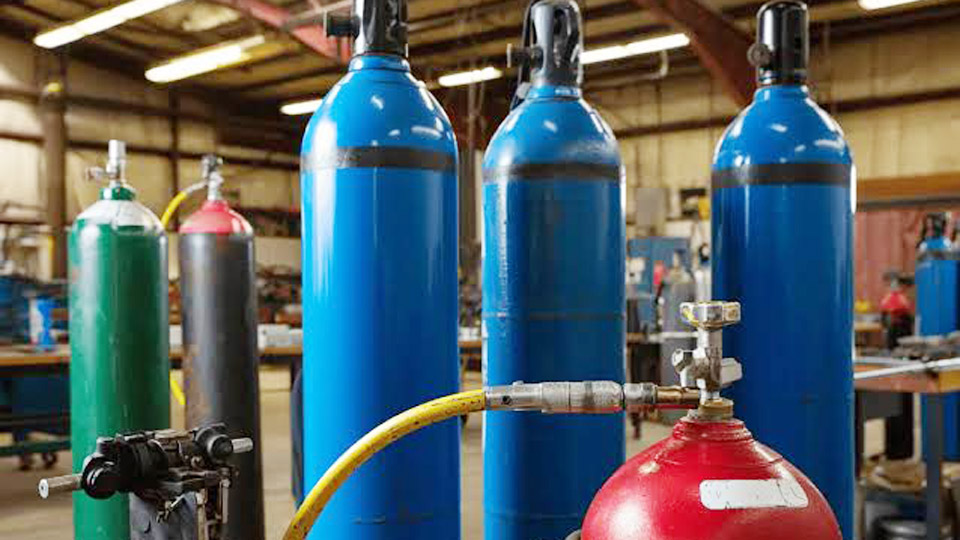
Image by minhasmobilewelding
Why Shielding Gas Choice Matters for Stainless MIG Welding
Stainless steels (austenitic 304/316, duplex, etc.) have lower thermal conductivity than carbon steel, leading to higher heat concentration and greater risk of distortion or sensitization. The shielding gas directly influences:
- Arc characteristics and metal transfer mode (short-circuit, spray, pulsed).
- Weld pool fluidity and wetting.
- Carbon or oxygen pickup that can reduce corrosion resistance.
- Bead profile, spatter levels, and post-weld cleanup.
- Travel speed and productivity.
Incorrect gas leads to oxidation, porosity, or weakened mechanical properties. Proper selection maintains the alloy’s integrity while optimizing performance.
Common Shielding Gas Options for Stainless Steel MIG
Argon-CO2 Blends: Versatile Everyday Choice
98% Argon / 2% CO2 stands as the most recommended two-part mix for general stainless MIG welding. Argon provides excellent arc stability and inert protection. The minimal CO2 addition stabilizes the arc, improves wetting, and allows short-circuit or pulsed transfer without excessive carbon absorption.
This blend excels on thin to medium sections (up to about 1/4 inch) in all positions. It produces smooth beads with low spatter and preserves corrosion resistance better than higher-CO2 mixes. For vertical or overhead work, it offers good puddle control without excessive fluidity.
98% Argon / 2% Oxygen serves as an alternative for applications prioritizing bead appearance and minimal oxidation. Oxygen additions enhance arc stability and fluidity more than CO2 in some setups, yielding a slightly wider bead and better wetting on austenitic grades. Use it cautiously on low-carbon “L” grades to avoid excessive oxidation.
Tri-Mix Gases: Premium Performance for Demanding Applications
Helium-argon-CO2 tri-mixes rank as the professional benchmark, especially for thicker stainless or high-productivity work. A common formulation—90% Helium / 7.5% Argon / 2.5% CO2—combines helium’s high thermal conductivity for deeper penetration and hotter puddle with argon’s arc stability and low CO2 for controlled reactivity.
Benefits include:
- Significantly faster travel speeds.
- Improved fusion and reduced lack-of-fusion defects.
- Flatter, wider beads with excellent toe wetting.
- Better performance in short-circuit transfer on thicker material.
- Reduced distortion in some cases due to efficient heat input.
Tri-mix costs more due to helium but pays off in reduced labor time and superior weld quality on sections over 1/8–3/16 inch or multi-pass joints.
Pure Argon and Other Variants
Pure argon works for very thin stainless (<1/8 inch) where minimal heat input is critical, but it often produces unstable arcs and poor wetting in standard MIG. It suits pulsed spray modes better. Higher helium mixes (without or with minimal CO2) appear in specialized applications for nickel alloys or super-duplex but require precise parameter tuning.
Avoid 75/25 argon/CO2 on stainless for anything beyond non-critical repairs. The high CO2 content increases carbon pickup, leading to sensitization, reduced corrosion resistance, and poorer bead appearance.
Gas Selection by Material Thickness and Weld Requirements
Thin Stainless Steel (Under 1/8 Inch / 3 mm)
Prioritize low heat input and distortion control. 98% Ar / 2% CO2 delivers stable short-circuit transfer with minimal spatter and clean beads. Keep voltages lower (typically 18–20V range depending on wire diameter) and use forehand technique (push) for better coverage. Tri-mix can work but may require voltage adjustments to prevent burn-through.
Medium Thickness (1/8 to 1/4 Inch)
Both 98/2 Ar/CO2 and tri-mix perform well. Switch to tri-mix when faster speeds or deeper penetration in a single pass matter. For spray or pulsed spray transfer, argon-oxygen mixes (1–2% O2) often yield smoother arcs and better bead profiles.
Thick Sections and Multi-Pass Welds (Over 1/4 Inch)
Helium-rich tri-mix shines here. The added thermal energy improves root fusion and sidewall wetting in groove welds, reducing the number of passes needed. Expect higher flow rates and adjusted parameters (higher voltage/wire speed) to handle the hotter arc.
Comparison Table of Common Gases:
| Gas Mixture | Best Thickness | Key Strengths | Limitations | Typical Transfer Modes |
|---|---|---|---|---|
| 98% Ar / 2% CO2 | Thin to medium | Arc stability, low spatter, corrosion preservation | Limited penetration on thick | Short-circuit, pulsed |
| 98% Ar / 2% O2 | Thin to medium | Excellent wetting, smooth beads | More oxidation potential | Spray, pulsed spray |
| Tri-Mix (90% He / 7.5% Ar / 2.5% CO2) | Medium to thick | Deep penetration, speed, fluidity | Higher cost, higher flow needed | Short-circuit to spray |
Welding Parameters and Technique Adjustments for Different Gases
Gas choice requires corresponding machine settings. Stainless typically uses 0.030″ or 0.035″ ER308L or ER316L wire (low-carbon “L” grades preferred).
For 98% Ar / 2% CO2 on 1/8″ material with 0.035″ wire: Expect around 90–130 amps, 19–22 volts, wire speeds 200–300 IPM, and gas flow 20–30 CFH.
Tri-mix often runs hotter, allowing slightly higher travel speeds but demanding careful heat management to avoid distortion. Increase inductance or use pulsed modes for better control on thinner sections.
Gas Flow Rates: Stainless demands 20–30 CFH indoors (higher in drafts). Helium mixes may need the upper end due to lighter gas behavior. Use a gas lens or larger nozzle for better coverage in critical applications. Monitor for turbulence—excessive flow pulls in air as much as low flow does.
Maintain proper stick-out (3/8–1/2 inch), clean base metal thoroughly (no carbon steel contamination), and use dedicated stainless tools.
Transfer Modes and Gas Compatibility
Short-Circuit Transfer: Ideal for thin material and out-of-position welding. Tri-mix excels with excellent puddle control and reduced spatter. 98/2 Ar/CO2 also performs reliably.
Spray and Pulsed Spray: Better for thicker material and flat/horizontal positions. Argon-oxygen or high-argon blends stabilize the arc at higher currents. Tri-mix supports these modes with added heat for fusion.
Pulsed MIG broadens the sweet spot for most gases, reducing heat input while maintaining spray-like transfer.
Cost, Availability, and Practical Considerations
Tri-mix offers the best performance but commands higher cylinder refill costs due to helium. For occasional hobbyist work, 98/2 Ar/CO2 provides an excellent balance of quality and affordability. Many suppliers offer pre-mixed cylinders tailored for stainless.
Consider your workflow: High-volume fabrication benefits from tri-mix productivity gains. One-off repairs or thin sheet work may not justify the premium.
Store cylinders properly and check for leaks. Always match gas to wire manufacturer recommendations for optimal results.
Advanced Techniques and Optimization
For critical applications like food-grade or pressure vessels, test welds for corrosion resistance (e.g., ASTM practices). Post-weld cleaning (pickling or passivation) restores the oxide layer regardless of gas, but better gas selection minimizes the work needed.
In pulsed programs, fine-tune peak/background currents based on gas thermal properties—heavier helium mixes transfer heat differently.
Experiment on scrap with your specific power source, as machine characteristics (inductance, waveform) interact with gas performance.
Final Thoughts
Selecting the best gas for MIG welding stainless steel ultimately comes down to matching the blend to your material thickness, joint design, and quality requirements. High-argon low-reactive mixes handle most everyday jobs with excellent corrosion performance, while tri-mix elevates productivity and fusion on demanding work.
Test parameters on scrap, prioritize clean metal prep, and dial in your setup—the difference in weld quality and efficiency justifies the attention to detail. For pro-level results on critical stainless fabrications, the investment in the right tri-mix and pulsed capability consistently delivers stronger, cleaner, and faster welds that hold up in real-world service.
FAQ
What is the absolute best gas for MIG welding stainless steel?
For most professional results, a helium-argon-CO2 tri-mix (such as 90/7.5/2.5) provides superior penetration, speed, and bead quality, especially on thicker material. For general use and thinner sections, 98% argon / 2% CO2 is highly effective and more economical.
Can I use 75/25 argon/CO2 for stainless steel?
It works in a pinch for non-critical welds but is not recommended. Higher CO2 increases carbon pickup, risking reduced corrosion resistance and poorer bead appearance. Limit to 2–5% CO2 maximum for stainless.
What gas flow rate should I use for stainless MIG?
20–30 CFH is the standard range. Start at 25 CFH indoors and adjust based on nozzle size, drafts, and helium content. Higher flows for tri-mix; avoid exceeding levels that cause turbulence.
Does gas choice affect distortion in stainless welding?
Yes. Lower-heat gases like 98/2 Ar/CO2 help minimize distortion on thin material. Tri-mix’s efficient heat delivery can reduce overall heat input through faster travel speeds on thicker sections.