You’re facing a joint between stainless steel and carbon steel, or need a weld that holds up under high heat and corrosive conditions. The standard 308 rod risks cracking from dilution, while a mismatched filler fails in service. This is where the 309 welding rod excels.
The 309 welding rod (E309 or ER309/309L) is an austenitic stainless steel electrode or filler designed primarily for welding dissimilar metals, such as stainless steel (e.g., 304) to mild or low-alloy carbon steel.
Its higher chromium (23-25%) and nickel (12-14%) content compensates for dilution, delivers crack-resistant welds, and provides excellent oxidation and corrosion resistance up to approximately 870–1100°C (1600–2000°F) depending on the variant.
Professionals and hobbyists reach for it in repairs, fabrication, cladding, and high-temperature environments because it bridges material differences that would otherwise cause failure. Understanding its composition, applications, and parameters ensures strong, durable results every time.
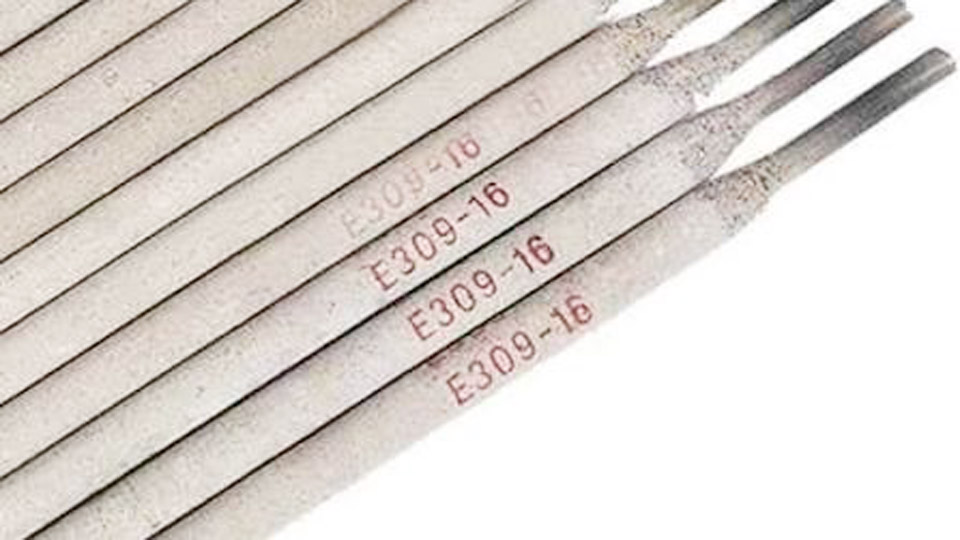
Image by weld-ready.ca
Composition and Key Properties of 309 Welding Rod
Chemical Makeup and Variants
The core of a 309 rod is an austenitic structure with elevated alloy levels compared to common 308 fillers. Typical deposited weld metal includes:
- Chromium (Cr): 23.0–25.0% — drives oxidation and corrosion resistance.
- Nickel (Ni): 12.0–14.0% — stabilizes austenite and improves toughness.
- Carbon (C): ≤0.15% standard; ≤0.04% in 309L — the low-carbon “L” version minimizes carbide precipitation and intergranular corrosion.
Other elements like manganese (0.5–2.5%), silicon (≤1.0%), and low levels of molybdenum or copper appear in variants. The ferrite number (FN) typically ranges 8–18, providing hot-crack resistance even with dilution from carbon steel.
309 vs 309L: Choose 309L for corrosion-sensitive or post-weld heat-treated applications to reduce sensitization risk. Standard 309 suits high-temperature service where creep strength matters more.
Mechanical Properties
As-welded deposits typically deliver:
- Tensile strength: 75,000–90,000 psi (520–620 MPa) minimum.
- Yield strength: Around 55,000 psi.
- Elongation: 30–45%.
- Good impact toughness and ductility that handles thermal cycling.
These properties make the weld forgiving in mixed-metal joints where expansion coefficients differ.
Primary Applications: When to Use 309 Welding Rod
Dissimilar Metal Welding
The most common use is joining stainless steel (304, 304L, 321, etc.) to mild steel, low-alloy steel, or unknown alloys. The over-alloyed chemistry compensates for iron pickup from the carbon side, preventing martensite formation and cracking.
Real-world examples include:
- Stainless tanks or piping attached to carbon steel frames.
- Repair of lift truck forks, leaf springs, or mixed-alloy equipment.
- Transition joints in food processing, chemical plants, or structural fabrication.
High-Temperature and Oxidation-Resistant Service
309 rods resist scaling and maintain strength in furnace parts, heat exchangers, annealing covers, rotary kilns, and exhaust systems. The high chromium content supports service up to 1000°C+ in oxidizing atmospheres.
Overlay and Cladding Work
Apply 309 as a buffer or transition layer before harder or more corrosion-resistant overlays. This is standard in petrochemical, power generation, and wear-resistant repairs on carbon steel bases.
Other Practical Uses
- Welding 309-type base metals or similar alloys.
- Repairing worn components in corrosive or thermal environments.
- Situations with uncertain base metal chemistry in salvage or maintenance work.
309 vs 308 Welding Rod: Decision Framework
Composition contrast: 308 (18–21% Cr, 9–11% Ni) matches 304 stainless closely for like-to-like welds. 309’s higher alloys tolerate dilution better.
Use 308 for stainless-to-stainless joints prioritizing exact corrosion matching and lower cost. Switch to 309 when one side is carbon/low-alloy steel or high dilution is expected. In borderline cases with some carbon pickup, 309 provides a safety margin without over-alloying pure stainless joints excessively.
When 309 fails to substitute perfectly: In highly corrosive service requiring molybdenum (e.g., 316 environments), 309 lacks Mo and may underperform long-term. Match the final surface requirements accordingly.
Welding Parameters and Techniques for Success
SMAW (Stick) Settings
Common diameters and amperage (DCEP or AC, depending on coating -15, -16, -17):
- 3/32″: 70–110 A (flat); slightly lower out-of-position.
- 1/8″: 85–140 A.
- 5/32″: 110–185 A.
Maintain a short arc (roughly rod diameter). -16 coatings offer good all-position performance with smooth arcs and low spatter. Keep interpass temperatures low (typically <350°F / 175°C) to control heat input and carbide risks.
MIG (GMAW) with ER309L Wire
Shielding: 98% Ar/2% O2 or tri-mix variants. Short-circuit for thin material; spray transfer for thicker sections.
Typical settings for 0.035″ wire:
- Short circuit: 75–160 A, 17–22 V.
- Spray: 180–300+ A, 24–29 V.
Push angle (5–15°) helps with wetting and slag control.
TIG (GTAW) with ER309L Rod
Pure argon, 100% for most work. DCEN polarity. Amperage scales with thickness: 80–150 A for 1/8″ material with 3/32″ rod. Use 2% lanthanated or thoriated tungsten.
Technique Insights
- Clean surfaces thoroughly: Remove oxides, oil, rust, and mill scale on both metals.
- Stringer beads preferred over wide weaves for controlled cooling and crack resistance.
- For vertical/uphill: Whip or pause technique to control puddle.
- Post-weld: Natural cooling or controlled treatment; pickle/passivate stainless side for corrosion performance.
Joint Preparation and Real-World Decision Factors
Base Metal Thickness and Position
For thin sections (<1/8″), lower heat input and smaller diameter rods/wire prevent burn-through. Thicker joints (>1/4″) benefit from multi-pass with buffer layers if extreme dilution is a concern.
All-position capability varies by coating type (-16 generally versatile). Flat/horizontal is easiest for high-deposition work.
Preheat, Interpass, and Post-Weld Considerations
Carbon steel side may need modest preheat (150–200°C for thick sections) to reduce cracking risk, but stainless side stays cooler. Limit interpass to 150–175°C. Avoid prolonged high heat that promotes sensitization.
Cost and Availability Trade-offs
309/309L costs more than 308 due to alloy content. Stock both for shop efficiency, but select based on joint metallurgy rather than habit. For high-volume dissimilar work, the reliability payback is significant.
Advanced Considerations for Professional Results
Ferrite control via WRC-1992 diagrams helps predict cracking susceptibility. Aim for 5–20 FN in the weld metal. High dilution from carbon steel naturally increases ferrite—309’s starting chemistry balances this.
In cladding, multiple layers with 309 as the first build-up restore stainless properties before final passes. For nuclear or code work, verify with actual chemistry and mechanical testing.
Wrapping Up
The 309 welding rod solves the classic problem of mismatched thermal expansion and dilution in mixed-metal fabrication. Selecting it correctly—matching variant to service (L for corrosion, standard for heat), controlling heat input, and preparing joints properly—delivers welds that outperform generic fillers in demanding conditions.
For pros pushing performance limits, pair it with precise ferrite prediction and layered techniques to achieve code-compliant, long-lasting results in the toughest environments.
FAQ
What metals can 309 welding rod join?
It excels at stainless (304 series) to carbon or low-alloy steel, similar 309 alloys, and as a buffer for overlays. It is not the best match for pure stainless-to-stainless corrosion-critical joints.
Is 309L better than standard 309?
Yes for most corrosion or low-temperature service due to reduced carbon and lower sensitization risk. Use standard 309 where higher carbon aids high-temperature creep strength.
Can I use 309 rod for stainless-to-stainless welds?
Technically yes, but it over-alloys the deposit. Prefer 308/308L for chemistry match and cost unless dilution or temperature demands 309’s higher alloys.
What amperage for 1/8″ 309 stick rod?
Typically 85–140 A depending on position and machine. Start conservative, maintain short arc, and adjust for stable puddle and penetration.