Many shop projects fail because a finished tool edge or punch face softens under load or wears too quickly, even after careful grinding. The question becomes whether how to harden steel with a torch can deliver usable martensite without a furnace.
Torch hardening works only when the steel contains enough carbon, the austenitizing temperature is reached evenly, and the quench is fast enough to suppress pearlite.
Done correctly it produces a hard surface or through-hardened small section; done poorly it leaves soft spots, coarse grain, or cracks.
The method is practical for knives, chisels, punches, and localized wear surfaces when the right alloy and process controls are applied.
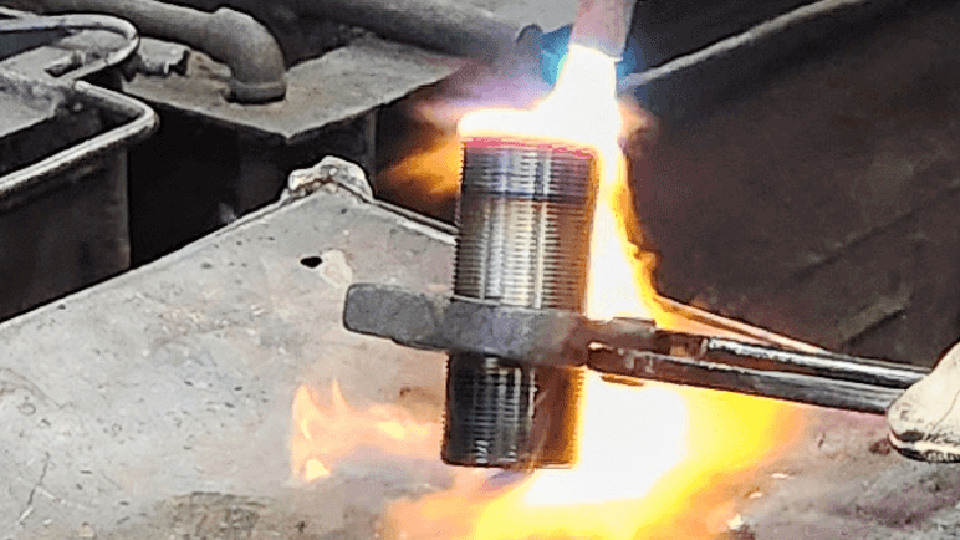
Image by incertec
Which Steels Respond to Torch Hardening?
Carbon content sets the maximum hardness that martensite can reach. Below roughly 0.30 % C the structure after quenching remains largely soft ferrite and pearlite; above 0.40–0.45 % C the hardness climbs rapidly toward 55–65 HRC depending on quench severity and section size.
Medium- and High-Carbon Plain Steels
AISI 1045, 1050, 1084, and 1095 respond reliably. 1084 is particularly forgiving for torch work because its eutectoid composition requires little soak time once non-magnetic. These grades harden in oil or water and are common for knives and simple tools.
Oil-Hardening Tool Steels
O1 and similar grades harden from approximately 1450–1500 °F and prefer oil quench. They tolerate the uneven heating of a torch better than water-hardening grades because the critical cooling rate is lower.
Grades That Produce Little or No Hardening
Mild steel (1018, A36, most structural plate) and low-carbon sheet will not reach useful hardness by simple torch quench. Surface carburizing compounds can create a thin hard case, but that is a separate process requiring different timing and chemistry.
What Temperature Must the Steel Reach?
Austenite must form so that rapid cooling can produce martensite. For most plain-carbon and low-alloy steels the practical target is just above the point at which the steel loses magnetism (Curie point near 1425 °F / 775 °C).
Using the Magnet Test in Practice
Heat the part while periodically touching a magnet to a cooler section or the edge. When the magnet no longer sticks, the steel is near or above the lower critical range.
Continue heating a short distance past non-magnetic—typically one shade brighter cherry-red to orange—then quench immediately. Prolonged heating at temperature encourages grain growth and surface decarburization under an open flame.
Color and Approximate Temperature Correlation
Cherry red corresponds roughly to 1400–1450 °F. Bright cherry to orange lies in the 1500–1600 °F band used for many carbon steels. Temperatures above bright orange risk excessive scale and coarse prior-austenite grains that reduce toughness even after tempering. Work in subdued light so color judgment remains consistent.
Flame Adjustment for Controlled Heating
A neutral oxy-acetylene flame or a slightly carburizing flame limits oxidation and carbon loss. Hold the inner cone ½–1 inch from the surface and keep the torch moving. Propane or MAPP torches suffice for thin sections under ¼ inch but struggle to heat heavier cross-sections evenly before the surface overheats.
How to Quench Torch-Heated Steel Without Cracking
The quench rate must exceed the critical cooling rate of the specific steel so that the austenite transforms to martensite rather than pearlite or bainite.
Water and Brine for Maximum Hardness
Water or brine produces the highest surface hardness on plain-carbon steels (often 60+ HRC on 1080–1095). The rapid cooling also raises residual stress and the probability of cracking, especially on thick or sharply notched sections. Agitate the part vigorously to break the vapor blanket.
Oil Quench for Reduced Distortion
Commercial quench oil or clean mineral oil slows the cooling rate enough to lower crack risk while still hardening O1, 1084, and many medium-carbon grades. Warm the oil to approximately 120–140 °F before use for more consistent results. Quench tip-first or edge-first on blades and keep the part moving vertically to minimize warpage.
Timing and Technique
Transfer from flame to quench must be immediate. Any pause allows the surface to drop below the critical range and form soft transformation products. Fully submerge the heated zone; partial immersion creates a soft band at the water or oil line.
Selective Hardening Versus Full-Section Hardening with a Torch
A torch naturally lends itself to localized heating because the heat input is concentrated.
Edge or Face Hardening of Tools
Heat only the cutting edge or working face of a chisel, punch, or die. The unheated body remains tougher and supports the hard zone. This differential hardening is common for woodworking tools and cold chisels. Maintain a sharp temperature gradient by directing the flame and quenching promptly.
Full Hardening of Small Parts
Thin knife blades, small punches, or thin springs can be heated through their entire cross-section. Even heating remains the limiting factor; a simple heat-retaining setup of firebrick or a short pipe section improves uniformity when only a torch is available.
Section Size Limits
Torch hardening becomes impractical once the cross-section exceeds roughly ½–¾ inch for plain-carbon steel. Core cooling rates fall below the critical value and the center remains soft. Alloy steels with higher hardenability extend the usable thickness, but furnace or induction methods are still preferred for heavy sections.
Tempering After Torch Hardening
As-quenched martensite is hard but brittle. Tempering reduces residual stress and restores usable toughness while trading some hardness.
Temperature Selection by Application
Knives and fine edges are typically tempered in the 350–450 °F range (light straw to dark straw oxide color) to retain high hardness. Punches and striking tools may be drawn to 500–600 °F for greater toughness. Two short temper cycles of 1–2 hours each are more effective than one long cycle.
Torch Tempering Method
After the part has returned to room temperature, clean the surface to bright metal. Reheat gently with a soft flame, watching oxide colors run.
When the desired color reaches the critical zone, remove the heat and allow air cooling or quench if the steel is air-hardening. Avoid overshooting the temper temperature; the color changes rapidly once they appear.
Practical Process Sequence for Torch Hardening
Clean the steel to bare metal. Heat uniformly or selectively to non-magnetic plus a short additional increment. Quench immediately in the chosen medium with agitation.
Verify hardness with a file (it should skate) or hardness tester. Clean scale and temper without delay. Delayed tempering increases the chance of quench cracks forming from residual stress.
Limitations Compared with Controlled Furnace Hardening
Torch methods lack precise atmosphere control and uniform soak times. Surface decarburization and scale are common. Temperature measurement relies on color and magnetism rather than thermocouples, introducing operator variability.
For critical aerospace or high-volume production parts, furnace or induction processes deliver tighter hardness bands and better toughness. Torch hardening remains valuable for one-off tools, field repairs, and selective surfaces where equipment cost and speed matter more than absolute consistency.
Wrapping Up
Successful torch hardening depends on matching steel carbon content to the quench severity, reaching but not exceeding the austenitizing range, and tempering promptly. When those three decisions are correct, a simple oxy-acetylene or propane setup produces edges and working faces hard enough for real shop use.
Advanced operators further improve results by pre-heating thicker sections to reduce thermal gradients and by using a slightly carburizing flame to protect surface carbon during the brief austenitizing window.
FAQs
Can you harden mild steel with a torch?
No. Mild steel lacks sufficient carbon (typically under 0.25–0.30 %) to form hard martensite. A torch quench produces little lasting hardness; carburizing compounds are required for a thin hard case.
What is the best quench for torch-hardened 1084 or O1?
Fast oil is preferred. It delivers high hardness with lower cracking risk than water on these grades. Water can be used on 1084 for maximum hardness if the section is thin and geometry is simple.
How do you know the steel is hot enough without a pyrometer?
Use a magnet. When the steel loses magnetism it has reached the Curie point near the lower critical temperature. Heat a short distance beyond that point (brighter color) and quench immediately.
Does torch hardening work on stainless steel?
Most stainless grades do not harden by simple quench. Martensitic stainless (e.g., 410, 420) can respond if the composition allows, but austenitic grades (304, 316) remain soft after torch heating and quenching.