Welding a damaged engine block is one of the most demanding cast iron repair jobs in metal fabrication. Understanding how to weld a cast iron engine block requires more than selecting a filler metal and striking an arc.
Cast iron is highly sensitive to thermal stress, and improper welding procedures can create cracking, hard heat-affected zones, distortion, or repeat failures after the engine returns to service.
Because engine blocks experience constant vibration, temperature cycling, and mechanical loads, weld quality directly affects reliability and repair cost. Factors such as preheating, filler selection, heat control, and cooling rate all influence whether the repair succeeds or fails.
A properly executed weld can restore serviceability, while poor technique often leads to additional cracking and expensive rework.
The key is using welding methods that minimize stress while producing a sound, durable repair that can withstand real operating conditions.
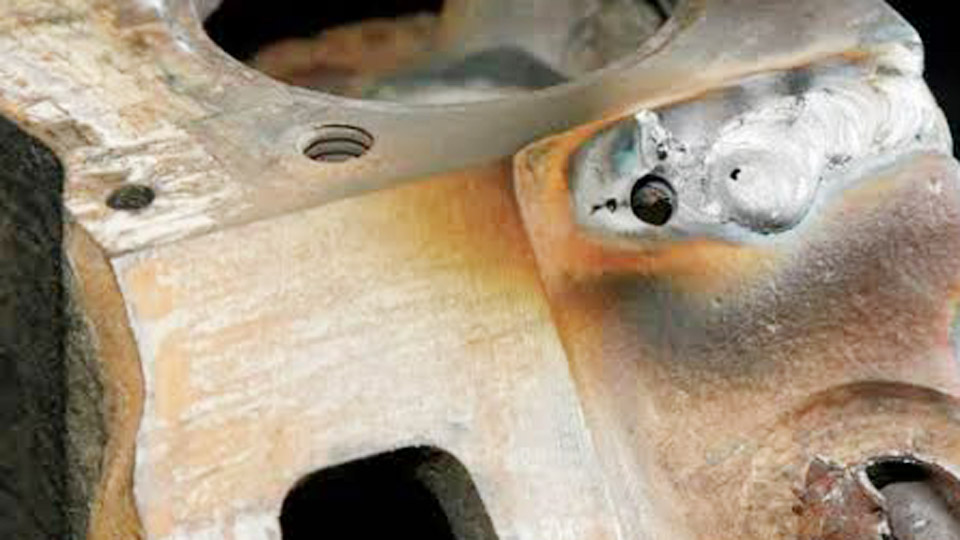
Image by hotrod
Understanding Cast Iron Challenges in Engine Blocks
Material Properties Affecting Weldability
Gray cast iron, the most common type in engine blocks, contains 2-4% carbon as graphite flakes. This gives excellent vibration damping and wear resistance but makes the material highly sensitive to thermal shock. When welded improperly, the heat-affected zone (HAZ) can form hard, brittle white iron or martensite, leading to cracking under engine stresses or thermal cycling.
Engine blocks add complexity due to varying section thicknesses, embedded oils from operation, and proximity to critical areas like cylinder bores, main caps, and coolant passages. Residual casting stresses from original manufacturing compound these issues.
Common Failure Points Requiring Repair
Cracks frequently appear in high-stress areas:
- Between cylinder bores and water jackets from freeze damage or overheating.
- Around main bearing webs from mechanical overload.
- In exhaust manifold mounting flanges or timing chain covers from thermal fatigue.
Identifying crack extent with dye penetrant or magnetic particle inspection before starting prevents incomplete repairs. Drill stop holes at crack ends (typically 1/8″ to 3/16″ diameter) to arrest propagation.
Preparation Steps for Successful Welds
Thorough Cleaning and Contaminant Removal
Oil and carbon contamination in porous cast iron causes porosity and poor fusion. Soak the block in a hot parts cleaner or degreaser tank to boil out embedded oils. Remove the crack area with a carbide burr or grinder to create a U or V-groove (60-90° included angle) for good penetration.
Use a stainless steel wire brush or flap disc to clean 1-2 inches beyond the repair zone until bright metal appears. Acetone or non-chlorinated solvent finishes the prep.
Avoid carbon steel brushes, which can embed contaminants.
Groove Design and Crack Termination
For through-cracks, back-gouge from the opposite side if accessible. In water jacket repairs, ensure the groove allows full penetration without excessive material removal that weakens the block. Studding (drilling and tapping for steel studs) strengthens large breaks by providing mechanical interlocking before weld overlay.
Welding Processes and When to Choose Each
Stick Welding (SMAW) for Most Engine Block Repairs
Stick welding remains the go-to for cast iron engine blocks due to its versatility, portability, and availability of specialized electrodes. It allows short, controlled passes essential for managing heat.
Electrode Choices:
- ENi-CI (99% Nickel, e.g., Tech-Rod 99): Best for machinable welds and single-pass applications. Produces soft, ductile deposits with minimal dilution.
- ENiFe-CI (55% Nickel, e.g., Tech-Rod 55 or Ni55): Preferred for multi-pass welds needing higher strength. Lower coefficient of expansion reduces cracking risk.
- Proprietary rods like MuggyWeld 77 for high crack resistance in maintenance repairs.
Use DC electrode positive or AC depending on the rod. Settings: 3/32″ rod at 70-110 amps; 1/8″ at 90-140 amps. Keep amperage low to minimize admixture.
TIG Welding (GTAW) for Precision Control
TIG offers superior heat control for thin sections or cosmetic repairs but inputs more overall heat, requiring careful preheat. Use pure nickel or nickel-iron filler rods (e.g., Ni99 or aluminum bronze for certain applications). AC TIG with 2% lanthanated tungsten works well. Typical settings: 100-150 amps for 1/8″ material.
Ideal for areas needing post-weld machining, such as sealing surfaces.
MIG Welding Considerations
MIG is possible with nickel-alloy wires and 80% Ar/20% CO2 shielding, using short-circuit transfer. It suits larger repairs but demands precise parameter control to avoid excessive heat. Less common for engine blocks due to higher dilution risks.
Brazing as a Lower-Heat Alternative
Oxy-acetylene brazing with bronze or nickel rods at 800-1100°F minimizes HAZ issues. Excellent for non-structural or water jacket cracks where fusion welding risks distortion. Preheat the entire block and maintain temperature during the process.
Preheat, Welding Technique, and Cooling Protocols
Preheat Strategies
Preheat is critical to reduce thermal gradients. For hot welding: 500-1200°F (260-650°C), ideally uniform across the block. Use rosebud torches, ovens, or thermal blankets. Never exceed 1400°F to avoid the critical range. For cold welding (no full preheat): Warm to ~100-200°F so you can keep your hand on it.
Local preheat for small repairs; full-block for major structural work.
Controlled Welding Techniques
Weld in short 1-inch segments or “dime-sized” passes. Skip around the block to allow cooling between passes. Peen each bead immediately while hot with a ball-peen hammer to relieve stresses and improve fusion into porous areas. Brush slag thoroughly between passes. Maintain consistent direction and stagger bead ends.
Monitor interpass temperature—keep it below 300-400°F for cold methods or maintain preheat range for hot.
Post-Weld Heat Treatment and Slow Cooling
Slow cooling prevents cracking. Wrap in insulating blankets, bury in dry sand or vermiculite, or use a furnace for controlled cool-down (e.g., 100°F per hour). For stress relief, heat to 480-590°C and air cool, or higher for full annealing if equipment allows.
Post-Weld Machining and Finishing
After cooling to room temperature, inspect with dye penetrant. Machine mating surfaces as needed—nickel welds are machinable. For water jackets, pressure test and apply sealing compounds if micro-cracks persist. Grind or blend welds for appearance and function.
Decision Factors for Repair vs. Replacement
Assessing Repair Viability
Consider crack location, engine value, and intended use. Minor jacket cracks often succeed with nickel rods and proper technique. Major structural failures near load-bearing areas may favor metal stitching, furnace welding, or replacement for long-term reliability.
Budget for multiple attempts if contamination is severe. Test welds on scrap cast iron first.
Advanced Considerations for Professionals
In high-performance or vintage applications, match thermal expansion closely. Some shops use powder welding or metal spraying for minimal heat input. For blocks requiring full remachining, fusion welding with cast iron rod in a high-temperature oven yields the most compatible metallurgy.
Real-World Application Insight
Successful cast iron engine block welds hinge on respecting the material’s need for gradual thermal management—hot or consistently cool—combined with nickel-based fillers that accommodate the brittle matrix.
The most critical pro-level decision is committing fully to one thermal strategy throughout, as switching mid-repair almost guarantees failure. Prioritize slow, uniform cooling over speed; a repair that lasts through thousands of thermal cycles justifies the patience.
FAQ
Can you weld a cracked cast iron engine block without preheat?
Yes, using the “cool” method with nickel rods, short passes, and aggressive peening. Warm the area slightly (~100-200°F) and never let it get too hot to touch. Success depends on thorough cleaning and slow cooling, but full preheat is more reliable for critical repairs.
What is the best rod for welding cast iron engine blocks?
ENiFe-CI (55% nickel) or proprietary high-nickel rods like MuggyWeld 77 balance strength, ductility, and crack resistance for multi-pass work. Use 99% nickel for maximum machinability in single-pass or finish layers.
How do you prevent cracks when welding an engine block?
Drill stop holes, clean aggressively, use short passes with peening, control heat input strictly, and cool very slowly. Avoid rapid temperature changes at any stage.
Is TIG or stick better for cast iron block repairs?
Stick welding is generally more practical for most block repairs due to better heat management in thick sections and portability. TIG excels for precision on smaller or accessible areas requiring fine control and minimal spatter.
(Word count: ~2,150)