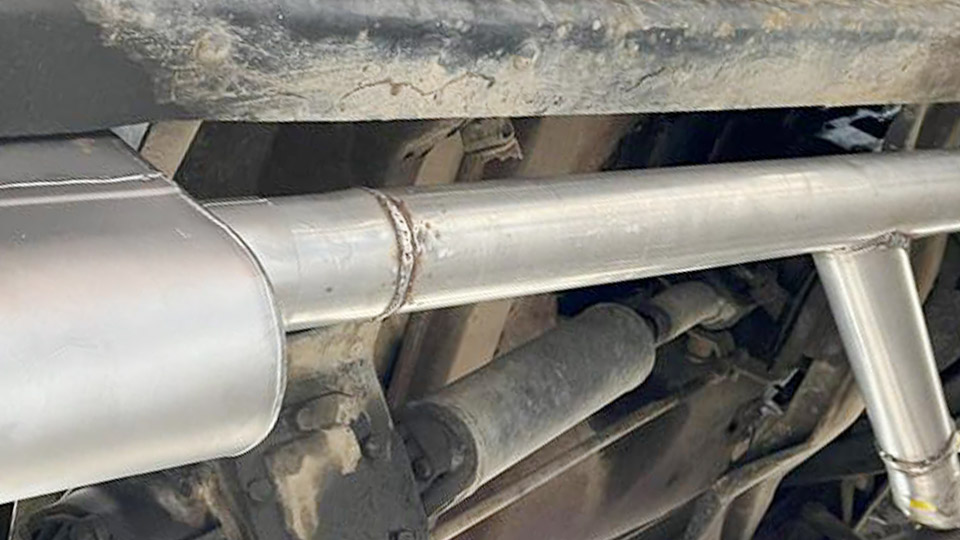
A repair that feels solid after a few hours can still fail under load or heat if the epoxy has only set and not fully cured. Knowing exactly how long does JB Weld take to dry prevents putting a joint back into service too early and risking bond failure on metal, exhaust components, or structural patches.
Set time is the point when the mixture hardens enough to handle; full cure is when tensile strength, chemical resistance, and heat tolerance reach their rated values.
Temperature, product formula, and mix ratio control those windows. Using the wrong timeline for Original versus KwikWeld leaves repairs under strength even when they look hard.
Image by popularmechanics
Official Set and Full-Cure Times for Common JB Weld Formulas
Manufacturer data separates the two stages clearly. Room-temperature figures (approximately 70°F / 21°C) form the baseline.
Original Steel-Reinforced Epoxy Windows
Original JB Weld sets in 4–6 hours to a dark gray color. Full cure requires 15–24 hours (some packaging lists 16–24). Handling is permitted after the set window; return to service needs the minimum 15-hour mark for rated performance. Tensile strength reaches 5,020–6,220 PSI once cured, with continuous heat resistance to 550°F (288°C).
KwikWeld and Faster Variants
KwikWeld sets in roughly 6 minutes and reaches full cure in 4–6 hours. Strength drops to about 3,127 PSI and heat resistance falls to 250°F (120°C). ClearWeld sets in 5 minutes and cures in 1 hour. WaterWeld putty sets in 25 minutes and hardens in about 1 hour. These faster formulas trade working time and ultimate strength for speed.
Product Comparison Table
| Product | Set Time | Full Cure | Approx. Tensile Strength | Max Continuous Temp |
|---|---|---|---|---|
| Original | 4–6 hours | 15–24 hours | 5,020–6,220 PSI | 550°F |
| KwikWeld | 6 minutes | 4–6 hours | ~3,127 PSI | 250°F |
| ClearWeld | 5 minutes | 1 hour | ~3,900 PSI | 250°F |
| WaterWeld Putty | 25 minutes | 1 hour | ~4,370 PSI | Varies |
| MarineWeld | 4–6 hours | 15–24 hours | ~5,020 PSI | 550°F |
How Temperature Changes JB Weld Dry and Cure Times
Epoxy cure is a chemical reaction. Every 10°C (18°F) change roughly doubles or halves reaction rate within practical limits.
Effect of Elevated Temperature
Above 50°F the process accelerates. Moderate heat (heat lamp or 100–120°F enclosure after the initial set) can cut remaining cure time substantially. Some users report near-full strength in 8 hours under strong sunlight or controlled 110°F conditions.
Avoid exceeding the product’s post-cure temperature rating during acceleration, and never force extreme heat on an unset mixture.
Cold-Weather Slowdown
Below 50°F set and cure times lengthen markedly. At 40–50°F expect 8–12 hours to set and 36–48 hours for full cure. Below 40°F the reaction can stall or extend beyond 48 hours. Supplemental low-level heat becomes necessary for reliable results.
Mixing ratios slightly richer in hardener can help initiate the reaction in cold conditions, but stay close to the 1:1 specification.
Humidity and Airflow Influence
Moderate humidity has limited impact on the chemical cure itself. High airflow can skin the surface faster while the interior remains soft, creating a false sense of readiness. Still-air conditions at stable temperature produce more uniform cross-linking.
When the Bond Reaches Usable Strength Versus Rated Strength
Set and cure are not interchangeable for load-bearing decisions.
Handling Strength After Set
After 4–6 hours (Original) the joint can usually be unclamped and moved carefully. Light machining or sanding is possible once the surface is no longer tacky. Structural or pressure loads at this stage risk deformation or incomplete fusion.
Full Mechanical and Thermal Performance
Rated tensile strength, chemical resistance, and 550°F heat tolerance appear only after the full 15–24 hour cure. Early return to service under vibration, pressure, or elevated temperature is the most common cause of field failure. For critical repairs, the conservative 24-hour mark is the safer decision point.
Visual and Physical Indicators of Progress
Color darkens to uniform dark gray as the reaction advances. Surface hardness increases; a fingernail no longer leaves a mark once set is complete. Full cure produces a glassy, non-yielding surface that accepts drilling, tapping, and filing without gumming.
Factors That Alter Real-World Dry Times Beyond the Label
Label times assume ideal mixing and surface conditions.
Mix Ratio Accuracy
Equal parts resin and hardener by volume are required. Excess resin leaves soft spots; excess hardener can accelerate set but may embrittle the final bond. Thorough mixing until streak-free is essential—poor mixing is the leading cause of prolonged tackiness beyond 24 hours.
Surface Preparation and Joint Design
Clean, abraded metal increases contact area and heat transfer from the curing mass. Large mass applications generate more internal heat and can cure faster in the core. Thin films or poorly clamped joints cool faster and may track the longer end of the published range.
Product Age and Storage
Shelf life is listed at three years under cool, dark storage. Aged material that has begun to separate or thicken often fails to reach full hardness on schedule. Always verify both components flow freely before mixing.
Practical Decision Rules for Shop and Field Use
Choose the formula and timeline according to the required strength and available downtime.
Selecting Original Versus Fast-Set Products
Use Original when maximum strength and heat resistance matter and 15–24 hours of downtime is acceptable. Switch to KwikWeld only for non-structural or temporary fixes where a 4–6 hour return to service is mandatory and lower strength is tolerable.
Scheduling Around Temperature
In cool shops, plan an extra 12–24 hours or apply controlled heat after the six-hour mark. In hot environments, reduce handling time slightly but still respect the full-cure window for load-bearing work.
Verification Before Loading
When in doubt, allow the full 24 hours. Sectioning a test bead or applying progressive load on a non-critical sample confirms readiness better than calendar time alone.
Wrapping Up
Full-cure time, not set time, determines whether a JB Weld repair can carry design loads or survive elevated temperature. Matching the product to the required strength and allowing the complete cross-linking window eliminates the majority of premature failures.
Advanced practice includes recording ambient temperature and mix conditions for each critical repair so future jobs can be scheduled with predictable margins rather than optimistic assumptions.
FAQs
How long does original JB Weld take to fully cure?
15–24 hours at room temperature after the 4–6 hour set. Allow the full period before applying structural or thermal loads.
Does heat make JB Weld dry faster?
Yes. Moderate heat after the initial set (heat lamp or 100–120°F) accelerates the remaining cure. Extreme heat on unset material is not recommended.
How long before I can use something repaired with KwikWeld?
Full cure occurs in 4–6 hours. Light handling is possible after the 6-minute set, but rated strength requires the full cure window.
Can JB Weld cure in cold weather?
It will cure, but times extend significantly below 50°F. Supplemental low heat is usually required for reliable results under 40°F.