Many DIY repairs fail because the wrong adhesive is used for the material. If you’re wondering does JB Weld Steel Stick work on plastic, the answer depends on the type of plastic, the surface condition, and the demands of the repair.
While Steel Stick is formulated to bond metal and many rigid materials, not all plastics provide the surface characteristics needed for a strong, long-lasting bond.
Using it on incompatible plastics can lead to poor adhesion, joint failure, and repeated repairs, especially when the part is exposed to vibration, heat, moisture, or mechanical stress.
Understanding where Steel Stick performs well—and where a plastic-specific adhesive is the better choice—helps you make a more reliable repair, avoid wasted time and materials, and achieve results that last.
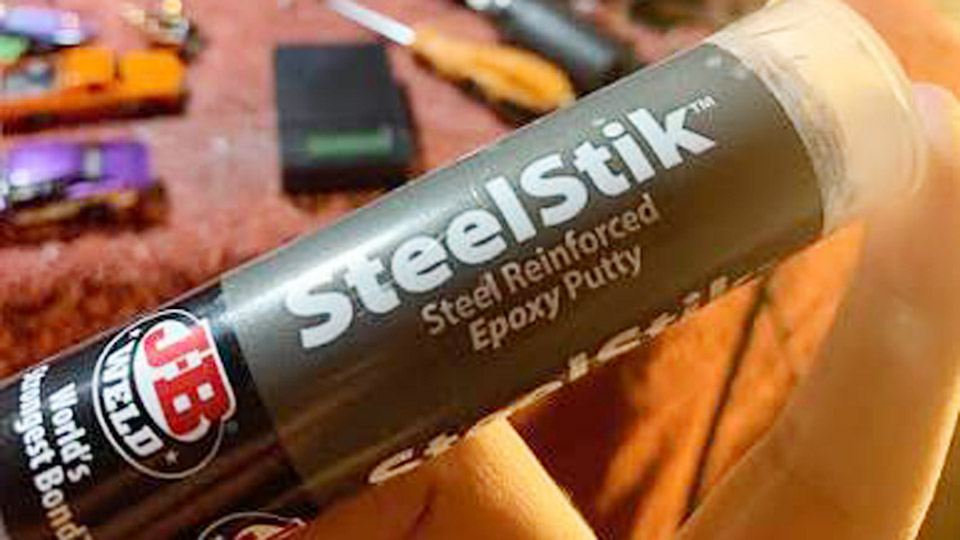
Image by DiecastRacingLeague
What SteelStik Is Actually Engineered to Bond
Steel-Reinforced Chemistry and Intended Substrates
JB Weld SteelStik is a two-part epoxy putty with steel particles suspended in the resin-hardener matrix. Once kneaded to a uniform dark gray color, it cures into a hard, machineable polymer rated at 4000 PSI tensile strength.
The manufacturer lists primary use on ferrous metals, aluminum, and automotive metal components. After a 5-minute set and 1-hour functional cure, the material can be drilled, tapped, ground, filed, and painted. Maximum continuous service temperature is 350°F.
These properties make it excellent for rebuilding stripped threads in steel housings, sealing metal pipe leaks, or filling corrosion pits, but the steel loading and resin system are optimized for metallic surfaces with high surface energy.
Why Plastic Surfaces Behave Differently
Most engineering plastics present low surface energy and smooth molecular structures that resist wetting by general-purpose epoxies. Polyethylene (PE), polypropylene (PP), and PTFE are classic non-stick examples; even rigid plastics such as ABS, PVC, and nylon require mechanical abrasion plus chemical compatibility for reliable adhesion.
SteelStik’s resin package lacks the specialized adhesion promoters found in plastic-dedicated formulas. When applied to plastic, any bond that forms is primarily mechanical—relying on surface roughness and mechanical interlock—rather than true chemical bonding.
Under load or thermal expansion mismatch, the joint typically fails at the adhesive-plastic interface long before the epoxy itself reaches its 4000 PSI rating.
Performance Limits When SteelStik Contacts Plastic
Measured Bond Strength Versus Plastic-Specific Putty
Independent shop tests and manufacturer data show clear differences. PlasticWeld epoxy putty, the product JB Weld markets for plastic repair, is rated at only 700 PSI tensile strength yet forms a stronger joint on ABS, PVC, and fiberglass because its chemistry matches the substrate.
SteelStik’s higher bulk strength is irrelevant if the interface peels at a few hundred PSI. On clean, abraded ABS, SteelStik may hold light non-structural loads for a short period; on PE or PP it often fails with hand pressure. Real-world vibration from engine mounts or road shock accelerates delamination.
Thermal and Chemical Expansion Mismatch
SteelStik expands and contracts at a rate closer to steel than to most plastics. A plastic housing that cycles from 20°F overnight to 180°F underhood creates shear stress at the bond line.
Fuel, coolant, and brake fluid exposure further weakens the already marginal interface. SteelStik claims oil and water resistance, but those ratings assume metal substrates. On plastic, chemical attack at the bond line is common within weeks.
Correct Product Selection for Plastic Repairs
When PlasticWeld or PlasticBonder Is the Right Call
For rigid plastics (ABS, PVC, polycarbonate, fiberglass, SMC), PlasticWeld putty or PlasticBonder syringe provides the formulated chemistry. PlasticWeld sets in 20–25 minutes and reaches functional strength in 2–3 hours at 700 PSI.
PlasticBonder reaches approximately 3770 PSI and is available in tan or black to match common automotive plastics. Both products still fail on PE and PP; for those materials a specialized polyolefin adhesive or mechanical fastening is required.
Hybrid Situations: Metal-to-Plastic Joints
Occasionally a steel bracket must be bonded to a plastic housing. In these cases neither pure SteelStik nor pure PlasticWeld is ideal.
Surface preparation becomes critical: abrade both sides aggressively, clean with acetone, and consider a thin layer of a versatile epoxy such as JB Weld Original (5020 PSI) or ClearWeld as a primer coat before applying the putty.
Even then, design the joint so the epoxy is loaded in compression or shear rather than pure tension, and add mechanical fasteners wherever possible.
Surface Preparation That Determines Success or Failure
Abrasion and Cleaning Protocol
Regardless of product, the plastic surface must be sanded to 80–120 grit to create a mechanical tooth. Wipe thoroughly with acetone or lacquer thinner—never alcohol or petroleum-based cleaners that leave residues. Allow complete evaporation.
On oily plastics such as certain nylons, a second cleaning cycle is often necessary. Any residual mold-release agent or plasticizer will act as a bond breaker.
Temperature and Humidity Windows
Apply SteelStik or PlasticWeld only when both substrate and ambient temperature are between 50°F and 90°F. Below 50°F the cure slows dramatically and ultimate strength drops. High humidity can cause surface blush on some epoxies; if relative humidity exceeds 70 percent, extend cure time by 50 percent before loading the joint.
Real-World Decision Matrix for Common Plastic Failures
Automotive Plastic Components
Radiator end tanks, intake manifold runners, and sensor brackets see heat, pressure, and vibration. SteelStik is routinely tried and routinely fails within a few hundred miles. PlasticBonder or a structural acrylic adhesive designed for plastics is the correct choice.
For temporary field fixes on non-pressurized parts, SteelStik can buy time until a proper repair is possible, but it should never be considered permanent on plastic underhood.
Plumbing and PVC Applications
PVC pipe and fittings respond better to solvent cement or PlasticWeld putty. SteelStik may seal a small hole in a non-pressurized drain line for a short period, but pressure cycles and thermal movement eventually open the joint. WaterWeld putty, formulated for wet surfaces and plastics, offers superior long-term performance in plumbing.
Structural Versus Cosmetic Repairs
If the plastic part carries load or contains pressure, treat SteelStik as unsuitable. For pure cosmetic filling of a non-structural crack where appearance and sandability matter more than strength, SteelStik can be used after thorough surface prep and will accept paint once cured. Document the temporary nature of the repair.
Advanced Application Technique When SteelStik Must Be Used on Plastic
Mechanical Interlock Design
When no alternative product is available, maximize mechanical keying. Drill a series of small holes or undercut grooves into the plastic so the putty forms anchors as it cures. Build a thick fillet that spreads stress over a larger area.
Clamp or tape the joint under light pressure during the 5-minute set window. After the 1-hour cure, avoid immediate heavy loading; allow a full 24 hours for maximum strength development when bonding dissimilar materials.
Post-Cure Reinforcement Options
After SteelStik has cured on plastic, consider wrapping the repair with fiberglass tape and a compatible epoxy resin or installing a mechanical brace. This hybrid approach transfers load away from the weak adhesive interface and can extend service life significantly in non-critical applications.
Temperature, Load, and Service Life Expectations
Continuous Service Limits
Even on metal, SteelStik is limited to 350°F continuous. On plastic the practical limit is far lower because the plastic itself softens and the differential expansion increases. Expect reduced bond life above 150–180°F. Cyclic loading above 20–30 percent of the theoretical interface strength shortens service life dramatically.
Inspection Criteria After Repair
Visually check for edge lifting, discoloration, or cracking at the bond line after the first thermal cycle and after the first 50–100 hours of service. Any movement or separation requires removal and a correct product re-repair.
Grinding away failed SteelStik is straightforward once the material has fully cured; the dark gray color makes residual epoxy easy to identify.
Decision-Making Summary for the Shop Floor
Select SteelStik only when the substrate is metal or when a temporary, non-structural plastic fix is acceptable and no plastic-rated product is on hand.
For any permanent plastic repair—especially under vibration, pressure, or heat—reach for PlasticWeld, PlasticBonder, or a purpose-formulated structural adhesive. Proper surface abrasion and solvent cleaning remain non-negotiable regardless of product.
The highest-strength epoxy is useless if the interface chemistry is wrong; matching the adhesive system to the substrate surface energy always outperforms raw tensile numbers.
FAQ
Does JB Weld SteelStik stick to ABS plastic permanently?
No. It can form a temporary mechanical bond on abraded ABS under light loads, but thermal cycling and vibration cause interface failure. Use PlasticWeld or PlasticBonder for lasting results.
Can I use SteelStik on a plastic fuel tank or radiator?
Not recommended. Fuel exposure and pressure differentials open the bond line quickly. Replace the component or use a plastic-specific structural adhesive rated for fuel contact.
What is the strongest JB Weld product for plastic-to-metal joints?
JB Weld Original or PlasticBonder provide better interface strength than SteelStik. Always abrade both surfaces, clean with acetone, and design the joint to minimize peel forces.
Will SteelStik work on polyethylene or polypropylene?
Almost never. These low-surface-energy plastics require specialized polyolefin primers or adhesives; general epoxy putties including SteelStik and even PlasticWeld fail to bond reliably.