Ultrasonic leak detection is widely used in welding, fabrication, and industrial maintenance because even small leaks can compromise system performance, inspection compliance, and production efficiency.
Understanding how does an ultrasonic type leak detector work is important when evaluating pressure vessels, piping systems, gas lines, and compressed-air networks where traditional leak detection methods may be slow or ineffective.
An ultrasonic leak detector identifies the high-frequency sound waves generated when gas or air escapes through a leak under pressure. By converting these ultrasonic signals into audible tones or visual readings, technicians can pinpoint leak locations quickly without shutting down equipment or disrupting operations.
In welding environments, accurate leak detection helps prevent shielding gas loss, reduces operating costs, improves process stability, and minimizes the risk of weld quality issues caused by inconsistent gas delivery.
A clear understanding of this technology allows welders and maintenance professionals to select the right inspection approach and improve overall system reliability.
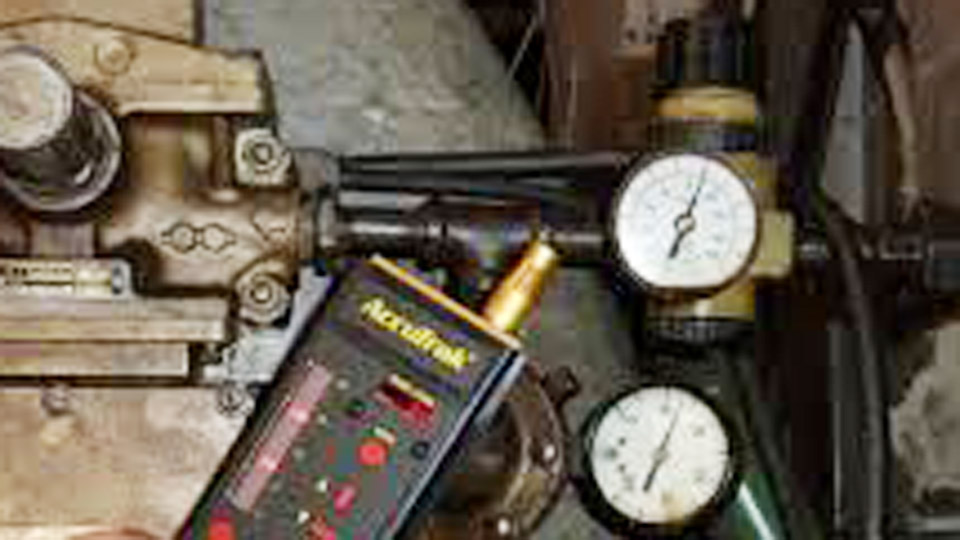
Image by superiorsignal
The Physics Behind Ultrasonic Leak Sounds in Welded Systems
Gas escaping through a weld imperfection—such as porosity, lack of fusion, or a pinhole crack—undergoes a transition from laminar to turbulent flow. This turbulence creates pressure waves across a broad frequency spectrum, with significant energy concentrated in the ultrasonic range above human hearing (20 kHz).
The leak sound intensity scales with pressure differential and orifice size. Higher system pressures (e.g., 100–500 psi common in compressed air, inert gas, or process lines) produce stronger ultrasonic signals.
Smaller leaks generate higher-frequency components, while larger ones may include lower-frequency audible hiss. Ultrasonic detectors are tuned to isolate the 25–70 kHz band, where leak signatures dominate over most industrial background noise.
In welding contexts, leaks often occur at root passes, crater ends, or intersections with base metal due to shrinkage stresses or contamination. The directional nature of ultrasound allows scanning along seams without flooding the entire structure.
Key Factors Influencing Ultrasonic Signal Strength
- Pressure Differential: Leaks below ~30 psi are harder to detect reliably; optimal performance starts around 50–100 psi for most handheld units.
- Orifice Geometry: Sharp-edged defects in welds produce more turbulence than smooth ones.
- Gas Type: Any gas works (air, nitrogen, CO2, argon), as detection relies on flow dynamics rather than chemical properties. Vacuum leaks also generate detectable ultrasound.
- Distance and Attenuation: Signals weaken with distance and obstacles; parabolic sensors extend range to 10–40 meters in open areas.
Core Components and Operating Principles of Ultrasonic Leak Detectors
A typical handheld ultrasonic leak detector includes a sensitive microphone (often piezoelectric), signal processing circuitry, headphones, and a visual display (LED bar graph or LCD).
The microphone captures airborne ultrasound. The raw high-frequency signal undergoes heterodyning—a frequency-shifting process that mixes it with an internal oscillator to produce an audible output (usually 0–5 kHz range) that operators hear as a hissing or rushing sound through headphones. Bandpass filters reject audible noise and unrelated machinery vibrations.
Many units feature adjustable sensitivity and frequency tuning to focus on specific bands, plus contact probes for structure-borne sound transmission along pipes or vessel walls.
Signal Processing and Display Features
Modern detectors amplify the signal, apply RMS (root mean square) calculations for intensity measurement, and display relative strength. Some include data logging for trend analysis during periodic inspections. Heterodyning preserves directional information, so volume increases as you aim closer to the source.
Ultrasonic Leak Detection Workflow for Weld Inspection
While not every task requires a rigid sequence, effective use follows logical scanning patterns tailored to the weldment.
Position the system under test pressure with a safe gas (nitrogen or air for initial checks). Scan systematically along the weld bead, maintaining consistent distance (typically 0.5–1 meter for handheld mics). Listen for rising intensity and use the display to confirm peaks.
Mark suspect areas for closer inspection or repair. For vacuum systems or enclosed vessels, external scanning works similarly due to inward flow turbulence.
Contact mode (probe against surface) helps trace leaks through thick walls or in noisy environments by conducting structure-borne ultrasound.
Applications in Welding Fabrication and Maintenance
Ultrasonic detectors excel for post-weld verification on pressure vessels, piping systems, heat exchangers, and storage tanks where full immersion or helium tracing is impractical.
In pipeline welding, they quickly survey long runs for girth weld integrity without sectioning. For hobbyists fabricating air receivers or custom manifolds, they confirm seal quality before final assembly.
Professionals use them for in-service inspections on operating compressed air systems, identifying leaks at flanged joints or repaired welds without shutdown.
They complement other NDT: Use after visual and before or alongside vacuum box testing on tank seams.
Specific Welding Scenarios
- Tank and Vessel Seams: Scan longitudinal and circumferential welds under pressure.
- Pipe Joints: Ideal for field repairs where access is limited.
- Multi-Layered Vessels: Detect interlayer pressure communication issues.
- Compressed Gas Systems: Common in welding shops for manifold and regulator leaks.
Advantages Over Traditional Leak Detection Methods
Ultrasonic detection operates independently of gas concentration, making it effective in ventilated shops or windy outdoor sites. It detects leaks instantly at the speed of sound, unlike methods waiting for gas buildup.
It works on any gas and in vacuum, requires no consumables like soap solution or tracer gas, and allows remote scanning. Sensitivity reaches small leaks (down to fractions of an ounce per year in optimal conditions), though not as fine as helium mass spectrometry.
Comparison Table: Leak Detection Methods for Welded Systems
| Method | Sensitivity | Best For | Limitations | Speed |
|---|---|---|---|---|
| Soap Bubble / Vacuum Box | Medium (visible bubbles) | Accessible seams | Messy, weather-sensitive, small leaks missed | Slow |
| Pressure Decay | Quantitative | Sealed systems | No location, temperature sensitive | Moderate |
| Helium Mass Spec | Very High | Critical, tiny leaks | Expensive, requires tracer gas | Moderate-Slow |
| Ultrasonic | High | Pressurized/vacuum, field | Not quantitative for very low flows | Fast |
Limitations and When Ultrasonic Detection May Not Suffice
Ultrasonic methods struggle with very low-pressure systems (<30 psi) or extremely small molecular leaks better suited to helium. They do not quantify exact leak rates easily (though intensity correlates roughly) and can be affected by strong competing ultrasound sources like steam traps or pneumatic tools if not tuned properly.
In very quiet environments or with tiny pinholes, confirmation with another method is prudent. Operator training is key for interpreting signals amid complex weld geometries.
Selecting the Right Ultrasonic Leak Detector for Welders
Consider frequency range (20–90 kHz typical), sensitivity adjustment, battery life, and accessories like parabolic dishes for distance or probes for contact. Budget handheld units suit shop use; advanced models with spectrum analysis suit professional NDT teams.
Look for robust build quality resistant to shop dust and impact. Calibration checks against known sources ensure reliability.
Decision Factors by User Type
- Hobbyists/DIY: Affordable basic models with headphones and LED indicators.
- Students/Training: Units with visual displays for learning signal interpretation.
- Professionals: Data-logging, adjustable filters, and integration with inspection records for code compliance.
Best Practices for Accurate Results in Welding Environments
Scan in a grid pattern perpendicular to welds. Increase pressure incrementally if safe. Use sensitivity adjustments to zero out background noise, then boost for fine detection. Document findings with photos and intensity readings for traceability.
For repetitive inspections, establish baseline “normal” sound profiles for equipment. Combine with visual checks of weld profiles—convexity, undercut, or porosity often correlate with leak paths.
Integrating Ultrasonic Detection into Your Welding Quality Process
Effective welders treat leak detection as part of a layered quality approach: proper joint prep, qualified WPS, in-process controls, and post-weld NDT. Ultrasonic tools provide immediate feedback that reduces rework loops and builds confidence in pressure-containing welds.
In high-stakes fabrication (boilers, pipelines, vessels), it supports compliance with codes like ASME Section VIII or API standards by enabling thorough, documented testing.
Performance-Based Takeaway
Mastering ultrasonic leak detection equips you to verify weld integrity faster and more reliably across diverse projects, minimizing downtime and safety risks.
The advanced insight for pro-level welders lies in recognizing that leak behavior reveals more than presence—it indicates root causes like improper shielding gas flow, travel speed variations, or material prep issues.
Correlating ultrasonic findings with welding parameters refines your technique for consistently sound joints that pass the most demanding service conditions.
FAQ
How sensitive is an ultrasonic leak detector for small weld defects?
It reliably detects leaks producing turbulence equivalent to small pinholes under moderate pressure (50+ psi), often down to 0.5 oz/year flow rates depending on model and conditions. Very tiny molecular leaks may require helium methods for confirmation.
Can ultrasonic detectors find leaks in vacuum systems or specific gases?
Yes. They work on vacuum leaks (inward flow turbulence) and any gas, including inert shielding gases or process fluids common in welding setups.
Is ultrasonic leak detection suitable for noisy welding shops?
Highly suitable. Frequency tuning and filtering isolate ultrasonic signals from audible arc noise, grinders, or compressors.
How does it compare to vacuum box testing for tank welds?
Faster for initial scanning over large areas; vacuum box offers visual bubble confirmation on specific seams. Many use both sequentially for thorough verification.