Fillet weld strength is a critical factor in determining whether a welded joint can safely withstand the loads it will encounter in service. Understanding how to calculate fillet weld strength is essential for welders, fabricators, inspectors, and engineers working on structural steel, piping systems, equipment frames, and other load-bearing applications.
An incorrect strength calculation can lead to undersized welds, premature joint failure, failed inspections, costly rework, or unnecessary welding that increases labor and material costs. Factors such as weld size, effective throat thickness, weld length, and the mechanical properties of the filler metal all influence the final strength of a fillet weld.
By knowing how these variables interact, you can verify weld capacity, meet code requirements, and make informed decisions during fabrication and design. Accurate calculations help ensure both structural reliability and welding efficiency in real-world applications.
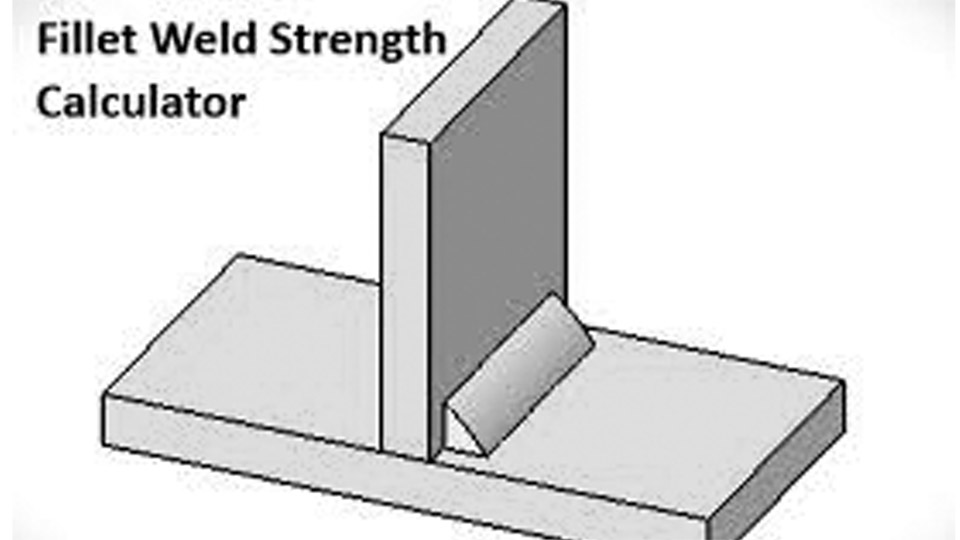
Image by qualitypros
Understanding Fillet Weld Geometry and Load-Bearing Basics
Effective Throat vs. Leg Size
The leg size measures the visible sides of the isosceles right triangle formed by the weld. The effective throat—the shortest distance from root to face—determines strength. For a standard 45-degree fillet weld, throat thickness equals leg size × 0.707 (or approximately 70.7% of leg).
A 1/4-inch (6.35 mm) leg produces a theoretical throat of about 0.177 inches (4.5 mm). This throat area resists shear. Convex or concave profiles alter the actual throat slightly, but design uses the theoretical value unless penetration data confirms otherwise.
Weld Metal Strength and Electrode Selection
Strength depends on the filler metal. For E70XX electrodes (common for mild steel), the nominal tensile strength is 70 ksi. AWS D1.1 sets allowable shear stress at 0.30 × electrode tensile strength, yielding 21 ksi for E70XX.
Matching or slightly under-matching electrodes to base metal avoids issues. Over-matching filler rarely adds proportional strength in fillet welds due to throat failure mode.
Effective Length Considerations
Effective length excludes start and stop craters. For end-loaded welds longer than 100 times the leg size, apply reduction factors per AISC or equivalent standards to account for non-uniform stress. Intermittent welds require careful spacing to maintain overall capacity without creating stress risers.
Core Formula for Fillet Weld Strength Calculation
Basic Shear Strength Formula
For a fillet weld loaded in shear parallel to its length:
Strength (F) = 0.707 × leg size × effective length × allowable shear stress
Using E70XX (21 ksi allowable shear):
F (lb) = 0.707 × leg (in) × length (in) × 21,000
Per inch of 1/4-inch fillet: approximately 3,700 lb capacity (two-sided double fillet doubles this).
Accounting for Loading Direction
Transverse fillets (load perpendicular to weld axis) gain 30-50% extra strength due to higher resistance. The directional strength increase factor (1.0 + 0.5 sin^{1.5} θ) applies in combined cases, where θ is the angle of loading.
Longitudinal fillets rely purely on shear. Combined loading requires vector summation of stresses.
Step-by-Step Calculation Examples
Single Fillet in Pure Shear
Consider a bracket with 10,000 lb vertical load on a 6-inch long single fillet weld using 1/4-inch leg E70XX.
- Throat = 0.707 × 0.25 = 0.1768 in
- Area = 0.1768 × 6 = 1.0608 in²
- Capacity = 1.0608 × 21,000 ≈ 22,277 lb
This exceeds the 10,000 lb load with a safety margin. A smaller 3/16-inch leg might suffice depending on code requirements.
Double Fillet T-Joint
Double fillets balance loads and roughly double capacity. For the same 10,000 lb load:
Each fillet carries half. Total throat area doubles, providing redundancy against eccentricity.
Transverse Fillet Example
A transverse fillet under tension benefits from the directional factor. At 90°, the increase reaches about 1.5 in some provisions, though conservative designs often use 1.0-1.3.
Factors That Reduce or Increase Fillet Weld Strength
Base Metal Thickness and Minimum Size
AWS D1.1 Table 7.7 (or equivalent) sets minimum fillet sizes based on thicker part joined. For material 1/4 to 1/2 inch thick, minimum leg is often 3/16 inch to ensure proper fusion and avoid cracking.
Maximum size on thin material is limited to base thickness minus 1/16 inch to prevent burn-through.
Penetration and Effective Throat Enhancement
Root penetration beyond the theoretical throat increases effective area. Consistent short-circuit or spray transfer MIG with proper parameters can allow smaller leg sizes for equivalent strength.
Measure macro-etched samples during procedure qualification to quantify extra throat.
Eccentric Loading and Weld Groups
Bracket connections with welds not symmetric to the load line create torsion and uneven stress. Use instantaneous center of rotation (ICR) methods for complex groups. Simple vector analysis works for basic eccentric cases.
Calculate the polar moment of inertia of the weld group and resolve stresses at the critical point.
Material-Specific Calculations
Mild Steel (A36, 36 ksi yield)
Base calculations on weld metal properties rather than base. Ensure weld strength does not exceed base metal shear capacity in critical joints.
Base metal shear allowable ≈ 0.6 × Fy (21.6 ksi for A36).
Higher Strength Steels
For 50 ksi or 70 ksi steels, select matching electrodes (E80XX or higher) but verify allowable stresses. Throat calculations remain the same; only the stress value changes.
Stainless and Aluminum
Stainless uses different multipliers due to work hardening and corrosion considerations. Aluminum strength drops significantly with heat input; calculate with appropriate alloy filler data (e.g., 4043 or 5356) and lower allowable stresses.
Advanced Loading Conditions
Combined Shear and Tension
Resolve forces into parallel and perpendicular components. The resultant stress on the throat must stay below allowable.
Equivalent stress = √(σ_perp² + τ_parallel²) ≤ allowable
Apply interaction formulas from AISC or Eurocode for precision.
Bending on Fillet Welds
Treat the weld group as a line with section modulus. Maximum stress occurs at the farthest point from the neutral axis.
For a vertical weld group under moment: calculate direct shear + bending shear, then vector sum.
Fatigue Considerations
Static formulas do not apply under cyclic loading. Fatigue life depends on weld profile, toe radius, and stress range. Use Category C or lower detail classifications with lower allowable stress ranges for fillet welds.
Grinding toes or using low-hydrogen processes improves fatigue performance.
Practical Workshop Decision Making
Choosing Leg Size for Common Applications
- Light brackets (under 5,000 lb): 1/8 to 3/16 inch legs
- Structural supports: 1/4 to 3/8 inch, often double-sided
- Heavy machinery repairs: Match or exceed base thickness guidelines
Always verify with load calculations rather than rule-of-thumb alone.
Accounting for Real-World Variables
Heat input affects distortion and residual stress. Multi-pass welds on thick sections require interpass temperature control. Uneven cooling can reduce effective strength.
Test welds under expected conditions when critical. Destructive testing (break test or tensile) validates calculations for non-coded work.
Software and Calculator Tools
Many online weld strength calculators use AISC or AWS formulas. Input leg size, length, electrode, and load angle for quick estimates, but understand the underlying math for adjustments.
Comparing Standards: AWS, AISC, and Others
AWS D1.1 focuses on structural steel with specific allowable stresses. AISC provides detailed provisions for building connections, including directional factors and group analysis.
Eurocode uses different partial factors and correlation coefficients for throat stress. Always follow the jurisdiction or project specification. For hobby/DIY, AWS-based methods offer a conservative, widely accepted baseline.
Common Calculation Pitfalls to Avoid
- Using leg size directly instead of throat
- Ignoring effective length reductions on long welds
- Applying full electrode strength without the 0.30 factor
- Neglecting eccentricity in single-sided welds
- Assuming all welds in a group share load equally
Vector resolution and critical point analysis prevent these errors.
Final Thoughts
Calculating fillet weld strength correctly shifts decisions from guesswork to engineering precision. Match throat area to applied loads, respect directional effects, and validate against base metal limits.
In high-performance fabrication, the real insight comes from recognizing that optimal welds balance calculated capacity with practical execution—consistent penetration, minimal defects, and controlled distortion often determine success more than marginal size increases. This approach delivers joints that perform reliably under actual service conditions.
FAQ
What is the difference between leg size and throat in fillet weld strength?
Leg size is the measured side; throat (0.707 × leg) is the failure plane used in calculations. Strength is based on throat area.
How much load can a 1/4 inch fillet weld hold per inch?
Approximately 3,700 lb per inch of length for E70XX in shear (single fillet). Double this for balanced double fillets.
Does weld position affect fillet weld strength calculation?
Position influences deposition and quality more than the base formula. Overhead or vertical welds may require technique adjustments but use the same throat math unless procedure qualification shows differences.
When should I use transverse instead of longitudinal fillet welds?
Use transverse orientation when possible for higher capacity under tension. Combine both in groups for optimal load distribution, applying directional factors carefully.