Many welders assume TIG is the “clean” process and therefore safe on stainless, yet personal air sampling often shows hexavalent chromium still present in the breathing zone.
The question Is TIG welding stainless steel dangerous centers on whether the low total fume volume offsets the formation of Cr(VI), ozone, and the risk of oxygen displacement by argon.
Chromium in grades such as 304 and 316 oxidizes under the arc into a known human carcinogen; OSHA sets a permissible exposure limit of only 5 µg/m³ as an 8-hour time-weighted average, with an action level of 2.5 µg/m³ that triggers monitoring and medical surveillance.
Without source capture and respiratory protection, even short sessions can approach or exceed those thresholds, and long-term inhalation raises lung-cancer risk.
Accurate exposure data and engineering controls decide whether the process stays within acceptable limits or becomes a chronic health liability.
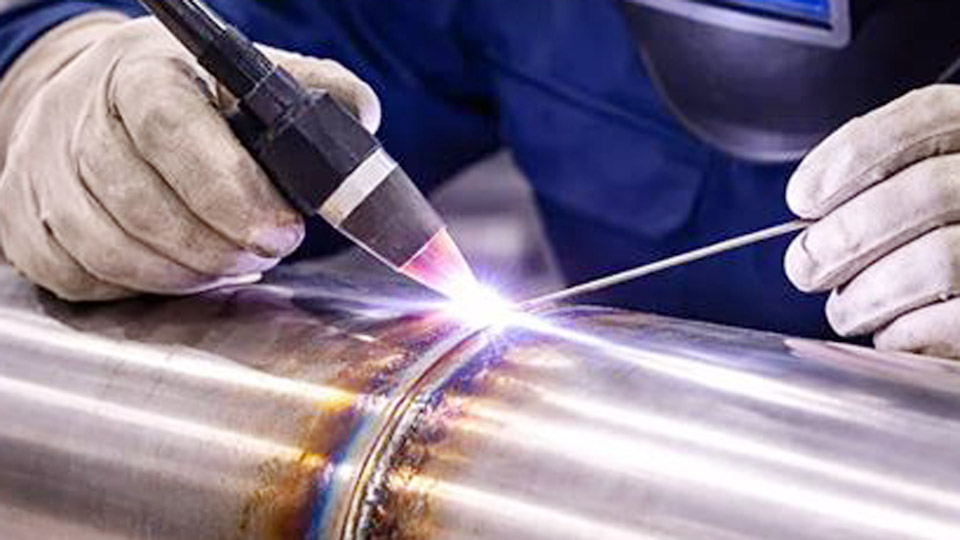
Image by kongfangmetal
How Much Hexavalent Chromium Does TIG Actually Generate on Stainless
TIG produces far less particulate than stick or flux-cored processes because the non-consumable tungsten electrode does not transfer metal through the arc. Measured mean Cr(VI) concentrations for GTAW on stainless typically fall in the 0.14–0.42 µg/m³ range under open-shop conditions—well below the OSHA PEL and frequently under the action level.
However, the concentration of Cr(VI) within the fume itself remains high; the particles are sub-micron and remain airborne longer than ordinary iron-oxide fumes.
Comparison of Fume Generation Rates Across Processes
Studies rank processes by average Cr(VI) exposure and percentage of samples exceeding the PEL: carbon-arc or plasma cutting highest, followed by SMAW, FCAW, GMAW, then GTAW and submerged arc at the bottom.
TIG consistently records the lowest generation rate—often 5–10 % of the fume mass produced by stick welding for the same metal deposited. Higher amperage, thicker sections, and continuous multi-pass work increase the absolute quantity of Cr(VI) released even with TIG.
Influence of Current, Filler, and Shield Gas
Raising current from 100 A to 150 A roughly doubles total fume emission. Adding filler metal (especially high-chromium alloys) increases chromium vaporization.
Pure argon produces lower Cr(VI) than argon–oxygen or argon–CO₂ mixtures because less oxygen is available for oxidation. Short-circuit or pulsed modes further reduce generation compared with continuous high-energy arcs.
Secondary Gases and Radiation Hazards Unique to TIG on Stainless
While particulate volume is low, the intense ultraviolet output of the TIG arc creates secondary gases that stick and MIG generate in smaller amounts.
Ozone and Nitrogen Oxides Formation
UV radiation photochemically converts ambient oxygen into ozone immediately outside the gas shield. Concentrations can exceed 0.1 ppm near the arc—enough to cause throat irritation, chest tightness, and reduced lung function after prolonged exposure.
Nitrogen oxides form simultaneously. Both gases are more pronounced during TIG than during processes with heavier fume plumes that partially absorb the UV.
Argon Displacement and Confined-Space Asphyxiation
Argon is denser than air and accumulates in low points, tanks, pipe interiors, and fabrications. Oxygen levels can drop below 19.5 % within minutes when purge or torch gas leaks into an enclosed volume. Loss of consciousness occurs without warning because the respiratory drive is triggered by rising CO₂, not falling O₂.
Any stainless pipe or vessel work that requires internal purging demands continuous oxygen monitoring and forced ventilation or supplied-air respirators.
Practical Exposure Control Hierarchy for TIG Stainless
Engineering controls take precedence over respirators. The goal is to keep airborne Cr(VI) below the action level so that respiratory protection becomes a secondary rather than primary barrier.
Local Exhaust Ventilation Placement and Performance
Position a movable fume arm or on-torch extraction nozzle 150–200 mm from the arc with a capture velocity of 0.5–0.75 m/s (100–150 fpm). Flow rates of 400–600 cfm through a 75–100 mm hose typically reduce personal Cr(VI) samples by 60–80 %.
Downdraft tables work for bench work on small components. General shop ventilation alone is insufficient once stainless welding becomes routine.
When Respiratory Protection Is Required
If air monitoring shows levels at or above 2.5 µg/m³, NIOSH-approved P100 filters or powered air-purifying respirators (PAPRs) with assigned protection factors of at least 25 are mandatory.
Loose-fitting PAPR hoods maintain positive pressure and are better tolerated during multi-hour sessions. Ordinary N95 dust masks provide no protection against sub-micron Cr(VI) or ozone.
Electrode and Consumable Choices That Affect Risk
Thoriated tungsten (EWTh-2) contains radioactive thorium dioxide. Grinding the tip releases alpha-emitting dust that is an inhalation hazard separate from the welding fumes. Lanthanated, ceriated, or zirconiated electrodes eliminate that risk while delivering comparable arc starting and stability on stainless.
Filler rods should match the base-metal chromium content; excess chromium in the filler increases Cr(VI) generation without improving corrosion resistance.
Decision Criteria for Shop Versus Field Stainless TIG Work
In a well-ventilated fabrication bay with functioning LEV, measured Cr(VI) rarely exceeds the action level for intermittent TIG on stainless sheet or light pipe. The same process performed inside a tank, ship compartment, or outdoor wind-sheltered enclosure without extraction routinely pushes exposures above 5 µg/m³.
Continuous production welding of heavy-section stainless requires both fixed extraction and periodic personal monitoring. Field crews must treat every stainless joint as a potential regulated area until sampling data prove otherwise.
Wrapping Up
The technical decision reduces to measured concentration versus regulatory thresholds. When source capture keeps Cr(VI) under 2.5 µg/m³ and oxygen monitors confirm safe atmospheres, TIG on stainless remains controllable. Once those numbers are exceeded, the process shifts from routine fabrication into a regulated exposure that demands full PPE, medical surveillance, and documented controls.
Advanced shops further lower risk by combining pulsed TIG parameters with on-torch extraction and real-time oxygen sensors inside purged fabrications, keeping both particulate and asphyxiant hazards at the lowest practical levels.
FAQs
Does TIG welding stainless steel produce hexavalent chromium?
Yes. Chromium in the base metal and filler oxidizes under the arc into Cr(VI). TIG generates less total fume than stick or MIG, but the Cr(VI) fraction is still present and regulated.
What is the OSHA limit for hexavalent chromium in welding?
The permissible exposure limit is 5 µg/m³ as an 8-hour time-weighted average. The action level is 2.5 µg/m³; exceeding it requires monitoring, medical surveillance, and written records.
Is a regular dust mask enough for TIG stainless?
No. Sub-micron Cr(VI) particles and ozone pass through ordinary dust masks. Use NIOSH-approved P100 filters or a PAPR when exposure reaches the action level.
Can argon from TIG purge kill you in a confined space?
Yes. Argon displaces oxygen without odor or irritation. Levels below 19.5 % O₂ cause rapid loss of consciousness. Continuous oxygen monitoring and forced ventilation are mandatory for any enclosed stainless work.