Choosing the right electrode depends on understanding the 6011 welding rod specifications, including amperage range, polarity, tensile strength, and recommended electrode diameter. E6011 is a cellulosic stick welding electrode known for its forceful arc, deep penetration, and ability to operate on AC or DC electrode-positive power sources.
These characteristics make it useful for maintenance, repair work, rusty steel, and applications where surface preparation may be limited.
However, using the wrong rod diameter or amperage can cause excessive spatter, unstable arc behavior, undercut, or burn-through on thinner materials. Understanding the electrode’s classification and operating requirements helps welders match the rod to the base metal, joint design, and welding position.
Accurate specifications also make it easier to select suitable machine settings and produce consistent welds without unnecessary rework.
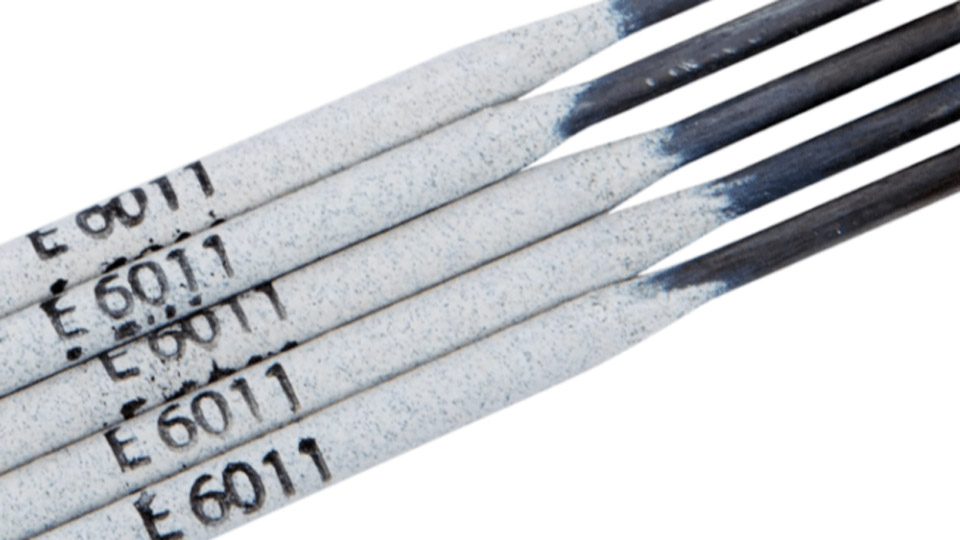
Image by indiamart
Core AWS Classification and Mechanical Properties of E6011
The AWS A5.1 designation E6011 encodes the essential performance envelope.
Tensile, Yield, and Elongation Requirements
Minimum tensile strength is 60,000 psi (430 MPa). Yield strength is 48,000 psi (330 MPa) minimum. Elongation in 2 inches must reach at least 22 percent.
Typical as-welded values from manufacturer data sheets often exceed these minima—tensile results in the 70–85 ksi range and Charpy V-notch impact values meeting or exceeding 20 ft-lbf at –20 °F are common. These numbers place E6011 in the same strength class as E6010 while adding AC capability.
Flux Coating Chemistry and Arc Behavior
The high-cellulose potassium coating generates a forceful, digging arc with rapid solidification. Potassium stabilizers allow stable operation on alternating current and either DC polarity. The thin, friable slag covers the bead incompletely in many cases and removes easily with light chipping.
Spatter volume is higher than rutile or low-hydrogen electrodes, yet the arc force clears light surface contaminants that would stall softer rods.
Amperage Ranges by Diameter and Position
Operating current is diameter-dependent and must be adjusted for gravity effects in out-of-position work.
Standard Amperage Chart for Common Diameters
| Diameter | Typical Amperage Range (AC/DC) | Flat / Horizontal Starting Point | Vertical / Overhead Adjustment |
|---|---|---|---|
| 3/32″ (2.4 mm) | 40–85 A | 55–70 A | 40–60 A |
| 1/8″ (3.2 mm) | 75–125 A | 90–110 A | 75–95 A |
| 5/32″ (4.0 mm) | 110–165 A | 130–150 A | 110–130 A |
| 3/16″ (4.8 mm) | 140–210 A | 160–180 A | 140–160 A |
Lincoln Fleetweld 180 data lists tighter windows for 1/8″: 65–120 A on AC and 60–110 A on DC±. ESAB and other brands publish similar bands centered near 100 A for 1/8″ on DCEP. Always verify the specific product data sheet because coating formulation and core-wire chemistry produce small shifts.
How Position Changes the Working Current
Flat and horizontal joints accept the mid-to-upper portion of the range for maximum deposition and penetration. Vertical-up and overhead work require the lower third of the range to keep the puddle from sagging.
Travel speed and arc length become the primary controls once amperage is set; a short arc (roughly equal to electrode diameter) concentrates heat and reduces undercut.
Polarity Options and Their Effect on Penetration Profile
E6011 is one of the few cellulosic electrodes that operates successfully on AC, DCEP, and DCEN.
DCEP for Maximum Digging Action
Electrode-positive polarity concentrates approximately two-thirds of the arc heat at the workpiece. The result is the deepest penetration and strongest arc force. Most pipeline root and structural repair work defaults to DCEP when a DC machine is available.
AC Operation on Transformer and Inverter Machines
Alternating current produces a slightly softer arc than DCEP yet still delivers usable penetration. AC compatibility makes 6011 the practical choice for older buzz-box welders and many portable inverters that lack stable DC output at low amperages. Raise the set current 5–10 A relative to the DC recommendation to compensate for the continuous polarity reversal.
DCEN for Thin Material or Reduced Heat Input
Electrode-negative polarity reduces penetration and is useful on sheet metal or when burn-through risk is high. Arc force remains adequate for light contaminant removal, but the bead profile is wider and shallower than DCEP deposits.
Diameter Selection Relative to Base-Metal Thickness
Matching electrode diameter to plate thickness controls heat input and fusion depth more effectively than amperage alone.
Thin Gauge and Light Fabrication
3/32″ electrodes at 40–70 A handle 16-gauge to 1/8″ material without excessive distortion. Short arc length and moderate travel speed prevent melt-through while still achieving fusion on lightly contaminated surfaces.
General Fabrication and Repair Range
1/8″ rods cover the majority of field work on 1/8″ to 1/4″ plate. At 90–110 A the arc digs through mill scale and light rust, producing a concave or slightly convex bead suitable for multi-pass build-up.
Heavier Sections and Multi-Pass Joints
5/32″ and 3/16″ electrodes supply the deposition rate needed for 5/16″ and thicker material. Root passes still benefit from the aggressive arc; fill and cap passes may switch to higher-deposition electrodes once the joint is clean and properly fused.
Performance Differences Versus Closely Related Electrodes
Understanding where 6011 sits relative to 6010 and 6013 prevents incorrect substitution.
Comparison with E6010
Both electrodes share deep penetration and fast-freeze characteristics. E6010 is restricted to DCEP and produces a more aggressive arc preferred for open-root pipe work. E6011 adds AC and DCEN capability at a modest reduction in arc force, making it more versatile for mixed-power-source shops and outdoor repair.
Comparison with E6013
E6013 uses a rutile-potassium coating that yields a soft arc, easy slag removal, and limited penetration. It excels on clean sheet metal and produces aesthetically smoother beads. E6011 is selected when surface condition is poor or when deep fusion is required; the two electrodes are not interchangeable for structural root passes.
Storage, Handling, and Moisture Sensitivity
Cellulosic coatings absorb moisture more readily than low-hydrogen coatings, yet they do not require the same oven protocols. Store unopened packages in a dry area. Once opened, keep electrodes in a closed container at room temperature; avoid holding ovens above 130 °F because excessive heat degrades the cellulose. Reconditioning is generally not recommended—discard electrodes that show heavy rust or damp coatings.
Decision Criteria for Selecting 6011 on a Given Job
Choose E6011 when the joint involves mild or low-alloy steel, surface preparation is limited, all-position access is required, and the power source may be AC. Verify that the required tensile strength does not exceed 60 ksi and that the procedure does not mandate low-hydrogen consumables.
For open-root pipe or critical structural code work that demands maximum dig, evaluate E6010 on a DC machine first. When bead appearance and minimal cleanup dominate, move to E6013 or E7018 after proper joint preparation.
Correct application of 6011 welding rod specifications centers on matching the forceful cellulosic arc to contaminated or poorly fitted joints while staying inside the diameter-specific amperage windows. The electrode’s AC compatibility and all-position fast-freeze behavior make it the default field rod for many repair and light fabrication tasks.
Advanced operators further refine results by pairing short-arc technique with deliberate whip-and-pause motion on vertical and overhead passes, controlling the rapid solidification rate that defines the classification.
Wrapping Up
What amperage should I use for 1/8″ 6011 welding rod?
Most manufacturers list 75–125 A overall. Start at 90–110 A on DCEP or AC for flat work and drop toward 75–95 A for vertical or overhead.
Can 6011 rods run on AC welders?
Yes. The potassium-stabilized cellulose coating is specifically formulated for AC as well as both DC polarities, which is the primary distinction from E6010.
What is the tensile strength of E6011 electrode?
Minimum tensile strength is 60,000 psi (430 MPa) per AWS A5.1. Typical as-welded results from commercial products often fall between 70,000 and 85,000 psi.
Is 6011 better than 6010 for dirty metal?
Both electrodes cut through light rust and paint effectively. 6011 offers the advantage of AC operation and slightly greater tolerance for low open-circuit-voltage machines, while 6010 remains preferred for maximum penetration on DC-only pipeline roots.