A pressurized copper pipe develops a pinhole leak at 40–60 PSI household line pressure, or a fuel tank seam starts weeping under vibration and heat. Standard epoxies fail when water is present or when residual pressure keeps the surface wet.
This is exactly where the question “does JB WaterWeld work under pressure” becomes critical for DIY welders, hobbyists, and field technicians who need a reliable temporary or semi-permanent seal without draining the entire system.
JB WaterWeld is a two-part epoxy putty formulated to mix, apply, and cure in wet or fully submerged conditions. Manufacturer data rates it at 4370 PSI tensile strength and states it will withstand continuous water pressure up to 500 PSI once fully cured.
That rating exceeds typical residential plumbing (40–80 PSI), most low-pressure hydraulic lines, and many marine or pool applications. Real-world performance, however, depends on surface preparation, application thickness, cure conditions, and the type of stress the repair will see.
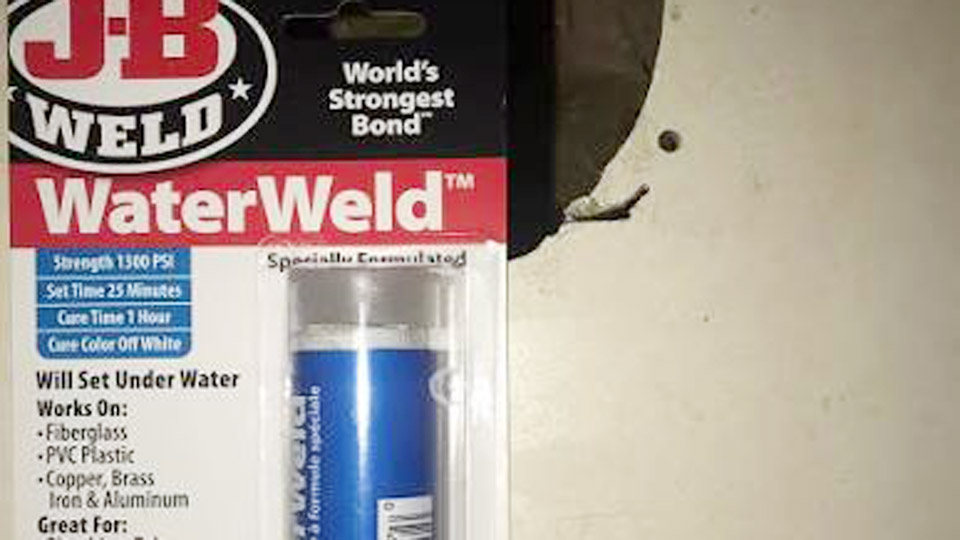
Image by barnhacksanddiy
Manufacturer Pressure Rating Versus Real Service Conditions
Official Strength Numbers and What They Mean
J-B Weld lists WaterWeld at 4370 PSI tensile strength and a maximum water-pressure resistance of 500 PSI after full cure. Temperature limit is 250°F continuous.
Set time is approximately 25 minutes; full hardness is reached in one hour under standard conditions. The product is NSF-certified for contact with potable water, which matters for domestic plumbing repairs.
These numbers come from controlled lab testing on properly prepared surfaces. The 500 PSI figure assumes the putty has been forced into the defect, allowed to cure without movement, and is not subjected to cyclic thermal shock or heavy vibration immediately after the one-hour mark.
Tensile strength of 4370 PSI is competitive with many structural epoxies, but the critical value for pressure sealing is the combination of adhesion to the substrate and the compressive resistance of the cured mass itself.
How Household and Industrial Pressures Compare
Standard municipal water systems operate between 40 and 80 PSI. Many residential boilers and closed-loop heating systems stay under 30 PSI. Compressed-air lines in small shops often run 90–120 PSI. Low-pressure hydraulic systems on equipment can reach 200–300 PSI.
At the upper end, some industrial process lines exceed 500 PSI; WaterWeld is not intended for those services once the rating is approached or exceeded.
In practice, a well-executed WaterWeld repair routinely holds 60–100 PSI on copper, steel, and PVC with no leakage for months to years when the defect is a pinhole or short crack and the putty is applied with sufficient mass and mechanical keying.
Larger holes or longitudinal cracks reduce the effective pressure margin because the putty is acting more as a patch than as a filled structural repair.
Surface Preparation That Determines Pressure Performance
Cleaning Requirements for Wet and Submerged Surfaces
Oil, scale, corrosion products, and biofilm reduce adhesion dramatically. On a pressurized leak the surface is already wet, so solvent wiping is limited. Mechanical abrasion with a wire brush, coarse abrasive cloth, or emery paper while the water is flowing (or immediately after isolation) creates a rough profile that the putty can key into.
For submerged applications the same principle applies: remove loose material and create texture even if the area remains wet.
Residue from previous sealants or thread compounds must be removed. Residual silicone or Teflon tape prevents the epoxy from wetting the metal. A quick pass with a carbide scraper or abrasive pad under flowing water is often enough for emergency work.
How Much Putty Mass Is Needed for Pressure Sealing
Thin smears fail under pressure. Successful high-pressure seals use a mass of putty that completely fills the defect and extends at least ½ inch beyond the edges in all directions, forming a mechanical lock. For a pinhole, a ¾-inch diameter by ⅜-inch thick plug is typical.
On a crack, the putty should be forced into the crack first, then built outward to create a reinforcing pad. Insufficient mass allows the pressurized fluid to find a path around the edge of the repair.
Application Technique Under Residual Pressure
Working Against an Active Leak
When the system cannot be fully isolated, the putty must be held firmly against the leak while it begins to set. Knead the required amount until uniform color is achieved, then press it into the defect and maintain hand pressure for several minutes.
As the epoxy starts to stiffen (usually within 10–15 minutes), the leak rate decreases. Once the surface of the putty is firm, additional layers can be added if needed. Complete isolation is still preferred whenever possible; residual flow can wash uncured material away or create voids.
Cure Time and When Pressure Can Be Restored
The product reaches handling strength in about one hour at room temperature. Full chemical resistance and maximum pressure capability develop after that point. Returning the system to service before the one-hour mark risks displacement of the still-soft material.
In cooler conditions (below 60°F) the cure slows; modest warming of the surrounding area can accelerate it without exceeding the product’s temperature limits during the cure phase.
After full cure the repair can be drilled, tapped, sanded, or painted if geometry requires it. For pressure applications, avoid removing material that contributes to the mechanical seal.
Limitations That Cause Pressure Failures
Defect Size and Geometry Constraints
WaterWeld performs best on small, discrete defects—pinholes, short cracks, and thread leaks. Long longitudinal cracks, large holes, or areas under continuous flexure exceed the product’s ability to act as a structural member.
In those cases the epoxy becomes a temporary plug that must be followed by mechanical repair or replacement of the component.
Vibration and thermal cycling also reduce service life. A repair that holds static 80 PSI may eventually develop micro-cracks if the pipe experiences repeated expansion and contraction or heavy equipment vibration. Monitoring the repair after the first thermal cycle is prudent.
Chemical and Temperature Boundaries
Although rated for petroleum products and many process fluids once cured, continuous exposure to strong solvents, high concentrations of acids, or temperatures approaching 250°F shortens the useful life of the bond.
For fuel tanks and oil lines the product has documented success when surface preparation is thorough and the putty mass is adequate, but it remains a repair rather than a permanent redesign.
Comparison With Other JB Weld Formulations for Pressure Work
When Standard JB Weld or SteelStik Is Preferable
Original JB Weld and SteelStik offer higher continuous temperature ratings and, in some cases, higher tensile values, but they require dry surfaces for reliable adhesion. On a wet or submerged leak they cannot be applied successfully.
WaterWeld’s advantage is the ability to cure in the presence of water; its pressure rating is deliberately matched to the environments where wet application is required.
For dry, high-pressure structural joints where water is not present, a higher-strength epoxy or a mechanical clamp plus sealant may provide a longer service interval. WaterWeld is selected when the alternative is complete system drainage or immediate component replacement.
Marine and Potable-Water Specific Considerations
NSF certification allows use on drinking-water systems. In marine environments the same product seals through-hull fittings, small hull cracks, and tank leaks. Salt water does not prevent cure, but surface cleanliness remains essential. After cure the off-white color can be painted to match surrounding surfaces if aesthetics matter.
Decision Criteria for Choosing WaterWeld Under Pressure
Matching the Repair to Expected Service Life
If the goal is a temporary seal that allows the system to remain in service until a scheduled shutdown, WaterWeld is highly effective within its 500 PSI rating. If the repair must last years under continuous pressure and vibration, the geometry of the defect and the quality of preparation become the controlling variables.
A well-executed repair on a clean pinhole routinely outlasts the expected temporary window; a poorly prepared large crack does not.
Quantifying Acceptable Risk
Document the system pressure, fluid type, temperature range, and accessibility of the repair. Compare those values directly with the published 500 PSI / 250°F limits. Leave a safety margin—operating at 50–60 % of the rated pressure is common engineering practice for field repairs.
When the numbers approach the limit, plan for a mechanical backup (clamp, sleeve, or replacement) rather than relying solely on the epoxy.
The product succeeds under pressure when the user respects both the published ratings and the physical realities of adhesion and mass. Applied with adequate preparation and volume, JB WaterWeld consistently holds typical plumbing, low-pressure hydraulic, and marine pressures.
Exceeding the 500 PSI threshold or applying it to large, poorly supported defects moves the repair outside the product’s design envelope.
FAQ
Does JB WaterWeld hold 100 PSI water pressure?
Yes, when applied to a small defect on a properly prepared surface and allowed to cure fully for one hour. The manufacturer rates it to 500 PSI, so 100 PSI sits well inside the design limit for most household and light industrial uses.
Can you apply JB WaterWeld while the pipe is still under pressure?
You can, but residual flow makes the job more difficult. The putty must be held firmly in place until it begins to stiffen. Isolating the line and relieving pressure produces a more reliable seal.
How long after applying WaterWeld can the system be repressurized?
Full cure is listed at one hour under normal temperatures. Waiting the full hour before restoring pressure is the safest practice. Cooler ambient conditions may require additional time.
Will WaterWeld seal a leaking threaded joint under pressure?
It can seal minor thread leaks if the putty is forced into the threads and formed into a continuous mass around the joint. Severe thread damage or large gaps are better addressed with thread sealant plus mechanical tightening or replacement of the fitting.