Undersized fillet welds fail under load because the effective cross-section carrying shear is smaller than the designer assumed. Knowing how to calculate the leg or throat of a fillet weld prevents that mismatch.
The leg dimension appears on most shop drawings and is the easiest to measure with a gauge, yet the theoretical throat controls strength calculations under AWS D1.1 and AISC rules.
Converting correctly between the two, recognizing when penetration increases effective throat, and applying minimum size tables based on base-metal thickness keep structural, pressure, and repair welds within code.
Incorrect conversion by the common factor of 1.41 produces a 30 % error in allowable load—large enough to reject a joint or, worse, leave an undetected weak plane.
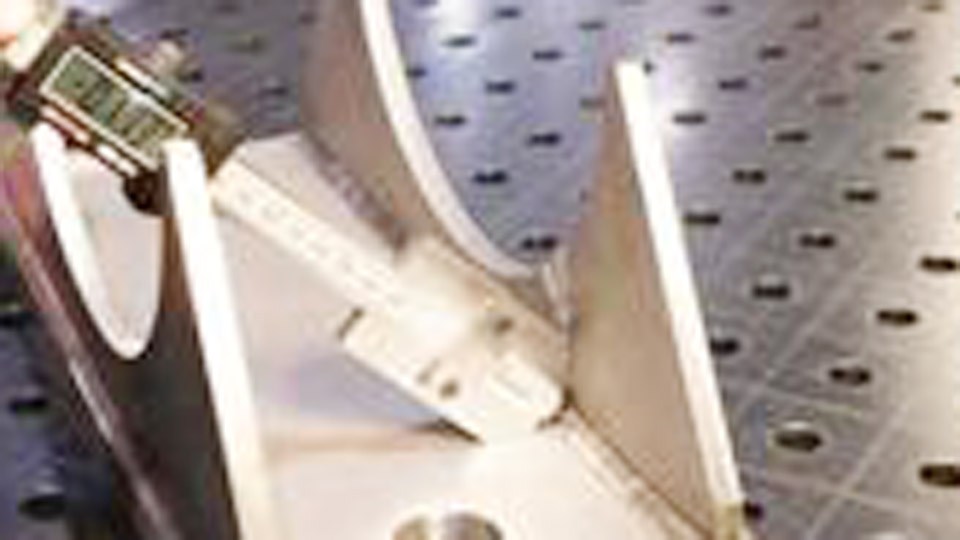
Image by thefabricator
Core Geometry That Links Leg Size to Theoretical Throat
Fillet welds join members at an angle, most often 90°. The cross-section is treated as a right isosceles triangle whose two equal sides are the legs.
Definition of Leg Length
Leg length is the distance measured along each fusion face from the root of the joint to the toe of the weld. On an equal-leg fillet the two legs are identical; the size called out on the welding symbol is this leg dimension.
Gauges measure it directly by placing a flat against one plate and a sliding pointer against the weld face on the other plate.
Definition of Theoretical Throat
Theoretical throat is the shortest distance from the root to the hypotenuse of the largest right triangle that can be inscribed inside the weld cross-section.
For a flat-faced equal-leg fillet this distance lies along the 45° bisector. Strength formulas use theoretical throat because it represents the minimum shear plane through the weld metal.
Exact Conversion Formulas
Trigonometry supplies the constant relationship for a 90° equal-leg fillet:
A ¼-inch (6.4 mm) leg therefore yields a theoretical throat of 0.177 inch (4.5 mm). A required throat of 5 mm demands a leg of approximately 7.1 mm.
Differences Between Theoretical, Effective, and Actual Throat
Codes distinguish three throat values; using the wrong one changes calculated capacity.
Theoretical Throat as Design Baseline
AWS D1.1 and AISC treat the theoretical throat of a prequalified fillet as 0.707 times the specified leg size, provided the weld is equal-leg and the joint angle is 60°–135°. No credit is taken for convexity, and no deduction is taken for normal root fusion.
Effective Throat When Penetration Is Proven
When a welding procedure (commonly SAW or certain FCAW) produces consistent root penetration beyond the original joint root, the effective throat may be increased by the measured penetration depth.
Qualification records or macro-etch specimens are required before the extra throat can be used in design. Concave faces reduce effective throat to the distance measured to the lowest point of the face.
Actual Throat Measured on the Finished Weld
Actual throat is the shortest physical distance from the finished root to the finished face. Inspectors record it with a throat gauge. Convexity is excluded from the effective value; concavity is included and may cause rejection if it drops the throat below the required minimum.
Minimum Fillet Sizes Required by Base-Metal Thickness
AWS D1.1 Table 5.8 (or equivalent in later editions) sets minimum leg sizes to ensure adequate heat input and fusion on thicker plates. These minima apply even when calculated strength would allow a smaller weld.
Thickness-Based Minimum Leg Sizes
| Base-metal thickness of thicker part joined | Minimum fillet leg size |
|---|---|
| ≤ ¼ in (6 mm) | ⅛ in (3 mm) |
| > ¼ in to ½ in (6–12 mm) | 3/16 in (5 mm) |
| > ½ in to ¾ in (12–20 mm) | ¼ in (6 mm) |
| > ¾ in (20 mm) | 5/16 in (8 mm) |
Cyclically loaded structures often carry an additional floor of 3/16 in (5 mm) regardless of thickness. The thinner member still governs maximum practical size; a fillet larger than the thinner plate thickness adds little strength and increases distortion.
When Calculated Size Exceeds the Minimum
Structural calculations that produce a required throat larger than the code minimum simply override the table. The designer converts that throat back to leg size with the 1.414 factor and rounds upward to the next standard increment (usually 1/16 in or 1 mm).
Handling Unequal-Leg and Non-90° Fillets
Not every fillet is isosceles or right-angled.
Unequal-Leg Geometry
When the two legs differ, theoretical throat is the shortest perpendicular distance from the root to the line joining the two toes. A conservative shop approximation multiplies the smaller leg by 0.707, then verifies the result with a sketch or CAD section.
The welding symbol lists both leg dimensions, larger leg first or with the longer leg on the side indicated by the symbol orientation.
Joint Angles Outside 90°
For dihedral angles between 60° and 135° the theoretical throat remains the perpendicular distance to the weld face. Outside that range the joint is usually detailed as a groove weld rather than a fillet.
The conversion factor 0.707 no longer applies; the designer must solve the actual triangle formed by the two fusion faces and the weld face.
Practical Measurement and Verification on the Shop Floor
Calculation is useless without reliable measurement after welding.
Gauge Techniques for Leg and Throat
A multi-purpose fillet gauge measures both legs and the throat in one placement. The leg scale is pressed against each plate in turn; the throat pointer contacts the face at the mid-point.
Readings are taken at several locations along the weld length because size can vary with travel speed and interpass temperature.
Acceptable Size Tolerances
AWS D1.1 permits undersize of up to 1/16 in (1.6 mm) for a limited portion of the weld length, provided the average size meets the specified value. Oversize is limited mainly by the maximum convexity table, which increases with leg size to control stress concentration at the toes.
Strength Calculation Using Throat Area
Once throat is known, allowable load follows directly.
Unit Strength of the Throat
AWS D1.1 allows a shear stress of 0.30 times the nominal tensile strength of the electrode (FEXX) on the effective throat. For E70XX electrodes the value is 21 ksi (145 MPa). Capacity per unit length is therefore:
A ¼-inch equal-leg fillet (throat 0.177 in) made with E70XX electrode carries approximately 3.7 kips per inch of length in pure longitudinal shear. Transverse loading receives a directional strength increase that can raise the allowable value by up to 50 %.
Effective Length Adjustment
Start and stop craters are not deducted under AWS D1.1 for continuous fillets; the full length is used. Some European codes deduct twice the leg size or twice the throat at each end. The governing code of the project decides which rule applies.
Decision Sequence for Selecting Final Leg or Throat Size
Begin with the required design load and electrode strength to obtain minimum throat. Convert to leg size with the 1.414 factor. Compare the result against the thickness-based minimum table and against the thickness of the thinner member.
Round upward to the next practical increment that the chosen process can deposit in one or two passes. After welding, confirm both legs and throat with a calibrated gauge.
If the measured throat falls short because of concavity, either build up the face or re-weld; do not rely on the larger leg dimension alone.
Correct conversion between leg and throat, combined with the thickness minima and verified penetration, produces fillet welds whose calculated capacity matches the as-built cross-section.
Advanced fabricators further optimize by qualifying deep-penetration procedures that allow a smaller leg while preserving the same effective throat, cutting both consumable cost and residual stress on thick restrained joints.