A bolt that spins freely in an engine block hole with no resistance signals stripped threads, and continuing to force it risks further damage to the casting or incomplete clamping force on critical components.
Knowing how to fix a stripped bolt hole in an engine block determines whether the repair restores original strength or creates a weak point that fails under thermal cycling and vibration.
Head bolts, main-cap fasteners, and accessory mounts demand full thread engagement to maintain sealing pressure and structural integrity; a failed repair can lead to coolant leaks, oil contamination, or warped decks.
The correct approach depends on damage severity, block material, and load requirements, ranging from simple thread chasing to solid inserts or weld-fill methods that restore a solid parent surface for retapping.
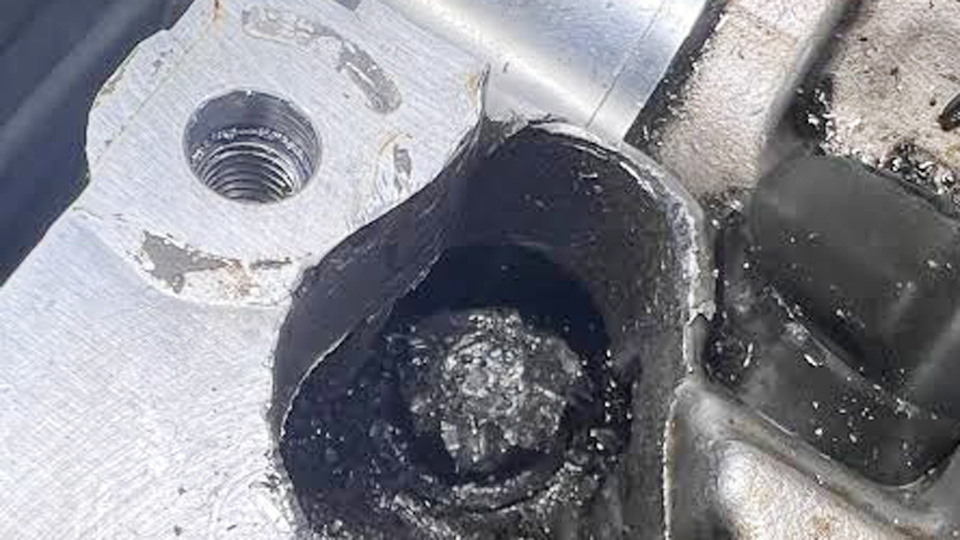
Image by CAR PROBLEM FIX AND HELP
Assessing Damage Severity and Block Material First
Thread condition and base-metal type dictate every subsequent decision. Blind guessing wastes time and enlarges the problem.
Identifying Minor Versus Complete Thread Loss
Minor damage shows as cross-threaded entry or a few damaged top threads; the bolt still engages partway and builds resistance. Complete stripping produces free spinning with zero torque resistance once the bolt enters. Use a thread pitch gauge and a new bolt of the correct size to confirm.
Debris, corrosion, or rolled-over crests often mimic stripping; a thread chaser or bottoming tap may restore function if enough original material remains. When more than half the engaged length is gone or the hole is out-of-round, inserts or weld repair become necessary.
Cast Iron Versus Aluminum Block Considerations
Cast iron blocks tolerate higher heat input but crack easily from rapid temperature change; aluminum blocks are softer, more prone to repeated stripping, and distort at lower temperatures. Aluminum also forms a tenacious oxide layer that interferes with weld fusion.
Wall thickness around the hole matters equally: thin sections near water jackets or oil galleries limit how far the hole can be enlarged before breakthrough. Measure remaining material with a depth micrometer or bore gauge before selecting an oversize method.
Choosing Between Thread Inserts for Most Engine Block Repairs
Thread inserts restore the original bolt diameter and pitch while placing harder threads into the softer parent metal. They remain the default professional choice for the majority of stripped engine holes.
Helicoil Wire Insert Performance Limits
A Helicoil kit drills the hole to a specified oversize, taps a special thread, and installs a stainless-steel wire coil that forms the new internal threads. The insert expands slightly against the parent metal and is locked by breaking off the installation tang.
Helicoils restore original bolt size and work well on moderate-load holes such as accessory brackets, valve covers, or oil-pan rails. They cost less and install faster than solid inserts.
Limitation: under repeated high-torque cycling or in soft aluminum, the coil can back out or unwind if the tang is not properly broken and the hole is not perfectly square.
Time-Sert Solid Insert Advantages on High-Load Fasteners
Time-Sert and similar solid bushing inserts use a thicker steel or stainless sleeve that is tapped into place and then mechanically expanded or cold-rolled at the bottom for positive locking. Installation requires a pilot drill, counterbore for the flange, special tap, and installation driver.
The solid body resists pull-out far better than a wire coil and is preferred for cylinder-head bolts, main bearing caps, and spark-plug holes in aluminum heads. Brand-specific kits exist for common engines; they maintain original bolt size and often exceed the strength of the original aluminum threads.
The trade-off is higher kit cost and the need for precise depth control so the flange seats flush without protruding into a mating surface.
When Oversizing the Hole and Changing Bolt Diameter Is Acceptable
If the surrounding wall thickness allows and the mating component can accept a larger fastener, drilling and tapping to the next standard size eliminates the need for an insert. Common steps move M8 to M10 or 5/16-inch to 3/8-inch.
The new threads are cut directly into fresh parent metal, producing full engagement length. This method fails when the hole is near a coolant passage, oil gallery, or another bolt hole; breakthrough ruins the casting.
Always verify clearance with a straightedge and feeler gauges or by reviewing the block casting drawing if available. Torque specifications must be recalculated for the larger fastener diameter to avoid over-clamping the joint.
Welding the Hole Closed and Re-Tapping for Severe or Repeated Failures
When previous inserts have failed, the hole is elongated, or wall thickness is insufficient for further enlargement, filling the void with weld metal and machining a new hole becomes the permanent solution. This approach is common in restoration and high-performance work where the block cannot be replaced.
Preheat, Filler Metal, and Technique for Cast Iron Blocks
Cast iron requires slow, even preheating to 400–600 °F (measured with temperature sticks or infrared) across a wide area to prevent quench cracking. Nickel-based electrodes (Ni-99 or Ni-55) or nickel rods for stick welding provide the necessary ductility; steel fillers crack.
Short stringer beads ½–1 inch long followed by immediate light peening relieve contraction stress. Allow the entire block to cool slowly under insulation—never quench.
Once cool, machine the weld flush, center-punch the original hole location using adjacent holes as reference, and drill and tap progressively to final size. Alignment must be held within 0.002–0.005 inch of perpendicular to the deck or the bolt will cock and leak.
Aluminum Block Welding Parameters and Distortion Control
Aluminum engine blocks demand TIG or pulsed MIG with AC polarity for oxide cleaning. Filler metals 4043 or 4943 reduce hot-cracking risk on common casting alloys such as A356. Preheat only to 200–300 °F maximum; higher temperatures accelerate distortion.
Use a short arc, low heat input, and skip welding to keep the heat-affected zone narrow. After cooling, the weld is soft relative to the original heat-treated casting, so the new threads should engage as much undamaged parent metal as possible.
A precision drill bushing or fixture referenced from undamaged holes is mandatory to keep the new centerline true.
Post-Weld Machining and Thread Quality Checks
After welding, the surface must be flat within the original deck or flange tolerance—typically 0.001–0.002 inch. Use a surface plate and dial indicator. Drill in progressive steps with cutting fluid, then tap with a high-quality spiral-point or bottoming tap under continuous lubrication.
Verify thread form with a go/no-go gauge and a new bolt torqued to 70–80 % of final specification before final assembly. Any binding or high spots indicate misalignment that must be corrected by reaming or further machining.
Controlling Alignment, Chip Evacuation, and Final Torque
Regardless of method, perpendicularity and cleanliness determine long-term success. A homemade or commercial drill guide that locates from adjacent holes keeps the new axis square.
Pack drill flutes and taps with grease on blind holes to capture chips; vacuum or blow out every chip before installing the insert or bolt.
On critical fasteners, apply the correct thread locker or anti-seize according to the service manual, then torque in stages to the published specification. Over-torquing a freshly repaired hole is the fastest way to strip it again.
Final Thoughts
The decision matrix is straightforward: chase minor damage, install a solid insert for high-load aluminum holes, oversize only when geometry permits, and weld-fill only when the parent metal is too compromised for mechanical inserts.
Matching the repair method to both the mechanical load and the metallurgy of the block produces a joint that survives thermal cycles and vibration without further intervention.
Advanced shops further improve longevity by lightly chamfering the top of the repaired hole and verifying that the bolt under-head radius clears the insert flange, eliminating a common stress riser that initiates new cracks.