Soldering copper joints often frustrates even experienced fabricators and plumbers when leaks appear after pressure testing or when the solder fails to flow evenly into the capillary gap.
This process, distinct from welding or brazing, relies on precise surface preparation, flux chemistry, heat control, and filler metal selection to create reliable, leak-free connections in plumbing, HVAC, or custom fabrication.
Mastering how to solder two pieces of copper together delivers strong, corrosion-resistant joints suitable for water, gas, or structural applications while avoiding distortion or weak bonds common in higher-temperature processes.
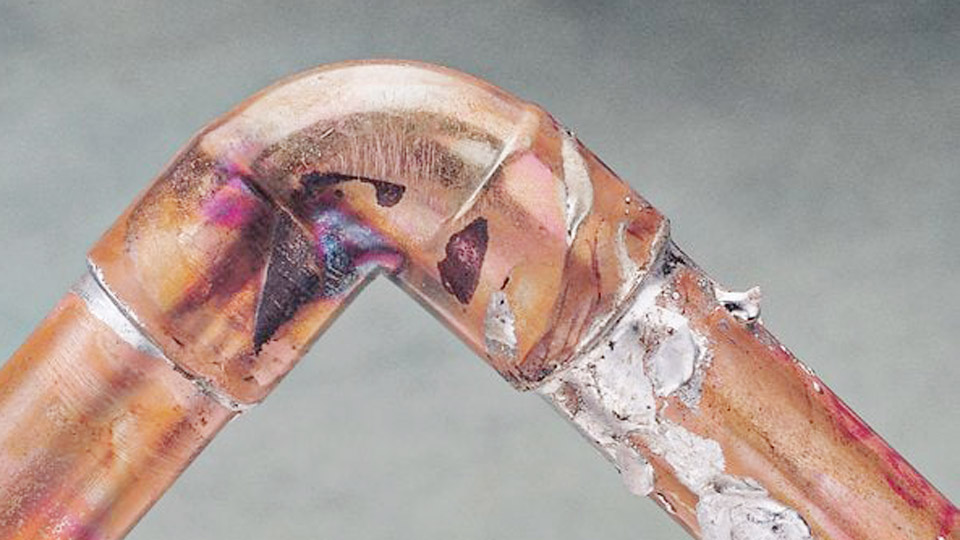
Image by familyhandyman
Understanding Soldering vs. Brazing for Copper
Temperature Thresholds and Joint Strength
Soldering uses filler metals that melt below 840°F (449°C), while brazing exceeds this threshold. For copper, soldering typically operates in the 350–500°F range depending on the alloy, preserving the base metal’s properties and minimizing heat-affected zones.
Brazing produces stronger joints for high-pressure or high-temperature service but risks annealing the copper and requiring more skill to manage thermal expansion.
Choose soldering for standard plumbing (up to 200–250 psi depending on pipe size and joint quality) and most DIY or hobby fabrication. Reserve brazing for applications exceeding 400°F service temperature or where mechanical strength demands a higher-melting filler.
When Soldering Makes Sense for Two Copper Pieces
Soldering excels with copper pipe-to-fitting connections, sheet lap joints, or seams in decorative or architectural work. It works effectively on Type K, L, or M copper tubing and sheet from 0.5 mm to several millimeters thick. For structural or load-bearing joints, consider mechanical reinforcement or brazing instead.
Essential Tools and Materials for Soldering Copper
Torch Selection and Heat Sources
A propane or MAPP gas torch provides the controlled heat needed for pipe joints. Smaller jobs (under 1-inch pipe) use a standard propane torch with a pencil tip; larger diameters require a larger tip or multiple passes to ensure even heating.
For sheet copper or precision work, soldering irons (electric or externally heated copper irons) or butane torches offer better control and reduce overheating risk.
Solder Alloys: Lead-Free vs. Traditional
Modern plumbing requires lead-free solder, typically tin-silver-copper (SAC) alloys like SAC305 with melting ranges around 420–460°F. These provide good flow but demand slightly higher temperatures and better heat management than older 50/50 or 60/40 tin-lead solders (melting ~360–370°F).
For non-potable or hobby applications, leaded solder flows more easily but is restricted in drinking water systems.
Wire solder (1/8-inch diameter common) allows precise application. Pre-mixed tinning pastes combine flux and solder powder for initial surface preparation.
Flux Types and Selection
Flux removes oxides, prevents re-oxidation, and promotes capillary action. Water-soluble fluxes clean easily after soldering and suit most plumbing. Tinning fluxes contain solder particles for challenging or larger joints.
Petroleum-based or inorganic acid fluxes (zinc chloride) handle heavily oxidized copper but require thorough post-cleaning to avoid corrosion.
Apply flux liberally but avoid excess that can trap inside pipes or cause buildup.
Cleaning and Preparation Tools
- Tubing cutter or hacksaw for clean cuts
- Deburring tool or file
- Emery cloth, sandpaper (120–220 grit), or wire brush for bright metal surfaces
- Flux brush
- Clean rags and water for post-cleanup
Preparing Copper Surfaces for Reliable Joints
Cutting and Deburring
Cut copper pipe square using a tubing cutter for minimal distortion. Deburr both inside and outside edges thoroughly—burrs prevent full insertion and create weak points or flow restrictions. For sheet copper, ensure edges are straight and mating surfaces overlap by at least 1/2 to 1 inch for lap joints.
Achieving Bright, Oxide-Free Surfaces
Oxides and oils block solder flow. Abrade both the pipe end (insert depth plus 1/2 inch) and fitting interior to shiny metal. For sheets, clean a wider area around the joint. Work quickly after cleaning—copper re-oxidizes rapidly in air. Avoid touching cleaned surfaces with bare hands.
Proper cleaning directly determines whether solder draws fully into the joint or beads on the surface.
Step-by-Step Process: Soldering Copper Pipe Joints
Assembly and Flux Application
Insert the cleaned pipe fully into the fitting. Rotate slightly while applying flux to both surfaces to ensure even coverage. The joint should fit snugly with a capillary gap of about 0.002–0.005 inches for optimal solder flow.
Heating Technique and Solder Application
Apply heat primarily to the fitting (higher mass) while moving the torch in a circular motion for even temperature. Heat the pipe end secondarily. Test readiness by touching solder to the joint opposite the flame—molten solder should flow freely when the joint reaches temperature.
Feed solder around the joint perimeter. Capillary action pulls it inward; a uniform silver ring indicates success. For 1/2-inch pipe, use roughly 1/2 inch of solder wire; scale accordingly for larger sizes. Avoid overheating, which burns flux and causes oxidation or leaks.
Remove heat immediately once filled. Allow natural cooling—quenching can crack joints.
Vertical, Overhead, and Tight Space Considerations
For vertical joints, start heating at the bottom and work upward. Overhead work requires planning sequences to avoid reaching over hot joints and extra care with molten solder drips. In confined spaces, use smaller tips or induction heating where available.
Soldering Copper Sheets and Fabricated Pieces
Lap Joints and Seams
For two flat copper pieces, clean overlapping areas extensively. Flux both, clamp or weight securely, and heat from one side or use dual torches for larger sheets. Apply solder along the edge; it should wick into the overlap. Tinning both surfaces first (applying a thin solder layer) improves results on large or tricky seams.
Maintain tight fit-up—gaps over 1/16 inch reduce strength significantly.
Using Soldering Irons for Sheet Work
Externally heated copper irons or large electric irons suit architectural copperwork. Tin the iron tip first, then run it along the seam with solder following. This method minimizes distortion compared to torch-only approaches on thin material.
Common Challenges and Technical Solutions
Achieving Full Penetration and Leak-Free Joints
Incomplete fill often stems from insufficient heat, poor cleaning, or water in the line. Dry pipes thoroughly before soldering—residual moisture prevents proper flow. Reheat and add more solder if needed, but avoid repeated cycles that degrade the joint.
Managing Heat on Different Copper Thicknesses and Types
Type M (thinner wall) heats faster than Type K. Larger diameters or fittings require more BTUs. Monitor color: dull red indicates excessive heat for soldering. Use heat sinks or wet rags on nearby joints to prevent disturbing previous work.
Post-Soldering Cleanup and Inspection
Wipe excess solder while warm for appearance, but prioritize removing flux residue with hot water and a brush or appropriate cleaner. Pressure test all plumbing joints. Visually inspect for full fillet and no pinholes.
Advanced Techniques and Decision Factors
Solder Quantity and Joint Design Optimization
Over-application creates internal protrusions that restrict flow; under-application leaves voids. Calculate based on pipe diameter and joint length. For high-reliability work, consider sweat soldering (pre-tinning) before final assembly.
Environmental and Code Considerations
Follow local plumbing codes for solder type in potable water systems. Lead-free is mandatory in most jurisdictions. Ventilation remains critical due to flux fumes, especially indoors.
Scaling for Professional or Repetitive Work
Batch preparation, consistent torch technique, and quality flux reduce failure rates. Experienced welders often develop preferences for specific flux-solder combinations based on climate and joint size—test on scrap for critical projects.
Choosing the Right Approach for Your Project
Evaluate service conditions: pressure, temperature, fluid type, and accessibility. Pipe soldering prioritizes speed and capillary reliability; sheet work emphasizes fit-up and controlled heat input. Lead-free alloys demand practice for flow characteristics but meet modern standards.
Mastering these variables separates functional joints from professional, long-lasting ones. Experiment with scrap copper to dial in your heat control and flux application before tackling visible or pressurized work. This technical foundation supports both hobby fabrication and professional installations with confidence.
FAQ
What is the correct temperature for soldering copper pipes?
Aim for the joint to reach roughly 400–500°F so lead-free solder flows properly. Use the solder itself as the indicator rather than a precise thermometer—when it melts and draws in easily, the temperature is right. Avoid exceeding temperatures that discolor the copper excessively.
Can you solder copper without flux?
No. Flux cleans oxides and enables capillary action. Without it, solder will not bond reliably or penetrate the joint, leading to immediate or eventual leaks.
How much solder do you need per joint?
A general guideline is one diameter length of wire solder per joint (e.g., 3/4 inch for 3/4-inch pipe). This provides enough to fill the capillary space without excess.
Is soldering copper pipes different from soldering copper sheets?
Yes. Pipe joints rely on fittings and capillary action with torch heat. Sheet seams often use lap joints, irons or torches, and sometimes pre-tinning for larger areas. Fit-up tolerances and distortion control differ significantly between the two.