Determining the Maximum Fillet Weld Size for Plate Thickness is a technical specification issue that directly affects joint strength, distortion control, and code compliance in fabrication work.
In real welding applications, oversizing a fillet weld beyond what the base metal can support can lead to excessive heat input, reduced fatigue performance, and unnecessary filler metal consumption.
Undersizing, on the other hand, risks failure under load and inspection rejection. This balance becomes critical in structural steel, pressure vessels, and heavy fabrication where plate thickness dictates allowable weld geometry and heat distribution.
Understanding these limits is essential for maintaining proper penetration, avoiding lamellar tearing, and ensuring consistent arc stability across varying joint configurations.
In the sections ahead, you will see how plate thickness governs fillet weld sizing, how standards define maximum limits, and how to apply these values in practical shop conditions without compromising performance or efficiency.
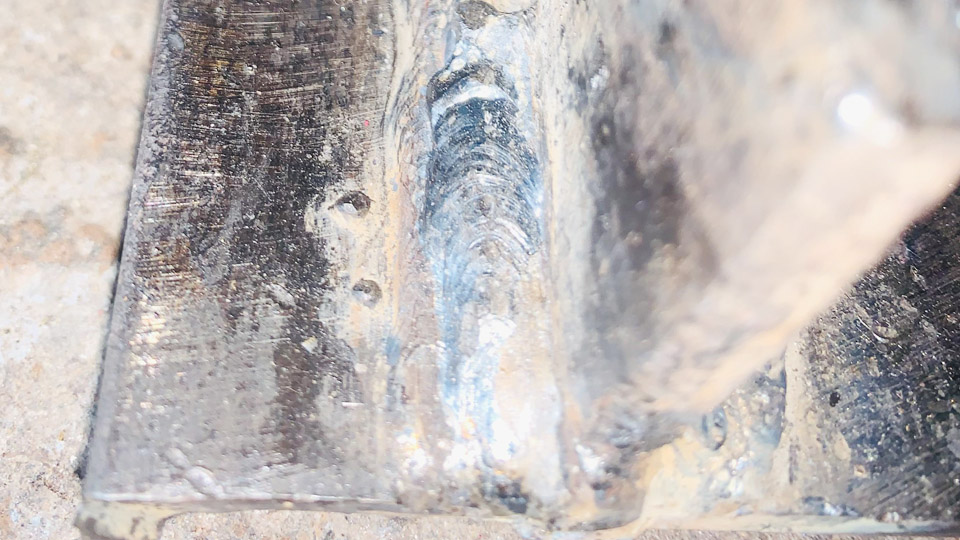
Image by reddit
Why Fillet Weld Size Limits Matter in Practice
Fillet welds transfer shear loads primarily through the throat. Their effective size depends on leg length, actual throat dimension, and plate thickness constraints. Codes like AWS D1.1 impose rules to prevent incomplete fusion, edge melting, and rapid cooling cracks.
Professionals must balance design requirements with practical welding variables such as process, position, and electrode diameter.
Understanding Fillet Weld Dimensions and Terminology
Leg Size vs. Throat Size
Fillet weld size is conventionally measured by the leg length—the distance from the root to the toe along the plate surface. For a theoretical isosceles right-triangle fillet (mitre profile), the throat equals leg length × 0.707. This 45-degree throat provides the effective load-bearing section.
In convex fillets, the leg size overstates the true throat. In concave fillets, it understates strength. Inspectors often verify both legs and calculate the effective throat for critical joints. Real-world measurements use fillet weld gauges that check the largest inscribed triangle.
Effective Throat and Theoretical vs. Actual
Design calculations use the theoretical throat, but production welds include convexity or concavity. AWS D1.1 allows slight convexity while maintaining minimum throat requirements. For maximum size considerations, excessive convexity wastes metal without proportionally increasing strength.
Deep penetration processes (e.g., certain FCAW or SAW) can increase effective throat beyond the visible leg, allowing smaller nominal sizes for equivalent strength.
Code Requirements for Maximum Fillet Weld Size
AWS D1.1 Limitations Along Edges
AWS D1.1 restricts maximum fillet weld size along edges of lap joints to prevent melting away the plate corner, which reduces actual throat. For material thinner than 1/4 inch (6 mm), maximum size equals plate thickness. For 1/4 inch and thicker, maximum size is plate thickness minus 1/16 inch (1.6 mm), unless the weld is detailed to build out for full throat.
This rule applies specifically to edge placements in lap joints. In T-joints or interior applications with sufficient plate width, larger welds are possible if needed for strength, though practicality and distortion often limit them.
AISC and Other Standards Alignment
AISC specifications mirror these edge limitations for structural steel. The intent protects against apparent full-size welds that lack adequate throat due to edge erosion. In non-lap configurations or when plates provide adequate backing, engineers can specify larger effective throats through multi-pass techniques.
Minimum vs. Maximum Fillet Weld Size: Key Distinctions
AWS D1.1 Minimum Size Table
While the query focuses on maximum size, minimums provide essential context for balanced decisions:
| Base Metal Thickness (T) | Minimum Fillet Weld Size |
|---|---|
| T < 1/4 in (6 mm) | 1/8 in (3 mm) |
| 1/4 ≤ T < 1/2 in | 3/16 in (5 mm) |
| 1/2 ≤ T < 3/4 in | 1/4 in (6 mm) |
| T ≥ 3/4 in | 5/16 in (8 mm) |
These minima address hydrogen cracking risks by ensuring sufficient heat input. For non-low-hydrogen processes without preheat, use the thicker part joined for determination.
When Maximum Size Becomes the Constraint
Maximum practical size often exceeds code edge limits due to process capabilities. Single-pass fillets rarely exceed 3/8 inch (10 mm) leg size reliably in horizontal positions without defects. Larger requirements demand multi-pass welding.
Factors Influencing Maximum Practical Fillet Size
Welding Process and Single-Pass Capabilities
SMAW: Limited to about 1/4–5/16 inch single-pass depending on electrode diameter and position. Larger sizes require multiple passes with interpass cleaning.
FCAW-G: With 1/16 inch or larger wire, single-pass up to 1/2 inch is feasible in flat or horizontal positions if heat input is controlled. Smaller wires (0.035–0.045 inch) max out around 1/4–5/16 inch.
GMAW: Similar limits; spray transfer helps larger single-pass but risks lack of fusion if parameters drift.
SAW: Supports the largest single-pass fillets, often exceeding 1/2 inch with proper flux and power.
Plate Thickness and Heat Sink Effects
Thicker plates act as better heat sinks, allowing larger welds with less distortion risk but requiring more energy for penetration. On thin plates (<1/4 inch), maximum size is inherently capped by burn-through risk and the edge rules above. Excessively large fillets on thin material cause warping and reduce fatigue life.
Joint Configuration and Position
- Lap Joints (edge welds): Strictest limits per code.
- T-Joints: More forgiving if the stem provides support.
- Horizontal (2F): Easier for larger sizes than vertical or overhead.
- Vertical Up: Multi-pass essential beyond 1/4 inch; weave techniques help control.
Calculating Required Fillet Weld Size for Strength
Strength-Based Sizing
Fillet weld allowable shear strength (per AWS/AISC) is typically 0.30 × electrode tensile strength × effective throat area. For E70XX electrodes, this yields approximately 21–30 ksi allowable shear depending on code.
To achieve full plate strength in shear (rule-of-thumb context), fillet leg size often equals about 3/4 of the thinner plate thickness. Example: For 1/2 inch plate, a 3/8 inch leg approximates full strength in many carbon steel applications.
This is not universal—actual calculations must consider load type (static vs. cyclic), eccentricity, and combined stresses.
Throat Area Formulas
Effective area = effective throat × weld length.
For 45° mitre: throat = 0.707 × leg.
Required leg = (Load / (Strength factor × length × 0.707))
Engineers use software or tables for precise values, but welders should understand the inverse relationship: small throat increases dramatically affect capacity due to the squared area term in volume calculations.
Multi-Pass Techniques for Larger Fillet Welds
Larger than single-pass limits require layering. Root pass establishes fusion, followed by fill and cap passes. Key considerations:
- Maintain interpass temperature to control HAZ.
- Use stringer beads for better properties in high-strength steels.
- Stagger starts/stops to avoid stress concentrations.
- Monitor for slag inclusions in FCAW.
For plates over 3/4 inch requiring >5/16 inch fillets, multi-pass becomes mandatory for quality.
Material-Specific Considerations
Carbon and Low-Alloy Steels
Higher carbon equivalents increase cracking sensitivity, making minimum size rules more critical. Maximum sizes are governed more by distortion than strength.
Stainless Steels
Lower thermal conductivity requires tighter heat control. Larger fillets increase sensitization risk in 300-series; use stringers and control interpass temps below 350°F.
Aluminum
Higher heat conductivity and lower strength demand different sizing. AWS D1.2 has separate acceptance criteria; maximum sizes limited by burn-through and distortion more severely than steel.
Inspection and Acceptance of Fillet Weld Sizes
Visual inspection checks leg sizes with gauges. Undersize allowances exist (e.g., 1/16 inch for 3/16 inch welds for limited lengths). Oversize is rarely rejected if profile and fusion are acceptable, but it impacts economics and distortion.
Ultrasonic or magnetic particle testing verifies root fusion in critical applications where maximum size was pushed for strength.
Common Decision Points in Fabrication
When to Specify Larger Than Minimum
- High shear loads
- Fatigue-prone cyclic loading (may need larger to reduce stress)
- Corrosion allowance in certain environments
When to Stay Conservative
- Thin materials prone to distortion
- Cost-sensitive projects
- Positions difficult for multi-pass
Practical Examples by Plate Thickness
1/8 inch Plate: Maximum leg typically 1/8 inch. Use 1/16–3/32 inch for most applications to avoid burn-through.
1/4 inch Plate: Edge max 1/4 inch, but 3/16 inch common. Code minimum 1/8 or 3/16 inch.
1/2 inch Plate: Edge max ~7/16 inch. Practical multi-pass up to 3/8–1/2 inch leg for full strength.
1 inch+ Plate: No practical upper limit beyond economics and distortion, but 5/16 inch minimum applies. Large welds use multi-layer techniques with peening if needed.
Welding Parameters for Achieving Target Sizes
Voltage, amperage, travel speed, and stickout directly influence bead size. For example, increasing wire feed speed in FCAW builds larger beads but risks cold laps if travel speed doesn’t match. Always qualify procedures for critical maximum-size welds.
FAQ
What is the maximum fillet weld size along the edge of a 3/8 inch plate?
Per AWS D1.1 and AISC, 3/8 inch minus 1/16 inch = 5/16 inch, unless built out for full throat.
Does plate thickness directly determine maximum fillet weld size?
It caps size along edges in lap joints. In other configurations, strength requirements and process limits govern more than thickness alone.
Can you make a fillet weld larger than the thinner plate thickness?
Yes, in non-edge applications or with proper build-out. However, the weld metal may not add proportional strength if base metal becomes the limiting factor.
How does multi-pass welding affect maximum achievable fillet size?
It removes single-pass limitations, allowing virtually unlimited size (subject to distortion and economics) while maintaining quality through controlled layers.
Wrapping Up
Maximum fillet weld size for plate thickness decisions ultimately balance code rules, calculated loads, process capabilities, and real-world constraints. Select sizes based on engineering requirements rather than rules of thumb alone.
In high-performance fabrication, the most advanced insight comes from recognizing that effective throat and fusion quality trump visible leg size—optimizing for both strength and productivity often means multi-pass welds with precise parameter control on thicker plates, where heat management determines success more than any single dimension.