Choosing the wrong TIG filler rod produces cracks, lack of fusion, or corrosion failures even when amperage and technique appear correct.
A precise TIG welding filler rod selection chart links base-metal chemistry, required mechanical properties, and rod diameter so the deposited weld metal matches or appropriately under-matches the parent material.
Incorrect selection turns a clean TIG puddle into a joint that fails bend tests, leaks under pressure, or develops intergranular corrosion months later.
Matching AWS classification to the alloy and sizing the rod to thickness controls dilution, heat input, and final strength without guesswork.
Which Filler Rod Matches Common Base Metals
Base-metal identification is the first decision. AWS classifications define chemistry and minimum tensile strength; using the wrong family guarantees metallurgical mismatch.
Mild and Low-Carbon Steel Choices
ER70S-2 and ER70S-6 both deliver approximately 70 ksi tensile strength under AWS A5.18. ER70S-2 carries triple deoxidizers (aluminum, titanium, zirconium) and lower silicon, producing a cleaner puddle on root passes or lightly contaminated surfaces.
ER70S-6 contains higher silicon and manganese for improved wetting and fluidity on clean mill-scale plate. For ordinary A36, 1018, or 1020 fabrication, either works; ER70S-2 is preferred when the joint will see radiographic inspection or when residual oxides remain after grinding.
Stainless Steel Grade Matching
ER308L is the standard choice for 304 and 304L austenitic stainless. The “L” designation limits carbon to 0.03 % maximum, reducing carbide precipitation in the heat-affected zone during multi-pass welding. ER316L adds 2–3 % molybdenum for chloride environments such as marine hardware or chemical process tubing.
When joining stainless to carbon steel, ER309L provides higher chromium and nickel to tolerate dilution and prevent martensite formation in the fusion zone. Duplex 2205 requires ER2209 to maintain the balanced ferrite-austenite microstructure.
Aluminum Alloy Decisions
ER4043 (approximately 5 % silicon) offers high fluidity and reduced cracking tendency on 6xxx-series alloys such as 6061. It produces a smooth, bright bead and is forgiving of minor fit-up variation.
ER5356 (approximately 5 % magnesium) delivers higher as-welded strength and better color match after anodizing, making it the preferred rod for 5xxx-series sheet and structural 6061 when post-weld strength is critical. Avoid both on most 2xxx and 7xxx series alloys because of hot-cracking susceptibility.
Specialty and Dissimilar Combinations
4130 chromoly tubing commonly uses ER80S-D2 for strength retention after heat treatment, although some procedures accept ER70S-2 when post-weld heat treatment is not applied.
Titanium grades require matching ERTi-2, ERTi-5, or ERTi-23 fillers and absolute inert-gas coverage. Silicon-bronze (ERCuSi-A) serves for copper-to-steel or decorative joints where color and flow are priorities.
How Base-Metal Thickness Determines Filler Rod Diameter
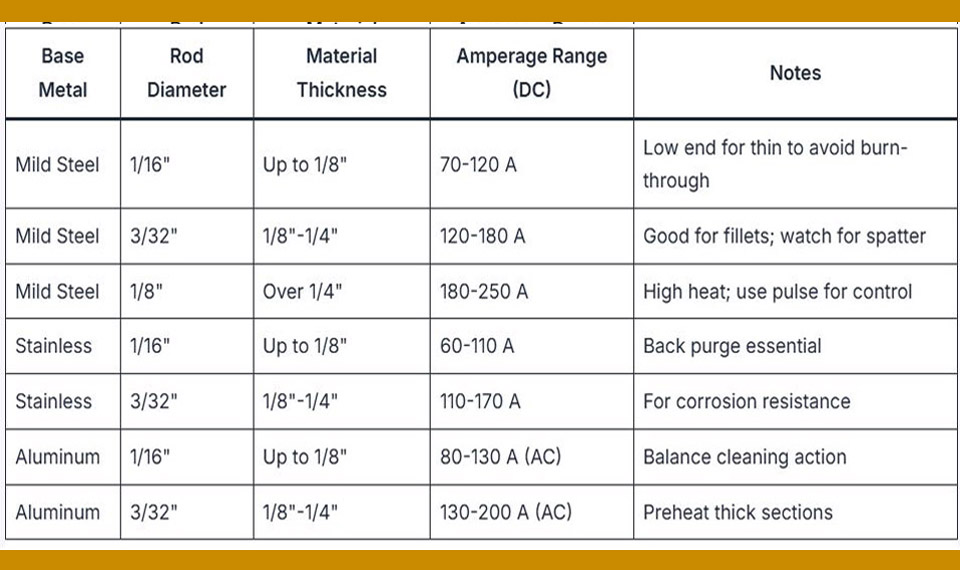
Rod diameter controls melt-off rate relative to the available heat. An oversized rod chills the puddle and produces cold laps; an undersized rod forces excessive amperage or multiple passes that raise heat input.
Diameter Guidelines for Carbon and Stainless Steel
| Base Metal Thickness | Recommended Filler Diameter | Typical Starting Amperage (DCEN) |
|---|---|---|
| Up to 1/16″ | 0.045″ or 1/16″ | 40–90 A |
| 3/32″–1/8″ | 1/16″ or 3/32″ | 80–140 A |
| 3/16″ | 1/8″ | 150–220 A |
| 1/4″ | 3/16″ | 200–280 A |
| 1/2″ and thicker | 1/4″ or multi-pass smaller | 250 A+ |
On stainless sheet, drop one diameter size relative to carbon steel at the same thickness because lower amperage is normally used and a large rod freezes the puddle prematurely.
Aluminum Diameter Adjustments
Aluminum’s high thermal conductivity often allows the same or one size larger rod than steel at equivalent thickness. 1/16″ rod handles 0.040″–1/16″ sheet cleanly; 3/32″ covers most 1/8″ work. When the rod balls excessively before reaching the puddle, increase diameter one step or tighten the arc length rather than raising amperage further.
Multi-Pass and Open-Root Considerations
On heavy plate, root passes frequently use a smaller diameter (1/16″ or 3/32″) for precise control and reduced dilution, then step up for fill and cap passes. Open-root pipe joints benefit from the smaller rod to maintain a consistent keyhole without excessive reinforcement.
Performance Differences Between Closely Related Filler Grades
Two rods that appear interchangeable can produce measurable differences in bead profile, toughness, and service life.
ER70S-2 Versus ER70S-6 on Carbon Steel
ER70S-2 yields a quieter arc and less silicon islands on the bead surface, advantageous for root passes that will be radiographed. ER70S-6 spreads more readily and tolerates residual mill scale better, reducing the need for complete oxide removal on non-critical structural work.
When the procedure specifies impact toughness at low temperature, verify the specific heat and lot against the WPS; both classifications meet the basic 70 ksi requirement but differ in residual deoxidizer content.
ER4043 Versus ER5356 on Aluminum
ER4043 melts at a lower temperature and flows with less operator input, reducing the chance of incomplete fusion on poorly fitted joints. Its lower strength is acceptable for many non-structural 6061 assemblies.
ER5356 retains higher magnesium and therefore higher tensile and shear strength, but it is more sensitive to hot cracking if joint restraint is high and is less fluid. Anodizing color match is noticeably better with 5356 on 5xxx alloys.
Low-Carbon “L” Grades on Stainless
Using non-L ER308 or ER316 on multi-pass or heavy-section stainless allows carbon to combine with chromium at grain boundaries during the critical temperature range, creating chromium-depleted zones susceptible to intergranular corrosion.
The L grades keep carbon low enough that this reaction remains negligible under normal TIG heat-input ranges.
Joint Design and Dilution Effects on Filler Selection
Dilution from the base metal alters the final weld-metal chemistry. High-dilution joints (open-root or high-amperage) require fillers with greater alloying reserve.
Dissimilar Metal Joints
Stainless-to-carbon steel transitions almost always call for ER309L. The elevated chromium and nickel content absorbs carbon dilution from the mild-steel side without forming brittle martensite. Nickel-based fillers such as ERNiCrMo-3 become necessary only when service temperatures or corrosion conditions exceed the capability of 309L.
High-Restraint or Crack-Sensitive Joints
Thick sections or highly restrained geometries increase residual stress. On aluminum, ER4043’s higher silicon content improves resistance to solidification cracking compared with ER5356.
On carbon steel, the triple-deoxidized ER70S-2 reduces the risk of porosity that can act as crack initiation sites under high restraint.
Corrosion and Temperature Service Limits
Marine or chemical exposure on 316 stainless requires the molybdenum-bearing ER316L. Elevated-temperature service on certain low-alloy steels may demand ER80S-D2 or ER90S-B3 rather than a standard 70-series rod so that creep strength is retained.
Always cross-check the filler against the maximum service temperature listed in the manufacturer data sheet.
Practical Selection Sequence for Shop and Field Work
- Identify the exact base-metal grade (not simply “steel” or “aluminum”).
- Determine required tensile strength, corrosion resistance, and any post-weld heat-treatment or anodizing requirements.
- Select the AWS classification that satisfies chemistry and mechanical properties.
- Choose diameter from the thickness table, adjusting one size smaller for thin stainless or one size larger for thick aluminum if puddle behavior demands it.
- Confirm shielding-gas purity and tungsten type are compatible with the chosen filler; 100 % argon remains standard for most carbon, stainless, and aluminum TIG applications.
- Run a test coupon on scrap of identical thickness and joint geometry before committing to the production piece.
This sequence eliminates the most common sources of rejectable welds: chemistry mismatch, incorrect heat input from oversized rod, and unexpected dilution effects.
Wrappping Up
Correct filler selection is a metallurgical decision, not a matter of convenience or stock availability. When the rod chemistry, diameter, and joint design align, the TIG process delivers its characteristic clean, high-integrity deposit with minimal post-weld cleanup.
Advanced operators further refine performance by matching filler silicon or magnesium content to the exact thermal cycle of the joint, ensuring both as-welded properties and long-term service reliability exceed the minimums of the governing code.
FAQs
What TIG filler rod for 6061 aluminum?
ER4043 for general fabrication and crack resistance; ER5356 when higher strength or better anodizing color match is required.
ER70S-2 or ER70S-6 for mild steel TIG?
ER70S-2 for clean root passes and critical inspection; ER70S-6 for better wetting on mill-scale or lightly oxidized surfaces.
What size TIG filler rod for 1/8″ steel?
3/32″ is the most common starting diameter; 1/16″ may be used for precise root control or open-root joints.
Can I use the same TIG filler for stainless and carbon steel?
No. Use ER308L or ER316L for matching stainless grades and ER309L specifically for stainless-to-carbon dissimilar joints.