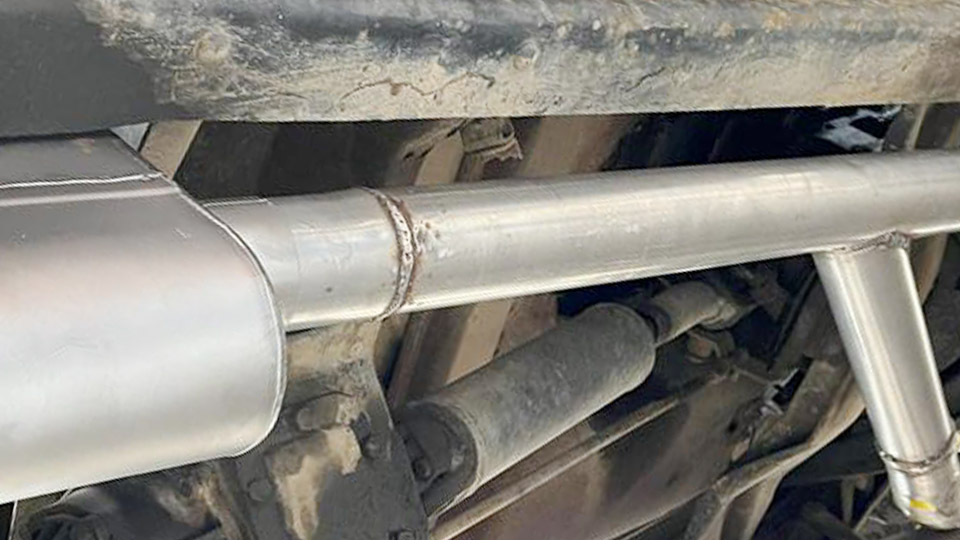
A cracked aluminum intake manifold, radiator tank, or bracket often forces the same decision: attempt a cold repair with epoxy or commit to proper TIG or MIG welding. Many reach for JB Weld because it claims high tensile strength and bonds to aluminum without heat.
The real question—how strong is JB Weld on aluminum—cannot be answered by the package PSI number alone. That rating reflects a laboratory test specimen, not a field joint under peel, vibration, thermal cycling, or residual oxide. Understanding the difference determines whether the repair lasts or fails under load.
JB Weld is a steel-reinforced two-part epoxy, not a fusion weld. Its cured bond relies entirely on surface adhesion. On aluminum the oxide layer, joint geometry, load direction, and temperature control the outcome far more than the headline strength figure.
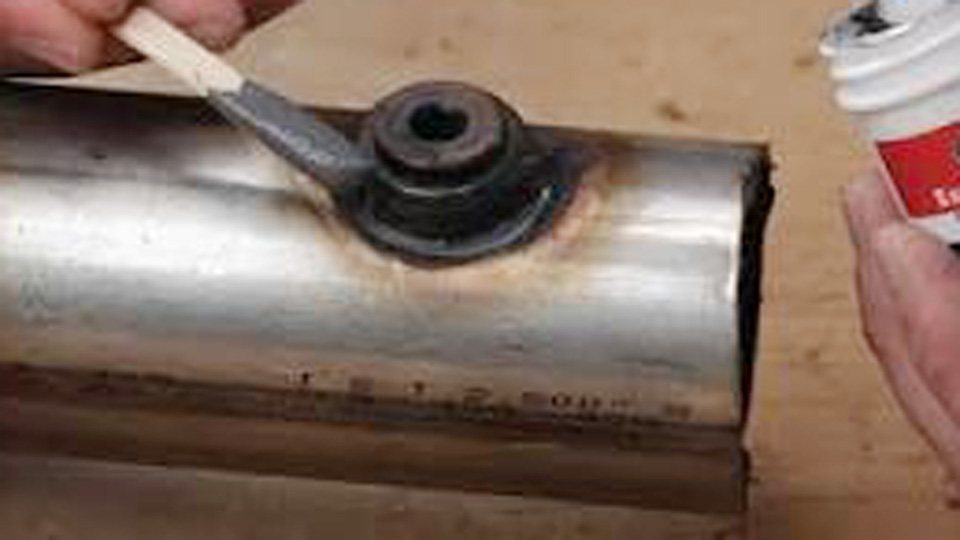
Image by kelloggsupplyco
Manufacturer Strength Ratings Versus Actual Joint Capacity
Published numbers vary by product version and testing standard. They describe the epoxy under controlled conditions, not the safe working load of a repaired aluminum part.
Official Tensile and Shear Values
Older technical data sheets list tensile strength (ASTM D638) at 3,960 psi. Current packaging and marketing for Original Cold-Weld commonly state 5,020 psi or, on some Twin-Tube labels, 6,220 psi.
Lap-shear data on aluminum (ASTM D1002) from the same technical literature shows approximately 1,367 psi after elevated-temperature exposure at 400 °F and only 580 psi at 550 °F. These shear numbers are more relevant to most repairs than pure tensile values because real joints rarely experience pure tension.
Why Package PSI Cannot Be Multiplied by Bond Area
A 1-square-inch overlap rated at 5,000 psi does not safely carry 5,000 pounds. Stress concentrates at the edges of the bond line. Peel and cleavage loads reduce capacity dramatically. Gaps, incomplete wetting, or residual oxide further lower performance.
Design codes treat adhesive joints with substantial safety factors precisely because laboratory coupon results do not translate directly to service loads.
Effect of Cure Time and Temperature on Final Strength
Full mechanical properties develop only after the complete 15–24 hour room-temperature cure. Handling strength appears in 4–6 hours, but the bond continues to gain strength overnight. Elevated cure temperatures accelerate the process yet must stay within the product’s thermal limits to avoid incomplete cross-linking.
Temperature Limits and Strength Loss on Aluminum
Heat is the most common reason JB Weld fails on aluminum components near engines or exhaust systems.
Continuous Versus Intermittent Temperature Ratings
Original JB Weld is rated for continuous service near 500 °F (260 °C) and short intermittent peaks of 550–600 °F. Strength declines as temperature rises. Lap-shear values already drop sharply by 550 °F. Thermal cycling that expands and contracts the aluminum substrate adds interfacial stress that the rigid epoxy cannot accommodate indefinitely.
High-Heat Product Variants
JB Weld HighHeat and ExtremeHeat formulations raise the temperature ceiling, with some claiming resistance well above 1,000 °F. Tensile ratings for these products typically fall in the 4,000–4,700 psi range—still far below welded aluminum. They remain adhesives and share the same surface-preparation and load-direction limitations.
Practical Temperature Decision Threshold
Any aluminum part that routinely exceeds 300–350 °F under load should be evaluated for welding rather than epoxy. Radiator tanks, certain intake components, and exhaust-adjacent brackets frequently exceed the reliable working range of standard JB Weld.
Surface Preparation Requirements Specific to Aluminum
Aluminum’s tenacious oxide layer is the primary obstacle to adhesion. Without mechanical and chemical preparation the bond relies on a weak oxide interface that fails under modest stress.
Mechanical Abrasion Steps
Remove all paint, corrosion, and oxide with 80–120 grit abrasive or a stainless-steel wire brush dedicated to aluminum. The goal is a fresh, dull metal surface with visible scratches that increase surface area. Anodized coatings must be completely removed in the bond zone; the anodic layer itself does not provide a reliable adhesive substrate.
Solvent Cleaning Sequence
After abrasion, degrease with acetone, isopropyl alcohol, or a dedicated aluminum cleaner. Avoid contaminating the surface with bare hands. Apply the mixed epoxy within minutes of final cleaning so the oxide layer cannot reform appreciably.
Gap-Filling Versus Close-Fitting Joints
JB Weld can bridge small gaps, but thicker bond lines reduce shear strength. For maximum capacity the joint should be as close-fitting as practical while still allowing complete wetting. Large voids or uneven coverage create stress risers that initiate failure.
Load Types That Control Failure on Aluminum Repairs
Different loading modes produce different failure modes. Tensile ratings alone mislead when the joint experiences peel or cyclic loading.
Shear and Tensile Performance
Lap-shear is the most favorable loading for epoxy. Overlap joints with adequate bond area and minimal edge peeling can approach the published shear values when preparation is correct. Pure tensile loading is less common in field repairs but is the basis for the higher package numbers.
Peel, Cleavage, and Impact Sensitivity
Rigid epoxies perform poorly under peel. A force that lifts one edge of the bond line concentrates stress at a single line and can unzip the joint at loads far below the tensile rating.
Impact and vibration introduce fatigue cracks that propagate through the brittle cured epoxy. Aluminum parts that flex or experience road vibration are therefore poor candidates for epoxy-only repairs.
Vibration and Fatigue Considerations
Continuous vibration, common on engine-mounted aluminum components, can initiate micro-cracks even when static strength appears adequate. Mechanical fasteners or a properly designed welded joint distribute cyclic loads more effectively.
When JB Weld Is Adequate and When Welding Is Required
The decision hinges on consequence of failure, operating temperature, and load type rather than the advertised PSI number.
Suitable Non-Critical Applications
Small static repairs—minor casting porosity, non-pressurized covers, decorative trim, or low-load brackets—can succeed with thorough preparation and full cure. Gap-filling of non-structural voids and temporary holding of parts prior to mechanical fastening are also appropriate uses.
Applications That Demand Fusion Welding
Any pressurized system, structural member, suspension component, or part subject to significant heat or vibration should be welded. AWS structural aluminum codes specify tensile strengths in the 30–40 ksi range for many common alloys—roughly six to ten times the adhesive rating.
Fusion welding restores continuity of the base metal and can match or exceed parent-metal strength when proper filler and technique are used.
Hybrid Approaches
In some cases mechanical fasteners carry the primary load while epoxy seals and dampens movement. This combination is more reliable than epoxy alone on aluminum parts that experience mixed loading.
Product Variants and Their Practical Differences
Not every gray epoxy tube labeled JB Weld shares identical properties.
Original Cold-Weld Versus KwikWeld
Original provides the highest tensile rating (commonly listed 5,020–6,220 psi) and longer working time. KwikWeld sets in minutes and reaches handling strength faster but carries a lower tensile rating, typically around 2,400–3,100 psi. The faster product sacrifices ultimate strength for speed.
Marine and High-Heat Formulations
MarineWeld maintains similar tensile strength while improving moisture resistance. HighHeat versions raise temperature capability at the cost of slightly lower room-temperature strength in some formulations. Always verify the exact product data sheet rather than assuming interchangeability.
Choosing the correct product still cannot overcome inadequate surface preparation or unsuitable joint design. The epoxy remains limited by adhesion physics regardless of marketing claims.
Wrapping Up
JB Weld on aluminum delivers usable strength only under static, moderate-temperature, well-prepared conditions with favorable loading. For any repair where failure carries safety, pressure, or structural consequences, the performance gap between a 4,000–6,000 psi adhesive bond and a properly executed aluminum weld remains decisive.
Advanced operators treat epoxy as a temporary or non-critical solution and design the joint so that the adhesive never becomes the sole load path under cyclic or elevated-temperature service.
FAQs
Does JB Weld work on anodized aluminum?
Only after the anodized layer is completely removed by abrasion in the bond area. The coating itself prevents reliable adhesion.
How long does JB Weld take to reach full strength on aluminum?
Handling strength develops in 4–6 hours at room temperature; full mechanical properties require 15–24 hours. Do not load the joint until the full cure is complete.
Can JB Weld repair a cracked aluminum engine block?
It can seal minor external cracks in non-critical zones under low stress and moderate temperature, but it is not a structural repair. Pressure, vibration, and heat usually demand welding or replacement.
Is JB Weld stronger than aluminum welding?
No. Proper TIG or MIG welds on common aluminum alloys routinely achieve 30,000–40,000 psi tensile strength—several times higher than the adhesive rating—and restore metal continuity rather than relying on surface adhesion.