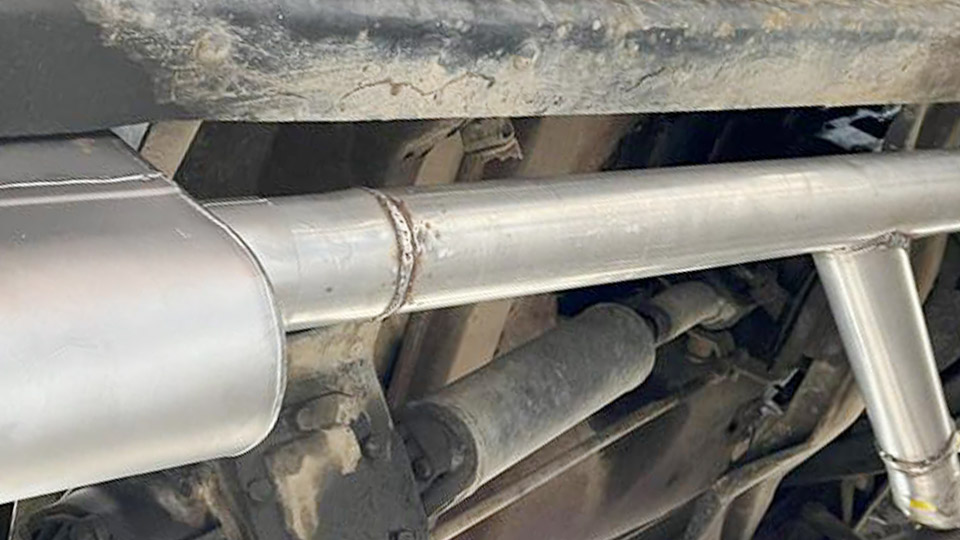
A cracked exhaust manifold or leaking muffler often appears at the worst time, when welding equipment is unavailable or the casting is too thin and contaminated for a reliable fusion weld.
How to use JB Weld ExtremeHeat correctly turns that temporary failure into a durable seal that survives continuous exposure up to 1000°F (537°C).
Improper surface preparation or incomplete mixing leaves the repair soft under heat cycling, while correct technique produces a metallic compound that can later be drilled or sanded.
The difference between a short-lived patch and a serviceable fix is measured in cleaning thoroughness, paste consistency, and strict adherence to the 24-hour full-cure window before returning the part to high-heat service.
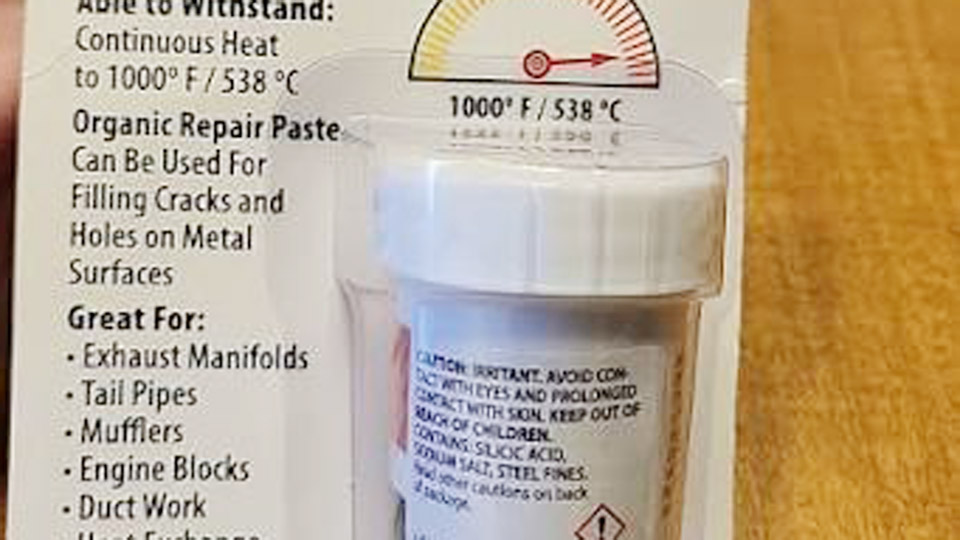
Image by sensorsllc
Surface Preparation Requirements That Determine Bond Strength
ExtremeHeat bonds mechanically to metal through surface roughness and chemical cleanliness rather than through chemical cross-linking alone. Any residual oil, carbon, or loose scale prevents the paste from locking into the substrate and causes the repair to separate under thermal expansion.
Cleaning Contaminants from Exhaust and High-Heat Parts
Remove all grease, oil, and carbon deposits with a solvent such as acetone, brake cleaner, or isopropyl alcohol. Wipe until the cloth shows no residue. For heavy scale or rust, use a wire brush or 80-grit sandpaper until the surface shows bright, dull metal.
Exhaust manifolds often carry a baked-on layer of combustion by-products; these must be ground away rather than simply wiped. Residual moisture must also be eliminated—warm the part gently with a non-flame heat source if ambient humidity is high.
Creating Mechanical Keyways in Cracks and Holes
Cracks or pinholes narrower than 1/8 inch must be opened to at least that width. Use a drill bit, rotary file, or grinder to create a shallow V-groove or parallel-sided slot. This geometry gives the paste a positive mechanical interlock and increases the surface area available for adhesion.
On through-holes, chamfer both edges so the paste can key from both sides. Avoid simply forcing the crack open with a screwdriver, which can introduce new stress risers in cast iron.
Mixing the Single-Component Paste for Uniform Performance
JB Weld ExtremeHeat is supplied as a single jar of metallic paste that settles during storage. The liquid component that rises to the top is the activator; incomplete redistribution produces soft spots that fail under heat.
Achieving Uniform Consistency in the Jar
Open the container and stir the entire contents thoroughly with a clean metal or plastic spatula for one to two minutes. Scrape the bottom and sides repeatedly until the paste reaches a uniform dark-gray color and smooth, putty-like texture with no streaks or liquid pockets.
The mixed material should feel slightly warm from the mechanical work. Do not attempt to mix only a portion while leaving the remainder undisturbed; the activator must be fully incorporated throughout the batch that will be used.
Managing Working Time Before Application
Once mixed, the paste remains workable for roughly 10–20 minutes at room temperature before it begins to stiffen. Mix only the quantity needed for the immediate repair. Excess material can be returned to the jar if it has not yet begun to set, but any paste that has started to firm should be discarded.
Ambient temperatures below 50°F slow the reaction; temperatures above 90°F shorten working time. Apply the mixed paste promptly to avoid skinning or premature stiffening on the mixing surface.
Application Techniques Matched to Repair Geometry
The paste must be forced into intimate contact with every surface of the prepared defect. Surface tension and viscosity prevent passive flow into tight spaces, so active pressure is required.
Filling Cracks and Pinholes in Manifolds
Press the paste firmly into the opened crack with a putty knife or gloved finger, working it back and forth until the material bottoms out against solid metal. Overfill slightly to allow for any minor shrinkage during cure.
On thin-walled exhaust tubing, apply from both accessible sides when possible, building a continuous plug rather than a surface skim. Smooth the exterior flush or slightly proud so that later sanding can restore contour without removing essential material.
Building Up Material on Larger Gaps or Seams
For gaps wider than 1/4 inch or for rebuilding worn edges, apply the paste in successive layers rather than one thick mass. Allow each layer to reach the initial set stage (approximately one hour) before adding the next. This staged approach reduces the risk of internal voids and improves heat dissipation during cure.
On muffler seams or catalytic-converter shells, feather the edges of each layer onto the surrounding metal so that thermal expansion stresses are distributed rather than concentrated at a sharp boundary.
Layering for Structural Reinforcement on Thin Sections
When the base metal is thin or the defect is near a high-stress location, embed a short length of stainless-steel mesh or wire into the first layer of paste before it sets. Cover the reinforcement completely with subsequent layers.
The metal insert shares load and reduces the chance of the cured compound cracking under vibration. This technique is useful on exhaust flanges or thin sheet-metal heat shields but is unnecessary for simple pinhole seals.
Cure Schedule and Timing of Heat Exposure
The chemical reaction that converts the paste into a hard metallic solid requires both time and moderate temperature. Premature exposure to exhaust heat before full cure produces a brittle or soft repair that fails within hours of service.
Room-Temperature Set and Full-Cure Windows
At typical shop temperatures of 70–80°F the paste reaches an initial set in one hour and becomes hard enough to resist a fingernail impression in two to four hours. Full chemical cure that develops maximum temperature resistance and machinability requires a continuous 24-hour period without disturbance.
During this interval keep the part at ambient temperature and protect it from vibration, moisture, or impact. Test readiness by pressing a fingernail or thumbnail firmly into the surface; if any indentation remains, additional cure time is required.
Accelerating Cure Without Compromising Strength
When schedule pressure demands faster turnaround, apply gentle non-flame heat after the initial set. A hair dryer or heat gun held at a distance that keeps surface temperature between 150°F and 200°F for one hour can advance the cure.
Avoid open flames or direct contact with heating elements that could scorch the outer surface while leaving the core under-cured. After any accelerated cycle, still allow the part to cool and rest until the full 24-hour mark before subjecting it to continuous high heat.
Cold ambient conditions below 50°F significantly extend both set and cure times; move the part to a warmer environment rather than attempting to force the reaction.
Post-Cure Machining Limits and Service Boundaries
Once fully cured, ExtremeHeat behaves like a soft metal that accepts conventional shop processes within defined limits.
Drilling, Sanding, and Finishing the Repair
After the 24-hour cure the compound can be sanded with 80- to 120-grit paper to restore original contours. It can also be drilled and, in some cases, lightly tapped for small fasteners.
Use moderate cutting speeds and sharp tools; the material is abrasive and will dull high-speed-steel bits faster than mild steel. Avoid aggressive grinding that generates excessive heat, which can soften the surrounding bond line.
Temperature and Load Limits After Full Cure
The cured compound is rated for continuous service at 1000°F (537°C). Intermittent higher temperatures may be tolerated for short durations, but prolonged exposure above the continuous rating causes progressive softening and loss of adhesion.
ExtremeHeat is intended for sealing and filling rather than for carrying primary structural loads. It will not restore tensile strength to a completely severed manifold ear or flange; those failures require welding or replacement.
Vibration and thermal cycling are tolerated well when the paste has been keyed into a properly prepared groove, but unsupported bridging across large gaps eventually fatigues.
Decision Criteria for Selecting or Rejecting ExtremeHeat
Not every high-temperature defect is a candidate for this paste. Matching the product’s capabilities to the actual failure mode prevents repeated repairs.
Structural Versus Sealing Applications
Use ExtremeHeat when the goal is to seal a crack, pinhole, or seam against exhaust gas or combustion products while the surrounding metal remains continuous. Reject it when two separate pieces must be rejoined under tensile or bending load; in those cases a conventional structural epoxy or proper weld is required.
Cast-iron manifolds with stress cracks that stop short of complete fracture are ideal candidates; manifolds that have broken into multiple pieces are not.
Alternatives for Continuous Flame or Higher Mechanical Demand
Direct flame impingement or temperatures consistently above 1000°F call for ceramic coatings, specialized welding alloys, or part replacement. For lower-temperature exhaust sections (mufflers and tailpipes) a dedicated muffler cement or exhaust wrap may provide faster set times and adequate performance at lower cost.
When the repair must also resist aggressive chemicals or continuous immersion, evaluate alternative high-temperature compounds formulated for those specific environments.
Wrapping Up
Selecting ExtremeHeat for the correct geometry and following the full preparation-mix-apply-cure sequence produces a repair that survives repeated heat cycles without leaking.
The critical variables remain surface cleanliness, complete mixing of the settled paste, positive mechanical keying into the defect, and an uninterrupted 24-hour cure before the first high-heat exposure.
Advanced users further improve longevity by combining the paste with a thin stainless mesh on thin-walled sections and by monitoring the repair for the first few heat cycles so that any minor edge lift can be addressed before it progresses.
FAQs
How long does JB Weld ExtremeHeat take to fully cure?
Full cure requires 24 hours at room temperature. Initial set occurs in about 1 hour; the compound is hard to a fingernail test in 2–4 hours, but high-heat service must wait the full 24 hours.
Can JB Weld ExtremeHeat be used on aluminum exhaust parts?
Yes. The product is rated for aluminum as well as iron and steel. Thorough cleaning and roughening remain essential for adhesion on aluminum surfaces.
What temperature can ExtremeHeat withstand continuously?
The continuous service rating is 1000°F (537°C). Short-term higher temperatures may be tolerated, but prolonged exposure above this limit reduces strength and adhesion.
Is ExtremeHeat a two-part epoxy like original JB Weld?
No. It is a single-component metallic paste that must be thoroughly mixed in its container before application. The liquid activator that settles must be fully redistributed for proper cure.