Undersized fillets fail inspection or crack under load; oversized ones waste filler, increase distortion, and raise cost without adding usable strength. A practical fillet weld size chart in mm resolves the confusion by linking leg length directly to base-metal thickness and the governing code.
Correct size delivers the required throat for shear capacity while satisfying metallurgical minimums that prevent incomplete fusion on thicker plate.
Drawings that simply say “weld all around” leave the welder guessing; the chart and the rules behind it remove that guesswork for structural, fabrication, and repair work.
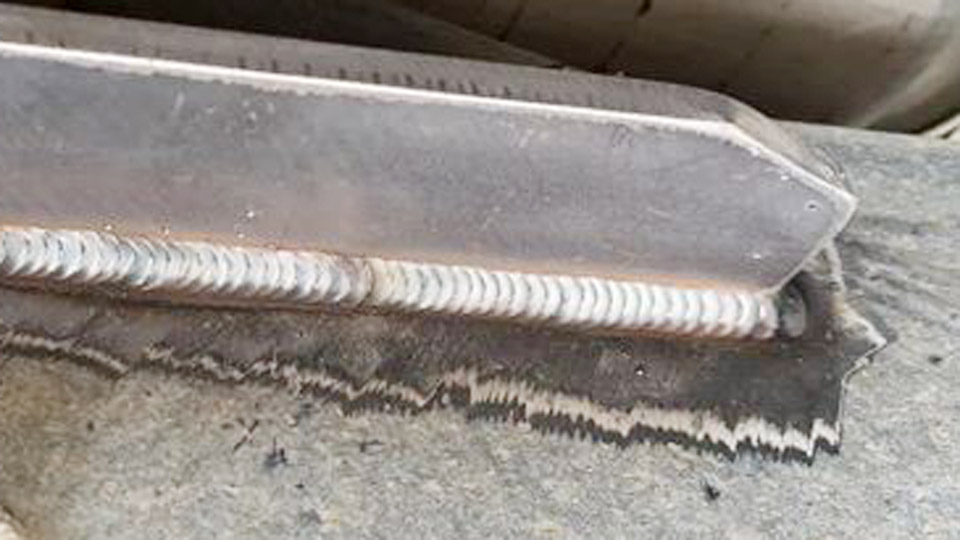
Image by structolution
AWS D1.1 / AISC Minimum Fillet Weld Size Chart in mm
The most widely referenced table for carbon and low-alloy steel appears in AWS D1.1 and AISC 360 Table J2.4. It sets the smallest leg that still produces adequate heat input and fusion.
| Base Metal Thickness of Controlling Part (T) | Minimum Fillet Leg Size (mm) | Typical Single-Pass Capability |
|---|---|---|
| T ≤ 6 mm | 3 | Yes |
| 6 mm < T ≤ 12 mm | 5 | Yes |
| 12 mm < T ≤ 20 mm | 6 | Usually |
| T > 20 mm | 8 | Multi-pass common |
Which Thickness Controls the Minimum
For low-hydrogen processes (7018, most FCAW and GMAW with basic flux) and for non-low-hydrogen procedures that include calculated preheat, T equals the thickness of the thinner part joined.
For non-low-hydrogen processes without such preheat control, T equals the thicker part. In either case the specified minimum never needs to exceed the thickness of the thinner member.
Cyclic-Loading Adjustment
Structures subject to fatigue (bridges, crane runways, vibrating equipment) raise the absolute floor to 5 mm regardless of the table value. That change eliminates the 3 mm option on thin material.
Maximum Fillet Size at Plate Edges
Excessive leg length on an edge creates undercut or burns through the toe.
Edge Thickness Rules
- Plate thinner than 6 mm: maximum leg equals full plate thickness.
- Plate 6 mm and thicker: maximum leg equals plate thickness minus 1.5–1.6 mm (AISC uses 1/16 in).
A 10 mm plate edge therefore accepts a maximum 8.5 mm leg. Larger deposits require edge preparation or a groove weld instead of a pure fillet.
Throat Thickness Versus Leg Length
Strength calculations use the effective throat, not the measurable leg.
Equal-Leg 90° Fillet Relationship
Throat ( a = 0.707 \times ) leg size.
A 6 mm leg yields a 4.2 mm throat; an 8 mm leg yields a 5.7 mm throat. Designers size for the required throat capacity and then convert to the nearest practical leg that also satisfies the minimum-size table.
Unequal-Leg and Skewed Joints
When legs differ or the dihedral angle departs from 90°, the theoretical throat is the shortest distance from the root to the face. The drawing must state both leg dimensions or the required throat explicitly.
How Load Direction Changes Required Size
Longitudinal shear uses the full throat capacity. Transverse loading increases effective strength by up to 50 % under AISC directional formulas, allowing a smaller leg for the same force in some cases. Most shop drawings ignore the increase and size for pure longitudinal shear to keep fabrication simple.
Practical Capacity Benchmarks (E70 Electrode)
Approximate allowable shear per mm of weld length (AISC φ = 0.75):
- 5 mm leg → ~0.73 kN/mm longitudinal
- 6 mm leg → ~0.88 kN/mm
- 8 mm leg → ~1.17 kN/mm
Double these values for balanced welds on both sides of a member. Actual capacity also depends on electrode classification and base-metal strength matching.
Comparison with Other Common Codes
Different codes control minimum size differently, which matters on international projects.
AS 4100 (Australia)
Minimums are based on the thinner part:
- ≤ 7 mm → 3 mm
- 7–10 mm → 4 mm
- 10–20 mm → 5 mm
- > 20 mm → 6 mm
EN 1993-1-8 (Europe)
No graduated leg table. Minimum effective throat is 3 mm; practical minimum leg is therefore about 4–5 mm. Many National Annexes and fabricators still apply larger values for thicker plate to control heat sink effects.
IS 800 (India)
Minimums step upward more aggressively with thicker plate (3 mm up to 10 mm thicker part, 5 mm for 10–20 mm, 6 mm for 20–32 mm, 8 mm first run above that). Maximum leg is thinner plate minus 1.5 mm.
When drawings reference more than one code, the stricter minimum governs unless the engineer explicitly states otherwise.
Single-Pass Versus Multi-Pass Decisions
A 5 mm or 6 mm fillet is routinely deposited in one pass with 1.2 mm solid wire or 1/8 in stick. An 8 mm leg usually requires two or three passes to maintain proper profile and avoid excessive convexity. Multi-pass fillets demand interpass cleaning and temperature control; the extra heat can distort thin members more than a single larger groove weld would.
Profile Acceptance
Convexity is limited (typically 1–2 mm depending on leg size). Excessive convexity concentrates stress and is rejected under visual criteria. Flat or slightly concave faces are preferred for fatigue service.
Measuring and Verifying Fillet Size on the Shop Floor
Leg length is measured with a fillet gauge placed against both fusion faces. The gauge must contact the toes without rocking. Throat gauges exist for critical work but are less common. Undersize greater than the code tolerance (usually 1–2 mm short on limited length) requires repair by additional weld metal, not grinding alone.
Length Rules That Affect Size Choice
Minimum effective length is four times the leg size and not less than 40 mm in most codes. Intermittent fillets must still meet the same minimum leg; spacing limits prevent buckling or fatigue initiation between segments.
Decision Sequence for Choosing the Final Size
- Determine the required throat from the design shear force and electrode strength.
- Convert throat to the next practical equal-leg size.
- Compare that size against the minimum table for the controlling thickness and loading type (static or cyclic).
- Check the maximum edge limit on any exposed plate edge.
- Confirm single-pass versus multi-pass practicality for the chosen process and position.
- Call out the leg size on the drawing; note throat only when unequal legs or non-standard angles are used.
Selecting a size larger than the calculated minimum is acceptable for constructability, but the increase should be deliberate, not arbitrary. Over-welding thick plate with an oversized single-pass fillet often produces more distortion and residual stress than a correctly sized multi-pass deposit.
What is the minimum fillet weld size for 10 mm plate?
Under AWS D1.1 / AISC the minimum leg is 5 mm when the controlling thickness is 10 mm.
How do you convert fillet leg size to throat thickness in mm?
For a standard equal-leg 90° fillet, multiply the leg size by 0.707. A 6 mm leg equals a 4.2 mm throat.
What is the maximum fillet weld size allowed on a plate edge?
For plate 6 mm and thicker the maximum leg is plate thickness minus 1.5 mm. Thinner plate may be welded full thickness.
Does cyclic loading change the fillet weld size chart?
Yes. AWS D1.1 raises the absolute minimum leg to 5 mm for cyclically loaded structures, eliminating the 3 mm option on thin material.