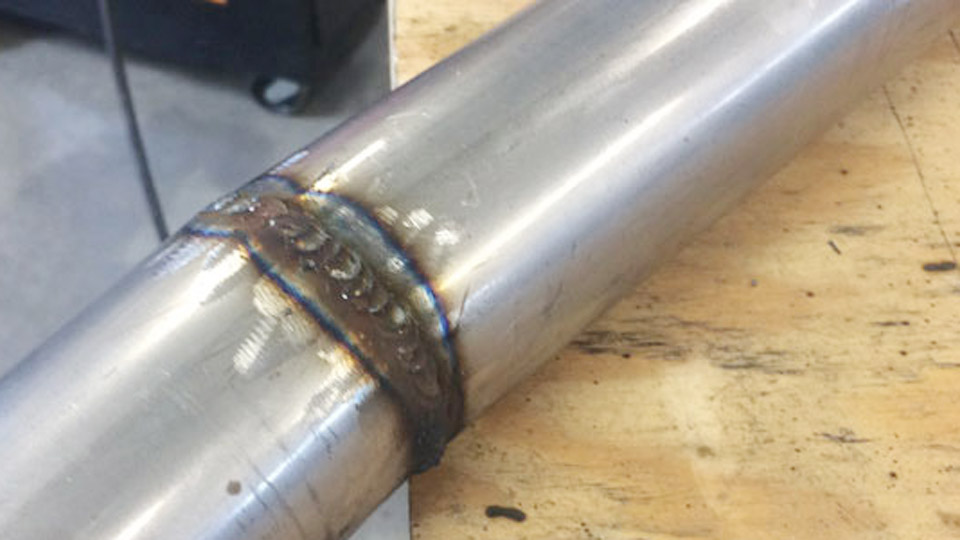
Stainless steel can be successfully joined with a MIG welder, but achieving a strong, clean weld requires more than simply changing the filler wire. Stainless steel responds differently to heat than mild steel, making factors such as shielding gas selection, wire type, voltage settings, travel speed, and heat input critical to weld quality.
Improper setup can lead to excessive spatter, distortion, discoloration, poor penetration, or reduced corrosion resistance—problems that often result in costly rework or premature weld failure.
Understanding how to weld stainless steel with a MIG welder is important for fabrication shops, repair work, automotive projects, and general metalworking applications where strength and corrosion resistance are required.
When the process is configured correctly, MIG welding offers a fast and efficient method for producing consistent stainless steel welds. I’ll explain the equipment, settings, techniques, and best practices needed to achieve reliable results while minimizing common welding defects.

Image by engweld
Material and Equipment Selection for MIG Welding Stainless Steel
Choosing the Right Stainless Steel Grade and Filler Wire
Match filler wire to base metal chemistry and service environment. For 304/304L, use ER308L wire. For 316/316L, select ER316L to maintain molybdenum content for improved pitting resistance. The “L” designation limits carbon to 0.03% max, reducing sensitization risk in the heat-affected zone (HAZ).
Wire diameters:
- 0.023–0.030″ for thin materials (<1/8″)
- 0.035″ for general purpose (most common)
- 0.045″ for thicker sections (>1/4″) in spray transfer
Use knurled or V-groove drive rolls to avoid crushing the softer stainless wire. Ensure the liner matches wire diameter precisely—undersized liners cause feeding issues, oversized ones allow buckling.
Shielding Gas Options and Their Effects
Shielding gas directly impacts corrosion resistance, bead shape, and heat input. Keep CO₂ or oxygen below 5% total to prevent carbon pickup that compromises the passive chromium oxide layer.
Common mixtures:
- Tri-mix (90% He / 7.5% Ar / 2.5% CO₂): Preferred for short-circuit transfer. High helium improves puddle fluidity and bead wetting on stainless, producing flatter beads with less convexity.
- 98% Ar / 2% O₂ or 98% Ar / 2% CO₂: Excellent for spray and pulsed spray. Provides stable arc with good wetting while minimizing oxidation.
- Avoid 75/25 Ar/CO₂ used for mild steel—it introduces excess carbon, leading to rusting welds despite good appearance.
Flow rates typically range 25–35 CFH, higher with helium blends due to their lighter density. Use a gas diffuser and check for leaks.
Welder Capabilities and Transfer Modes
MIG machines for stainless need good inductance control and preferably pulsed capability.
- Short-circuit transfer: Best for thin materials and out-of-position welding. Lower heat input minimizes distortion.
- Spray transfer: Ideal for thicker sections. Requires higher current (typically 180–300+ amps) for smooth, spatter-free deposition.
- Pulsed spray: Combines advantages—low average heat with spray-like transfer. Excellent for thin stainless without burn-through.
DCEP polarity is standard. Set inductance higher (around 50%) than for mild steel to improve puddle fluidity and reduce “ropey” bead appearance.
Surface Preparation and Joint Design
Cleaning Procedures That Matter
Stainless demands thorough cleaning. Contaminants like oils, oxides, or shop dirt cause porosity and inclusions.
Remove mill scale, heat tint, and oils with a dedicated stainless wire brush or flap disc (avoid carbon steel contamination). Use acetone or dedicated stainless cleaners—never use solvents that leave residue. Clean within 1–2 inches of the joint and on both sides. Re-clean if more than a few minutes pass before welding.
Joint Preparation and Fit-Up
Stainless expands more than carbon steel, so tight fit-up is critical to control distortion. Bevel thicker sections (over 1/4″) to 60–70° included angle for full penetration. Maintain root gaps of 0–1/16″ depending on thickness.
Use clamps, tack welds, or backing bars. For long seams, employ skip welding or back-step techniques to balance heat input.
Machine Settings and Parameter Selection
Voltage, Wire Speed, and Heat Input Guidelines
Settings depend on thickness, joint type, and transfer mode. Use the 1 amp per 0.001″ rule as a starting point for amperage, then fine-tune.
Typical ranges (0.035″ ER308L wire, tri-mix gas):
| Thickness | Transfer Mode | Voltage | Wire Speed (IPM) | Approx. Amps |
|---|---|---|---|---|
| 0.030–0.060″ | Short-circuit | 15–17 | 120–180 | 50–90 |
| 1/8″ | Short-circuit | 17–19 | 180–250 | 90–130 |
| 1/4″ | Spray | 22–26 | 250–350 | 180–250 |
Test on scrap of identical material and thickness. Adjust voltage for arc length: increase if stubbing occurs, decrease if arc is too long and erratic. Wire speed primarily controls amperage and deposition.
Stick-Out, Torch Angle, and Travel Speed
Maintain 3/8–1/2″ contact tip to work distance (CTWD) for short-circuit; slightly longer for spray. Push technique (forehand) at 5–15° travel angle improves shielding gas coverage, bead appearance, and reduces oxidation. Drag (backhand) increases penetration when needed but can trap slag or create convexity.
Travel speed must balance heat: too slow causes excessive heat input and distortion; too fast leads to lack of fusion or convex beads. Aim for steady motion with slight weave on wider joints.
Welding Techniques for Different Applications
Thin Gauge Stainless Steel (<1/8″)
Prioritize low heat input. Use 0.023–0.030″ wire in short-circuit mode. Pulse settings help if available. Back-purge with argon on pipe or tank welds to prevent sugaring (oxidation) on the root side, which destroys corrosion resistance.
Tack frequently with small tacks and allow cooling between passes. Consider copper backing bars to sink heat.
Thicker Sections and Structural Welds
Transition to spray or pulsed spray for 1/4″ and above. Ensure full penetration with proper beveling. Multiple passes may be needed—interpass temperature should stay below 350°F (175°C) to avoid sensitization in some grades.
For fillet welds, maintain consistent leg lengths and watch for undercut, common in stainless due to its fluidity.
Out-of-Position MIG Welding Stainless
Short-circuit transfer excels vertically and overhead. Reduce parameters by 10–15% from flat position. Use shorter stick-out and faster travel speed. A slight uphill progression helps control the puddle.
Post-Weld Treatment and Quality Control
Cleaning and Passivation
Remove heat tint with stainless pickling paste, dedicated cleaners, or mechanical methods (flap discs, abrasive pads). This restores the chromium oxide layer essential for corrosion resistance. Rinse thoroughly after chemical cleaning.
Inspection Criteria
Visually check for uniform bead profile, no undercut, porosity, or cracks. For critical applications, use dye penetrant or other NDT methods. Measure distortion and ensure mechanical properties meet requirements.
Common Parameter Adjustments and Troubleshooting
Addressing Distortion and Warping
Stainless’s high expansion coefficient makes distortion management key. Use:
- Balanced welding sequences
- Clamping and fixturing
- Lower interpass temps
- Pulsed MIG where possible
Bead Appearance Issues
Ropey or convex beads often result from insufficient inductance or wrong gas. Increase inductance for better wetting. Tri-mix gas typically produces flatter profiles than argon/oxygen mixes.
Porosity usually traces to poor cleaning, inadequate gas coverage, or wind drafts. Spatter indicates voltage/wire speed mismatch or wrong gas.
Advanced Considerations for Professional Results
Pulsed MIG systems allow independent control of peak and background current, enabling spray transfer at lower average heat—ideal for stainless. Synergic or auto-set machines simplify starting points but still require fine-tuning based on joint and position.
For dissimilar welds (stainless to carbon steel), use ER309L wire to handle dilution.
Performance-based Takeaway
Successful stainless MIG welding hinges on matching wire, gas, and parameters to the specific grade, thickness, and service conditions rather than generic settings. Prioritizing low carbon input, controlled heat, and proper post-cleaning consistently delivers welds that maintain both mechanical strength and corrosion resistance.
An advanced insight: in high-purity or food-grade applications, back-purging combined with pulsed spray transfer often separates acceptable welds from those that pass long-term inspection and regulatory standards.
FAQ
What gas is best for MIG welding stainless steel?
Tri-mix (90% helium, 7.5% argon, 2.5% CO₂) provides the best puddle control and bead shape for short-circuit welding. For spray transfer, 98% argon/2% oxygen or CO₂ works well. Always keep active gases low to protect corrosion resistance.
Can you MIG weld stainless steel with C25 gas?
It is possible but not recommended for critical applications. The high CO₂ content adds carbon, reducing corrosion resistance. Use it only for non-exposed, non-corrosive environments and test thoroughly.
What wire size should I use for 1/8″ stainless steel?
0.035″ ER308L or ER316L is the most versatile choice. It balances deposition rate, arc stability, and control without excessive heat input on this thickness.
How do I prevent burn-through on thin stainless sheet?
Use 0.023–0.030″ wire, short-circuit or pulsed mode, lower voltage/wire speed, fast travel speed, and good fit-up with backing if possible. Test settings on scrap first.