Joining copper pipe correctly is essential for creating leak-free plumbing systems that can withstand years of pressure, temperature changes, and daily use.
Whether you’re installing new water lines, repairing a damaged section, or extending an existing system, understanding how to join copper pipe helps prevent weak connections, costly water damage, and unnecessary rework.
The best joining method depends on factors such as pipe size, application, available tools, and local plumbing codes. Choosing the wrong technique or preparing the pipe improperly can result in poor sealing, corrosion, or premature joint failure.
By understanding the strengths of soldered, press-fit, compression, and push-to-connect fittings, you can select the most suitable approach and produce durable, professional-quality copper pipe connections with confidence.
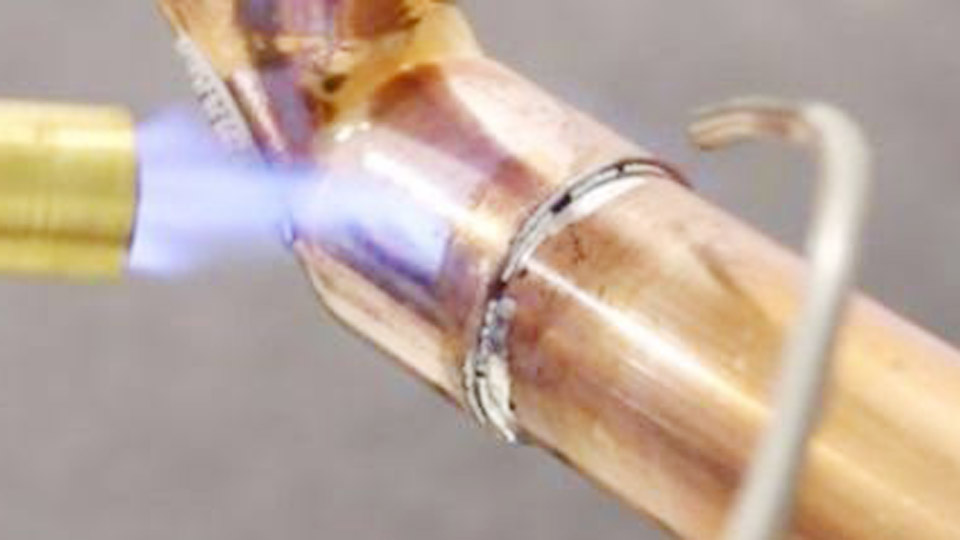
Image by fixmart
Choosing the Right Joining Method for Copper Pipe
The decision between soldering, brazing, and welding rests on service temperature, pressure, and whether the base metal must remain below its annealing range.
When Soldering Delivers Sufficient Strength
Soldering occurs below 840 °F (typically 350–600 °F in practice). Lead-free tin-antimony or tin-copper alloys such as 95/5 produce joints rated for continuous service up to roughly 250 °F. This range covers nearly all residential and light commercial potable-water systems.
Capillary fittings with full socket insertion develop adequate strength when the joint is completely filled; the fillet itself contributes little additional load-bearing capacity.
When Brazing Becomes Necessary
Brazing takes place above 840 °F, commonly 1100–1500 °F. Copper-phosphorus (BCuP) or silver-bearing fillers create higher-strength joints suitable for refrigerant lines, medical gas, and systems that see elevated temperatures or vibration.
Because the higher heat softens the tube, the allowable working pressure of an annealed copper system can drop compared with a soldered joint of the same size. Codes and manufacturer pressure tables must be checked before choosing brazing solely for strength.
When Fusion Welding Makes Sense
TIG (GTAW) or MIG welding melts the base metal and is reserved for fabrication, repair of thick-wall copper, or joints where no fitting is available. High thermal conductivity demands elevated amperage, preheat, and often helium-rich shielding.
Welding is rarely the first choice for standard plumbing or HVAC tubing because it alters mechanical properties over a wider heat-affected zone and requires more skill and equipment.
Preparing Copper Pipe and Fittings for Reliable Joints
Joint integrity is determined before the torch is lit. Surface condition and fit-up control whether capillary action or fusion can occur.
Cutting and Deburring Requirements
A tubing cutter produces a square end with minimal deformation. After cutting, ream the inside diameter to restore full flow area and remove the internal burr that would otherwise create turbulence or restrict filler flow.
External edges should be lightly dressed so the tube seats fully against the fitting stop. Any ovality or residual burr prevents uniform clearance and leaves voids.
Surface Cleaning Standards
Oxide, oil, and drawing lubricant must be removed to bright metal on both the tube exterior and the fitting socket. Abrasive cloth, dedicated fitting brushes, or Scotch-Brite pads work for most sizes; the cleaned surface must not be touched with bare hands afterward.
Skin oils reintroduce contaminants that block wetting. Cleaning should occur immediately before fluxing so re-oxidation remains minimal.
Flux Selection and Application
Soldering fluxes are typically petroleum-based pastes that meet ASTM B813 and are approved for potable water. Apply a thin, continuous film to the tube end and the inside of the socket—excess flux is pushed into the system and can corrode or restrict flow.
Brazing fluxes are water-based and formulated for higher temperatures; many BCuP fillers are self-fluxing on clean copper-to-copper joints and require no additional flux. Flux must be compatible with the filler; the two families are not interchangeable.
Soldering Technique for Copper Water Lines
Proper heat distribution and capillary timing produce a joint that is completely filled without overheating the tube.
Heat Control and Capillary Flow
A propane or MAPP-gas torch with a tip sized to the tube diameter supplies controlled heat. Direct the inner cone at the fitting body, not the tube, and move continuously around the circumference. When the flux begins to bubble and sizzle, the joint has reached soldering temperature.
Touch the solder to the opposite side of the flame; the heat of the metal—not the flame—should melt the alloy so capillary action draws it into the annular gap. Continue feeding until a continuous fillet appears around the entire joint.
Solder Quantity and Application Sequence
A practical rule is to use a length of solder roughly equal to the tube diameter (½ in of wire for ½-in tube). Excess solder forms a heavy external bead that does not improve strength and can mask incomplete internal fill.
After the joint is complete, wipe residual flux while the metal is still warm, then allow natural cooling. Forced quenching can introduce residual stress. Once cool, the joint may be pressure-tested.
Brazing Copper for High-Pressure Systems
Higher process temperatures and different filler behavior demand tighter control of atmosphere and heat input.
Torch Selection and Flame Settings
Oxy-acetylene with a neutral or slightly reducing flame is the standard heat source for most brazing. Air-fuel torches can handle smaller diameters if the heat is applied carefully.
Keep the flame moving to avoid localized overheating that anneals the tube excessively or burns the flux. The joint is ready when the copper reaches a dull red heat and the filler flows freely on contact.
Filler Metal Choices and Nitrogen Purging
BCuP-2, BCuP-3, BCuP-5, and similar alloys are self-fluxing on clean copper and are widely used for HVAC and refrigeration. Silver-bearing alloys (BAg series) require flux and are preferred when joining copper to brass or when greater ductility is needed.
For closed systems that will carry refrigerant, purge the interior with dry nitrogen during heating to prevent internal oxide scale. Without purge gas the oxide remains trapped and can later circulate as debris or restrict flow. After brazing, remove external flux residue with warm water and a brush.
TIG Welding Copper Pipe Joints
Fusion welding is practical only when the joint geometry or material thickness makes capillary methods unsuitable.
Amperage, Gas, and Preheat Decisions
Copper’s high thermal conductivity requires substantially higher current than steel of the same thickness. Typical ranges on DCEN are 50–160 A for 1–2 mm wall, 120–300 A for 2–5 mm, and 250–400 A or more for thicker sections.
Pure argon works on thin material; helium or argon-helium mixes increase arc energy for sections above approximately 2 mm. Preheat to 50–200 °C (or higher for heavy wall) reduces the thermal gradient and improves fusion. Back-purging protects the root from oxidation.
Filler and Technique Adjustments
ERCu (deoxidized copper) matches pure copper color and chemistry. Silicon-bronze fillers (ERCuSi-A) are sometimes chosen for dissimilar joints or when lower melting range is acceptable. Maintain a short arc, add filler steadily, and travel fast enough to stay ahead of the rapidly dissipating heat.
Crater cracks are minimized by tapering current at the end of each pass and filling the crater with additional metal.
Joint Inspection and Pressure Testing Criteria
Visual examination confirms external fillet continuity and absence of undercut or excessive reinforcement. Internal quality is verified by hydrostatic or pneumatic testing at the pressures specified by the governing code or manufacturer.
Any joint that weeps must be cut out and remade; attempting to “add more solder” after the system has seen water usually fails because residual moisture prevents proper wetting. For critical systems, radiographic or ultrasonic examination may be required by specification.
Wrapping Up
Selecting the correct process and executing the preparation and heat-control steps produces copper joints that remain leak-free under design pressure and temperature.
When the operating conditions approach the upper limits of soldered performance, the added strength of a properly purged and filled brazed joint outweighs the extra heat input.
Advanced fabricators further reduce residual stress by sequencing multiple joints so that the heat-affected zones do not overlap, preserving the full mechanical properties of the tube.
FAQs
What temperature is needed to solder copper pipe?
Soldering occurs between approximately 350 °F and 600 °F. The joint is ready when flux begins to sizzle and the solder melts on contact with the heated metal rather than the flame.
Do I need flux when brazing copper to copper?
Many copper-phosphorus (BCuP) fillers are self-fluxing on clean copper-to-copper joints and require no additional flux. Flux is still required when joining copper to brass or other alloys.
Can copper pipe be TIG welded instead of soldered?
Yes, but TIG welding is normally reserved for fabrication or thick-wall work. It demands high amperage, preheat, and often helium shielding because of copper’s thermal conductivity.
How much solder should be used for a ¾-inch copper joint?
Approximately ¾ inch of solder wire is sufficient for a standard ¾-inch capillary fitting when the joint is properly heated and capillary action fills the gap completely.