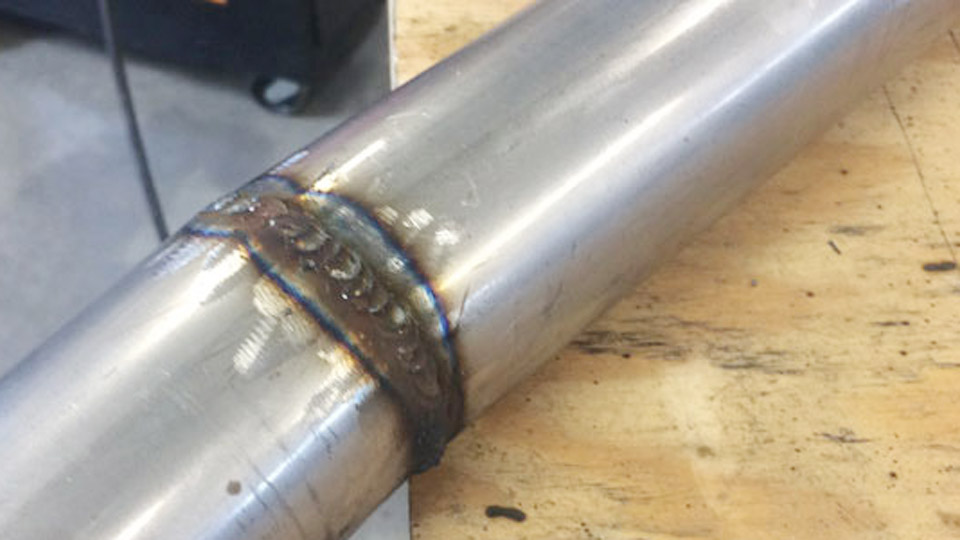
Using the wrong shielding gas can quickly turn a stainless steel MIG weld into a problem with excessive spatter, poor arc stability, oxidation, or an inconsistent bead.
If you’re wondering Can You MIG Weld Stainless Steel With 75/25 Gas?, the answer depends on the stainless grade, wire, welding process, and the quality of the finished weld you need.
A 75% argon/25% CO₂ mixture is commonly used for mild steel, but stainless steel responds differently to shielding-gas composition.
The higher CO₂ content can affect arc characteristics, spatter, bead appearance, and weld chemistry, making gas selection important for both appearance and performance.
Understanding when 75/25 gas may work—and when a stainless-specific shielding gas is the better choice—can help prevent wasted wire, excessive cleanup, and weld defects. This guide explains the practical considerations so you can choose the appropriate gas before striking the arc.
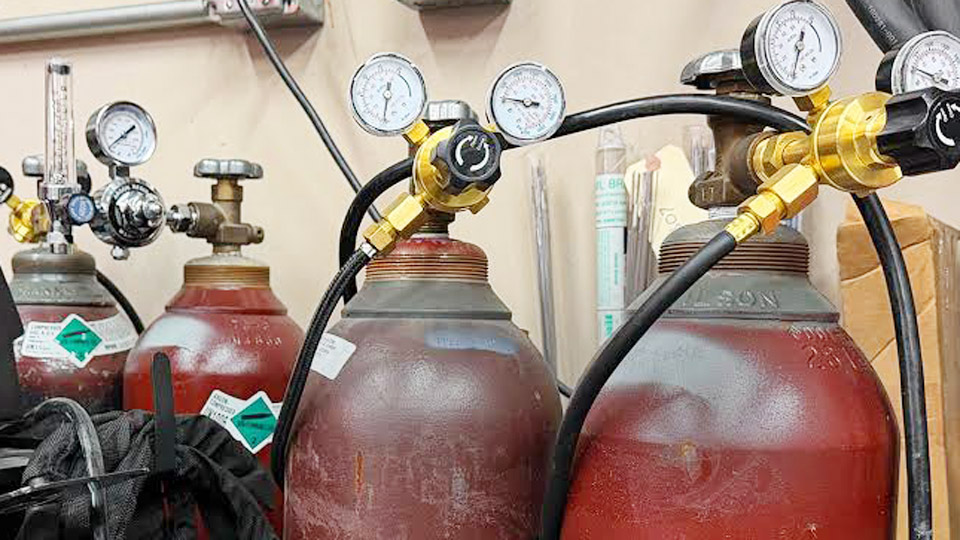
Image by eastwood
What Happens Chemically When C25 Contacts Stainless
Carbon Pickup and Sensitization Risk
Stainless relies on a continuous chromium-rich oxide film for corrosion resistance. Twenty-five percent CO₂ dissociates in the arc and supplies free carbon to the weld pool.
That carbon combines with chromium to form chromium carbides at grain boundaries (sensitization) in the 800–1500 °F temperature range that every weld pass experiences.
Once chromium is locked into carbides, the surrounding matrix loses its ability to reform the passive film. The result is intergranular corrosion that can appear months or years later as rust trails or pitting, even on 304L or 316L base metal.
Oxidation, Spatter Volume, and Surface Color
The same active oxygen that arrives with the CO₂ oxidizes chromium and iron at the weld surface. Beads turn gray or black instead of the bright straw-to-gold range expected from low-oxidizing gases.
Spatter increases because the arc becomes more aggressive and the puddle less fluid; stainless spatter is harder to remove than mild-steel spatter and often embeds oxide particles that become future corrosion sites.
Cleanup time rises and aesthetic requirements become difficult to meet without aggressive grinding that itself can reintroduce contamination.
Situations Where 75/25 Remains a Practical Choice
Non-Critical Indoor Fabrication
When the finished part will never see moisture, chemicals, or outdoor exposure—shop fixtures, temporary jigs, internal brackets—the loss of long-term corrosion resistance is irrelevant.
Mechanical strength remains adequate provided joint design and fusion are correct. In these cases the cost and logistics of switching cylinders can legitimately outweigh the metallurgical penalty.
Flux-Cored Stainless Wires
Many stainless flux-cored wires are formulated to run on C25. The slag system scavenges oxygen and carbon, shielding the deposit far better than solid-wire GMAW under the same gas. If the procedure specifies a flux-cored electrode, C25 is often the recommended shielding gas and the corrosion concern is reduced.
Preferred Shielding Gases That Keep Stainless Stainless
Tri-Mix for Short-Circuit and All-Position Work
The industry standard for thin-gauge and out-of-position stainless GMAW is approximately 90 % helium / 7.5 % argon / 2.5 % CO₂. Helium raises arc energy and puddle fluidity without adding large amounts of active gas; the 2.5 % CO₂ is low enough to avoid measurable carbon pickup while still stabilizing the short-circuit transfer. Flow rates typically run 25–35 CFH because helium is lighter and disperses faster than argon-rich mixes.
98/2 Argon-CO₂ or Argon-Oxygen for Spray Transfer
On material thicker than about 3/16 in where spray or pulsed-spray transfer is practical, 98 % argon + 2 % CO₂ (or 2 % O₂) produces a stable spray arc, low spatter, and minimal carbon addition.
Oxygen versions wet slightly better on some alloys; CO₂ versions are more widely stocked. Keep the active-gas fraction at or below 5 %—anything higher begins to erode corrosion performance.
Why the 5 % Active-Gas Ceiling Matters
Laboratory and production data consistently show that carbon content in the weld metal rises sharply once CO₂ exceeds roughly 5 %. Below that threshold the increase remains within the low-carbon specification of L-grade stainless fillers.
Above it, sensitization risk climbs and post-weld heat treatment or heavy grinding becomes necessary to restore corrosion resistance—costs that quickly exceed the price of the correct gas cylinder.
Practical Parameter Adjustments If C25 Is the Only Option
Filler-Metal Matching Still Applies
Use ER308L for 304/304L base metal, ER316L for 316/316L, and ER309L when joining stainless to carbon steel. The “L” designation keeps carbon low in the filler itself; the shielding gas then becomes the dominant carbon source.
Do not substitute mild-steel wire under any circumstances—dilution will destroy both corrosion resistance and mechanical properties.
Voltage, Wire Speed, and Travel Adjustments
Stainless conducts heat more slowly than mild steel, so heat input must be reduced. Start 10–15 % lower in wire-feed speed and voltage than the mild-steel chart for the same thickness and wire diameter.
Typical short-circuit starting points with 0.030–0.035 in wire on 1/8 in plate are 17–20 V and 200–280 IPM; raise travel speed to keep interpass temperature below 300 °F whenever possible. Gas flow should sit at 20–25 CFH indoors; increase only if porosity appears at the toes.
Torch Angle and Stick-Out Discipline
A 5–15° push angle and ⅜–½ in stick-out help control the more aggressive C25 arc. Longer stick-out increases resistance heating and can amplify oxidation. Maintain a consistent nozzle-to-work distance so the gas envelope remains effective; any draft will rapidly expose the puddle to air and accelerate discoloration.
Post-Weld Steps That Partially Recover Corrosion Resistance
Mechanical Cleaning and Acid Passivation
Immediately after welding, remove all spatter and heat tint with a stainless-dedicated stainless-steel wire brush or abrasive that has never contacted carbon steel. Follow with a nitric or citric acid passivation treatment that restores the chromium oxide layer on the surface.
Passivation cannot reverse chromium carbide precipitation in the grain boundaries, but it does eliminate the surface oxide scale that would otherwise become initiation sites for pitting.
When Heat Treatment Becomes Necessary
On critical components that must retain full corrosion resistance after C25 exposure, solution annealing above 1900 °F followed by rapid quench redissolves the carbides. This step is rarely practical outside a heat-treat shop and underscores why the correct shielding gas is preferred from the start.
Decision Framework for the Next Stainless Job
If the part will operate in a corrosive, outdoor, food-contact, or pressure-containing environment, obtain the proper low-CO₂ or tri-mix gas before striking an arc. The metallurgical damage from 25 % CO₂ is permanent without expensive remediation.
For purely mechanical indoor assemblies where appearance and long-term rust resistance are secondary, C25 will produce a structurally sound joint provided filler metal, heat input, and cleaning are controlled.
Advanced shops maintain a dedicated stainless gas station and calibrated flowmeters so the decision is never forced by cylinder availability; the marginal cost of the correct blend is recovered in reduced rework and warranty exposure.
FAQs
Can I use 75/25 gas on 304 stainless for a non-critical bracket?
Yes, provided the bracket stays indoors and dry. Expect more spatter and a dull bead; clean thoroughly afterward.
What gas flow rate should I use if forced to run C25 on stainless?
Start at 20–25 CFH indoors. Increase only if toe porosity appears; higher flow wastes gas and can create turbulence.
Is 98/2 argon-CO₂ better than tri-mix for all stainless MIG?
No. Use 98/2 primarily for spray-transfer work on thicker sections. Tri-mix remains superior for short-circuit and out-of-position thin material.
Will flux-cored stainless wire solve the C25 problem?
Often yes—the slag system protects the deposit. Confirm the wire manufacturer’s recommended gas; many stainless flux-cored electrodes are designed specifically for C25.