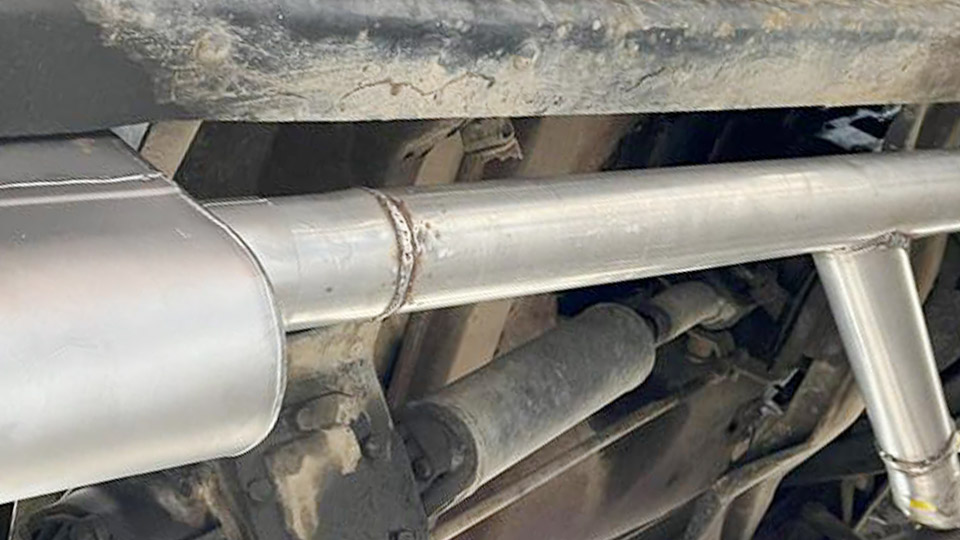
A cracked exhaust manifold or pinhole in a downpipe leaves most DIYers staring at the same choice: drop the system for a proper weld or reach for the tube of epoxy already in the toolbox. The question that follows is direct—does JB Weld work on exhaust leaks—and the answer is never a simple yes or no.
Surface temperature, product formulation, joint geometry, and expected service life decide whether the repair lasts months or fails in a single heat cycle.
Understanding those variables separates a temporary seal that buys time from a repair that creates new problems under thermal stress.
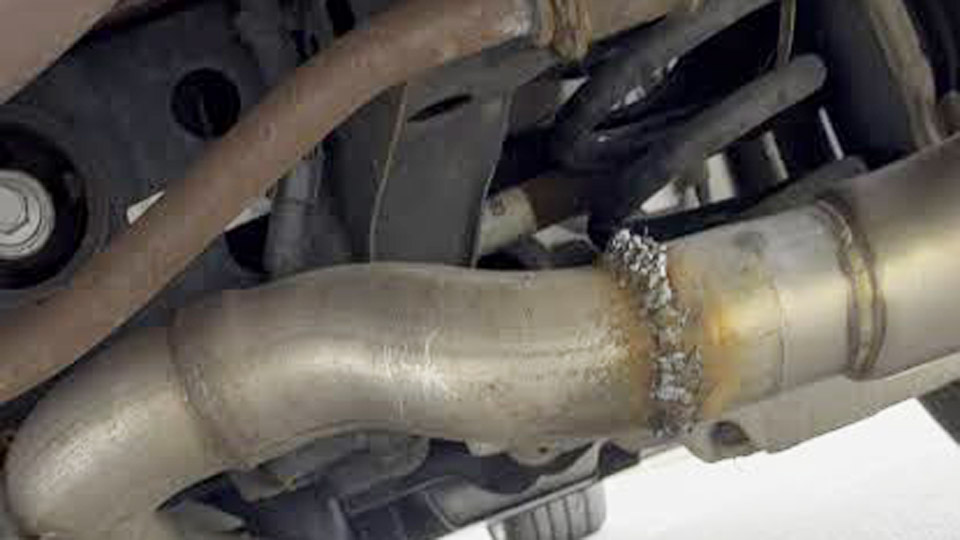
Image by r/MechanicAdvice
Temperature Ratings That Separate Working Fixes from Immediate Failure
Continuous vs Peak Exposure Limits Across JB Weld Formulas
Original two-part JB Weld epoxy is rated for continuous service at 500 °F (260 °C) and short-term peaks near 600 °F (316 °C). Exhaust manifold surface temperatures routinely exceed those numbers under load.
At highway speed or under boost, cast-iron manifolds commonly reach 800–1,200 °F; even mid-pipe sections can sit between 600–900 °F once the catalytic converter is hot. Applying standard JB Weld to those zones produces rapid softening, outgassing, and eventual detachment.
JB Weld ExtremeHeat is formulated for continuous exposure to 1,000 °F (537 °C). It is a single-component metallic paste, not a structural adhesive, and is intended for filling cracks and small holes rather than bonding two mating parts under tension.
ExhaustWeld fiberglass wrap is rated to 1,100 °F and relies on resin saturation plus mechanical wrapping rather than pure adhesion. Selecting the wrong product for the measured temperature zone is the most common reason a “JB Weld exhaust repair” fails within days.
Surface Temperature Gradients Along the Exhaust System
Temperature drops significantly downstream of the manifold. A leak at the collector or first flex joint may see continuous surface temperatures in the 700–900 °F range, while a muffler seam or tailpipe joint often stays below 500 °F under normal driving.
The same tube of ExtremeHeat that survives on a muffler can still degrade on a turbo manifold outlet because the local metal temperature exceeds the product’s continuous rating. Infrared thermometer readings taken after a 20-minute drive cycle under load give the only reliable data for product selection.
Location-Specific Performance of JB Weld Products
Exhaust Manifold and Header Cracks
Manifold cracks usually start at bolt bosses or between ports where thermal cycling is most severe. ExtremeHeat can fill a small crack if the surface is prepared to bare metal and the paste is forced into a slightly widened V-groove. Success is limited to low-mileage, non-boosted applications where peak temperatures stay under 1,000 °F.
On high-mileage iron manifolds or stainless headers that see repeated heat-soak cycles, the paste eventually pulverizes because it cannot match the expansion rate of the base metal. Structural welding or manifold replacement remains the only durable solution once the crack propagates beyond 1–2 inches.
Mid-Pipe, Downpipe, and Flex-Joint Leaks
These locations often involve thinner tubing and intermittent vibration. ExhaustWeld wrap or ExtremeHeat combined with a metal patch and band clamp produces the highest success rate. The wrap must be applied with at least five full layers centered on the defect and two to four inches of overlap on either side.
Aluminum tape is used only to hold the wrap during the initial cure; leaving it in place after heat-cycling traps moisture and accelerates corrosion under the repair. Vibration at flex joints will eventually fatigue any epoxy-only patch, so mechanical reinforcement is mandatory for service beyond a few hundred miles.
Muffler and Tailpipe Seams
Muffler shells and tailpipe joints operate at lower continuous temperatures, frequently allowing original JB Weld or muffler cement pastes to hold for longer periods.
Holes caused by internal corrosion are typically larger and irregular, so a combination of paste filler plus wrap or a sheet-metal patch clamped over the paste gives the best temporary seal.
Even here the repair remains non-structural; road vibration and internal pressure pulses will open the joint again once the underlying metal continues to thin.
Surface Preparation Requirements That Determine Bond Strength
Cleaning and Mechanical Abrasion Standards
Any residual oil, carbon, or scale prevents chemical adhesion. Wire-brushing alone is insufficient. The repair zone must be ground or sanded to bright metal over an area at least one inch larger than the defect in every direction.
A final wipe with acetone or brake cleaner removes the last film of oil; alcohol-based cleaners leave residues that interfere with curing. For ExtremeHeat, opening a crack to a minimum 1/8-inch width with a rotary tool or drill bit allows the paste to key mechanically into the metal rather than sitting on the surface.
Moisture and Temperature During Application
ExtremeHeat is water-based and will not cure properly if applied to a damp surface or in ambient temperatures below 50 °F. The paste must reach a firm set before the first heat cycle; forcing heat too early causes steam bubbles and a porous, weak repair.
ExhaustWeld wrap cures faster with heat but still requires a clean, dry substrate. Applying either product to a still-hot exhaust component is a common error that produces incomplete cure and early failure.
Mechanical Reinforcement Options That Extend Service Life
Clamps, Sleeves, and Sheet-Metal Patches
Pure paste or wrap repairs rarely survive long-term vibration. A stainless band clamp over a short section of larger-diameter tubing creates a mechanical sleeve that shares load with the epoxy.
For holes larger than ½ inch, a formed sheet-metal patch held with multiple clamps and bedded in ExtremeHeat or muffler cement distributes stress more evenly.
The clamp must be tight enough to compress the repair material without crushing thin muffler walls. Once the system is heat-cycled, re-torque the clamps after the first cool-down because thermal expansion loosens the initial setting.
Limitations of Reinforcement Alone
Even a well-clamped patch cannot restore original wall thickness or correct a joint that has separated under exhaust pressure. If the leak is at a flange or slip joint that has pulled apart more than 1/8 inch, the epoxy will simply fill the gap and then crack under the next thermal cycle.
At that point the correct decision is to cut out the damaged section and weld in a new piece of tubing or replace the entire component.
Decision Criteria for Temporary Versus Permanent Repair
Mileage and Operating Conditions That Justify Epoxy
A daily-driver car that sees mostly light-load commuting can tolerate an ExtremeHeat or ExhaustWeld repair on a mid-pipe or muffler for several months if the defect is small and properly prepared. Towing, track use, or boosted engines generate higher continuous temperatures and stronger vibration that accelerate failure.
In those cases the epoxy repair should be treated as a roadside or short-term measure only, with a hard limit of a few hundred miles before a welded repair is performed.
Cost and Time Trade-Offs Against Welding
A competent MIG or TIG weld on mild-steel exhaust tubing takes less than thirty minutes once the system is accessible and cleaned. Stainless requires more skill and often a different filler, but the resulting joint matches the base metal’s strength and thermal expansion.
The time spent preparing a high-quality epoxy repair—grinding, cleaning, curing, and reinforcing—often approaches the time required for a proper weld, especially if the vehicle must be raised and the exhaust partially dropped. For shops and serious DIY welders the permanent solution is almost always faster in the long run.
Product Selection Within the JB Weld Exhaust Line
ExtremeHeat Paste Versus ExhaustWeld Wrap
ExtremeHeat works best for small cracks and pinholes where the metal is still structurally sound. It can be drilled or sanded after full cure, which allows blending into the surrounding surface. ExhaustWeld wrap is better for larger holes, seams, or areas that need circumferential reinforcement.
The wrap’s fiberglass matrix provides tensile strength the paste lacks. Using both products together—paste to fill, wrap to reinforce—produces the longest-lived temporary repairs observed in the field.
Muffler Cement and Older Formulations
Traditional muffler cement is a lower-temperature paste designed primarily for sealing pipe joints and small seams. It remains useful on tailpipe connections but should not be expected to hold under manifold-level heat.
Mixing older or unlabeled tubes of “high-heat” epoxy with current ExtremeHeat formulas is unreliable because the chemistry and filler content have changed over the years.
Real-World Failure Modes and Inspection Intervals
Thermal Cycling and Vibration Fatigue
Even a correctly applied ExtremeHeat repair will eventually develop micro-cracks at the interface between the paste and the base metal. These cracks allow exhaust gas to escape in thin streams that are often inaudible until the opening enlarges.
Vibration from engine harmonics and road inputs accelerates the process. Inspecting the repair after the first 50–100 miles and again at 500 miles catches early separation before the leak becomes large enough to affect sensor readings or cabin noise.
Corrosion Under the Repair
Moisture trapped under a wrap or patch accelerates external rust. If the original hole was caused by internal corrosion, the surrounding metal continues to thin regardless of the external seal.
Once wall thickness drops below roughly 0.040 inch in mild steel, any repair—epoxy or welded—becomes temporary at best. Ultrasonic thickness measurement or simple pick testing with a sharp punch identifies sections that need replacement rather than patching.
Wrapping Up
A well-executed ExtremeHeat or ExhaustWeld repair can return a vehicle to quiet operation long enough to schedule proper fabrication work. Choosing the product by measured surface temperature, preparing the metal to bare clean condition, and adding mechanical reinforcement are the three decisions that determine whether the fix is measured in days or months.
Any epoxy repair on an exhaust system is a thermal and mechanical compromise; once the base metal has thinned or cracked under cyclic stress, the only permanent restoration of strength and gas-tight integrity remains a correctly executed weld.
FAQ
Does regular JB Weld hold up on a muffler?
Original JB Weld can seal a small muffler hole for a limited time if temperatures stay under 500 °F continuous. Expect service life measured in weeks to a few months under normal driving; vibration and continued corrosion will eventually reopen the leak.
Can JB Weld ExtremeHeat fix a cracked exhaust manifold?
It can fill a short crack temporarily if surface temperature stays under 1,000 °F and the metal is thoroughly cleaned. On most cast-iron manifolds that see repeated heat cycles the repair is short-lived and should be followed by welding or replacement.
How long does ExhaustWeld wrap last on a downpipe?
With proper preparation and clamping, ExhaustWeld wrap commonly lasts several hundred to a few thousand miles on non-boosted vehicles. High-load or track use shortens that interval significantly.
Is welding always better than JB Weld for exhaust leaks?
For any repair expected to last beyond a few months or subjected to high temperature and vibration, yes. Welding restores structural continuity and thermal expansion compatibility that no epoxy or wrap can match.