Selecting the wrong electrode for thin-gauge or appearance-critical work produces either burn-through or a ropey, high-spatter bead that requires excessive grinding.
Accurate 6013 welding rod specifications prevent that outcome by defining the exact tensile strength, coating type, polarity options, and current windows that match the electrode’s shallow-penetration, easy-slag behavior to the joint.
These values determine whether the arc stays stable on low open-circuit-voltage machines, whether the deposit meets 60 ksi minimum strength, and whether the bead wets cleanly on sheet metal or light fabrication.
Knowing the full set of AWS A5.1 requirements and manufacturer operating ranges lets the welder choose diameter, polarity, and amperage with confidence instead of trial-and-error.
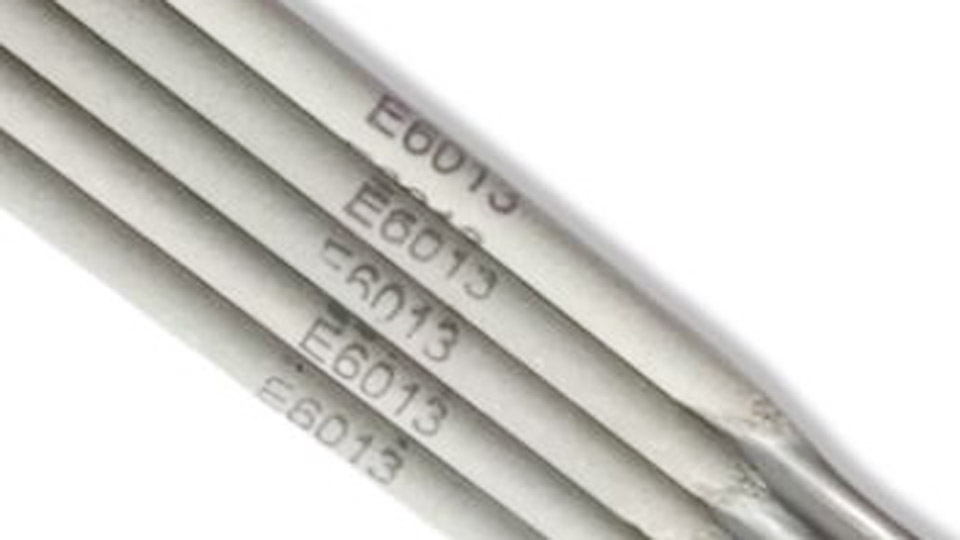
Image by homdum
AWS Classification Breakdown and What Each Digit Requires
The designation E6013 follows AWS A5.1 (or ASME SFA-5.1). Each character locks in measurable performance limits.
Tensile Strength and Mechanical Minimums
The “60” requires a minimum all-weld-metal tensile strength of 60 000 psi (430 MPa). Yield strength must reach at least 48 000 psi (330 MPa) and elongation in 2 in. must be 17 % or higher (some codes list 22 %).
Typical as-welded results from major manufacturers fall in the 67–75 ksi tensile range with 20–30 % elongation and Charpy V-notch values often exceeding 40–70 J at 0 °C or –20 °C, depending on the exact formulation.
Position Capability and Coating Chemistry
The “1” certifies all-position use (flat, horizontal, vertical, overhead). The final “3” identifies a high-titania (rutile) potassium coating. This coating produces a soft, quiet arc, low spatter, easy restrike, and a slag that lifts cleanly—often in large pieces. Potassium compounds stabilize the arc on AC, allowing reliable operation on transformer machines with lower open-circuit voltage.
Polarity Options and Heat Distribution Choices
E6013 runs on AC, DCEP, or DCEN. The choice alters penetration depth and bead shape without changing the electrode itself.
When AC Delivers the Best Results
AC is the most common shop setting because the coating was optimized for it. The arc remains stable through the zero crossings, and the bead stays flat with minimal undercut. Use AC on older buzz-box machines or whenever the power source lacks DC output.
DCEP versus DCEN Trade-offs
DCEP (electrode positive) concentrates more heat in the workpiece and increases penetration slightly. DCEN (electrode negative) shifts heat into the electrode, producing a cooler weld pool and shallower fusion—useful on very thin sheet to reduce burn-through risk.
Most data sheets list identical or nearly identical amperage windows for both polarities; the difference appears in puddle fluidity rather than absolute current.
Diameter Selection Linked to Material Thickness
Rod diameter must match both plate thickness and joint access. Undersized electrodes overheat and produce excessive reinforcement; oversized electrodes force high current that burns through thin sections.
Thin Sheet and Light Gauge (up to 3/16 in)
1/16 in (1.6 mm) and 5/64 in (2.0 mm) electrodes operate at 20–60 A. These sizes suit automotive body panels, ornamental iron, and sheet-metal ductwork where heat input must stay low. 3/32 in (2.4 mm) covers the bulk of 1/8–3/16 in work at 45–105 A.
Medium Plate and General Fabrication
1/8 in (3.2 mm) is the workhorse size for 1/8–1/4 in material. Typical ranges sit between 80–140 A on AC or DC. 5/32 in (4.0 mm) handles 1/4–3/8 in plate at 105–180 A and is useful for multi-pass fillets once the root is established with a smaller rod.
Heavier Sections
3/16 in (4.8 mm) electrodes run 150–230 A and are reserved for thicker plate or high-deposition flat work. Beyond this thickness most shops switch to higher-deposition electrodes such as E7014 or E7024 for productivity.
Practical Amperage Windows by Diameter
Manufacturer data sheets converge on the following practical ranges. Start near the middle of the band for the chosen position and polarity, then fine-tune 5 A at a time.
| Diameter | AC Range | DC± Range | Typical Thickness | Notes |
|---|---|---|---|---|
| 1/16 in (1.6 mm) | 20–40 A | 20–40 A | ≤1/8 in | Sheet metal only |
| 5/64 in (2.0 mm) | 25–60 A | 25–60 A | ≤3/16 in | Light fabrication |
| 3/32 in (2.4 mm) | 45–105 A | 40–95 A | 1/8–3/16 in | Most common thin-to-medium |
| 1/8 in (3.2 mm) | 80–140 A | 80–135 A | 1/8–1/4 in | General shop work |
| 5/32 in (4.0 mm) | 105–200 A | 105–180 A | 1/4–3/8 in | Multi-pass or thicker plate |
| 3/16 in (4.8 mm) | 150–260 A | 150–235 A | ≥3/8 in | Flat/horizontal preferred |
Vertical and overhead positions usually sit 10–15 % below the flat-position mid-point to keep the puddle controllable.
Chemical Composition Limits and Deposit Behavior
AWS A5.1 sets maximums of 0.20 % C, 1.20 % Mn, 1.00 % Si, 0.30 % Ni, 0.20 % Cr, 0.30 % Mo, and 0.08 % V. Typical all-weld-metal analyses run far lower—often 0.06–0.09 % C, 0.35–0.50 % Mn, and 0.20–0.40 % Si.
The low carbon and moderate manganese produce a ductile deposit with good resistance to cracking under moderate restraint. The rutile coating contributes titanium and silicon that improve wetting and bead appearance without adding significant alloy content.
Storage, Handling, and Moisture Sensitivity Relative to Performance
Unlike low-hydrogen electrodes, E6013 coatings tolerate ordinary shop humidity for short periods. Still, prolonged exposure softens the arc and increases porosity risk. Most manufacturers recommend storage below 50 % relative humidity or in a holding oven at 100–120 °F after the package is opened.
Reconditioning, when required, is mild—typically 250–300 °F for one hour. Excessive rebaking degrades the potassium compounds that stabilize the AC arc.
Bead Profile, Slag Behavior, and Visual Acceptance Criteria
A correctly set 6013 produces a flat-to-slightly-convex bead with fine, even ripples and minimal undercut. Slag is glassy and lifts in continuous sheets once the weld cools below red heat. Excessive amperage widens the bead, increases spatter, and creates undercut at the toes.
Insufficient amperage yields a high, ropey profile with incomplete fusion at the edges and slag that freezes tightly to the surface. Radiographic soundness is generally good on thin sections when the arc length stays short (approximately equal to electrode diameter) and travel speed matches the amperage.
Comparison Points Against Other Common Mild-Steel Electrodes
E6013 differs from E6010/E6011 in penetration and arc force: the cellulose electrodes dig deeper and tolerate dirty or rusty surfaces better, but produce more spatter and a harsher arc.
Against E7018, 6013 offers easier starts, lower open-circuit-voltage requirements, and superior appearance on thin metal, yet it cannot match the low-hydrogen crack resistance or higher tensile strength of the 70-series rods.
E7014 sits between the two in deposition rate and penetration; it is chosen when higher fill rates are needed without the storage discipline of 7018.
Decision Framework for Matching Specs to the Job
Confirm the base-metal thickness and joint type first. Select the smallest diameter that still provides adequate fill without excessive passes. Set polarity according to available power source and desired penetration.
Dial amperage to the mid-range of the published window for that diameter and position, then adjust until the arc produces a quiet hiss, the puddle remains fluid but controllable, and the slag releases cleanly.
For appearance-critical or thin-gauge work the soft arc and shallow penetration of E6013 remain the most efficient choice; for structural or high-restraint joints the higher-strength, low-hydrogen alternatives become mandatory.
When the electrode classification, polarity, diameter, and current all align with the published 6013 welding rod specifications, the resulting weld meets the 60 ksi tensile minimum, exhibits clean toes, and requires minimal post-weld cleanup—exactly the performance the classification was written to deliver.
FAQs
What does the 6013 classification mean on a welding rod?
E6013 indicates a mild-steel covered electrode with 60 ksi minimum tensile strength, all-position capability, and a high-titania potassium coating that runs on AC or DC.
What amperage should I use for 1/8 inch 6013 rod?
Most manufacturers list 80–140 A on AC and 80–135 A on DC. Start at 100–115 A for flat work on 1/8–1/4 in plate and adjust from there.
Can 6013 welding rods be used on AC and DC?
Yes. The potassium-bearing rutile coating was designed for stable operation on both AC and either DC polarity.
Is 6013 suitable for structural steel?
It meets 60 ksi tensile strength and can be used on light structural work, but low-hydrogen electrodes such as E7018 are preferred for high-restraint or code-critical joints where hydrogen cracking is a concern.