Choosing the wrong arc welding process turns a straightforward joint into undercut, porosity, or incomplete fusion. Many welders default to the machine they own rather than evaluating metal thickness, outdoor wind, required deposition rate, or final mechanical properties.
Understanding the different types of arc welding and their uses prevents that mismatch. Each process—SMAW, GMAW, GTAW, FCAW, SAW, and PAW—delivers distinct heat input, shielding method, and deposition characteristics that directly control weld integrity and productivity.
Selecting correctly reduces rework, controls distortion, and meets code requirements on structural steel, pipe, aluminum, or stainless. The decision starts with the joint demands, not the equipment already sitting in the shop.
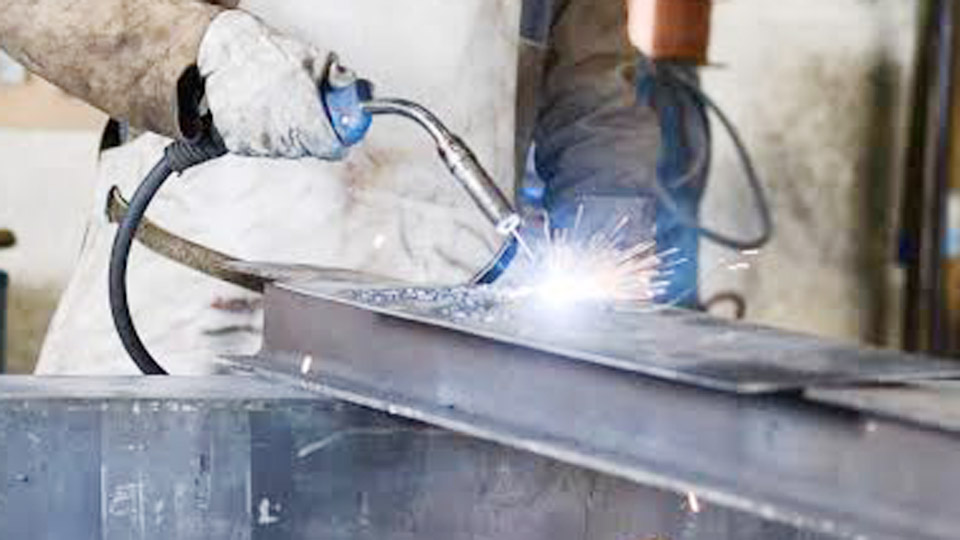
Image by hkfabrication
When Stick Welding (SMAW) Delivers Reliable Results Outdoors and on Contaminated Steel
Shielded metal arc welding uses a flux-coated consumable electrode that generates its own shielding gas and slag as it melts. The process runs on constant-current power sources, typically 50–300 A depending on electrode diameter, and works on AC or DC.
Outdoor and Contaminated Metal Performance
SMAW tolerates wind better than gas-shielded processes because the flux coating supplies local protection. Light rust, mill scale, or paint can often be burned through with cellulose or iron-powder electrodes such as E6010 or E7018.
This makes it the default for field structural steel, pipeline repair, and farm equipment where surface preparation is limited.
Portability and Power Source Constraints
Equipment consists of a power source, electrode holder, and ground clamp—highly portable and independent of gas cylinders. Duty cycle and open-circuit voltage limit continuous high-amperage runs; operators change electrodes frequently, lowering overall deposition rate compared with continuous-wire processes. Typical operating ranges stay between 15–35 V arc voltage.
Electrode Diameter and Amperage Matching
A 1/8-inch (3.2 mm) E7018 electrode commonly runs 90–160 A on DCEP. Smaller 3/32-inch rods drop to 70–110 A for thinner sections or vertical work. Larger 5/32-inch electrodes push 130–220 A for heavy fill. Polarity choice affects penetration: DCEP deepens the arc while DCEN or AC softens it for certain electrodes.
MIG Welding (GMAW) Decisions for Speed on Clean, Thin-to-Medium Sections
Gas metal arc welding feeds a continuous solid wire electrode through a gun while an external shielding gas protects the pool. Constant-voltage power sources maintain arc length; wire feed speed largely sets amperage.
Shielding Gas and Metal Transfer Mode Selection
Argon-rich mixtures (75 % Ar / 25 % CO₂) support short-circuit or pulsed spray transfer for thin mild steel and stainless. Pure CO₂ raises penetration but increases spatter.
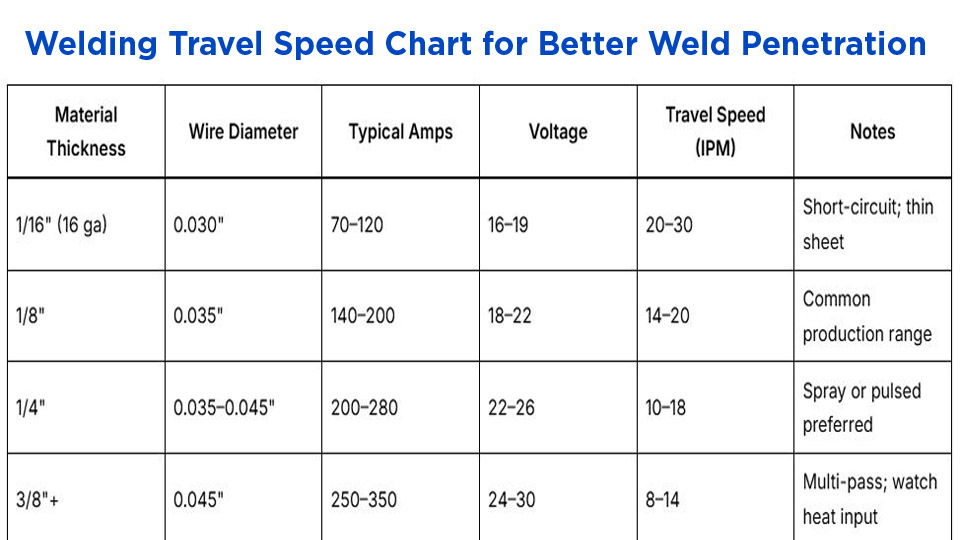
Spray transfer above the transition current (roughly 200–250 A for 0.045-inch steel wire) produces high deposition with minimal spatter on flat and horizontal joints thicker than 1/8 inch. Short-circuit transfer stays below 200 A for sheet metal and all-position work.
Thickness and Position Limits
GMAW excels from 24-gauge sheet up to medium plate when gas coverage is stable. Wind or drafts disrupt the shield, causing porosity. Out-of-position welding requires short-circuit or pulsed modes; conventional spray is restricted to flat and horizontal. Typical voltage windows run 18–32 V depending on wire diameter and transfer mode.
Productivity Versus Cleanup Trade-off
Deposition rates exceed SMAW because the wire feeds continuously. No slag forms with solid wire, reducing post-weld cleaning. Aluminum and stainless require pure argon or helium blends and specialized liners to prevent wire feed problems.
TIG Welding (GTAW) for Maximum Control on Critical and Thin Joints
Gas tungsten arc welding uses a non-consumable tungsten electrode and separate filler metal under inert gas (usually argon). Constant-current power sources allow precise amperage control, often with foot or finger remote.
Heat Input Management on Thin and Reactive Metals
Currents from under 10 A (micro-TIG) to 200–300 A handle foil to ¼-inch material. AC with balance control cleans aluminum oxide while DCEN concentrates heat for steel and stainless. Low heat input and independent filler addition minimize distortion and allow autogenous welds on close-fitting joints.
Filler Metal and Electrode Geometry Choices
2 % thoriated, lanthanated, or ceriated tungsten electrodes hold a sharp point for DC; pure or zirconiated tungsten forms a ball for AC aluminum work.
Filler rods match base metal chemistry (ER70S-2 for mild steel, ER308L for stainless). Arc length stays short—roughly equal to electrode diameter—to maintain shielding and avoid tungsten inclusions.
Quality and Speed Realities
GTAW produces the highest visual and radiographic quality among common arc processes but at the lowest deposition rate. It dominates aerospace, sanitary stainless, aluminum frames, and root passes on pipe where appearance and integrity override speed.
Flux-Cored Arc Welding Productivity Versus Slag Management
FCAW feeds a tubular wire filled with flux. Self-shielded (FCAW-S) generates its own protection; gas-shielded (FCAW-G) adds external gas for higher quality.
Self-Shielded Versus Gas-Shielded Wire Selection
FCAW-S operates outdoors without cylinders and tolerates moderate wind, similar to SMAW but with continuous feed. Typical currents for 0.045–1/16-inch wire range 150–300 A. FCAW-G uses CO₂ or argon mixes, delivers lower hydrogen and higher deposition, and suits shop fabrication of structural steel and heavy equipment.
Heavy Section and Out-of-Position Capability
Deposition rates surpass GMAW solid wire on thick plate. Vertical-up and overhead are practical with appropriate wires and reduced voltage. Slag must be removed between passes; fumes are higher than solid-wire GMAW, requiring stronger ventilation.
Parameter Windows for Common Diameters
0.045-inch flux-cored wire often runs 150–250 A at 22–28 V for horizontal work. Larger 1/16-inch wire pushes 200–320 A. Polarity is usually DCEP; some self-shielded wires require DCEN.
Submerged Arc and Plasma Arc Processes for High-Volume or Precision Industrial Work
High-Deposition Flat Seams with Submerged Arc Welding
SAW feeds a continuous wire under a blanket of granular flux that covers the arc completely. Currents of 300–2000 A produce deep penetration and deposition rates far above other arc processes.
Limited to flat or horizontal positions, it dominates long seams on pressure vessels, structural beams, and large-diameter pipe. Flux recovery systems reduce consumable cost. Arc voltage typically sits at 27–36 V.
Plasma Arc Welding Keyhole and Micro Modes
PAW constricts the arc through a fine orifice, creating higher energy density than GTAW. Micro-plasma (0.1–15 A) joins foil and thin sheet; keyhole mode (above 50–100 A) penetrates 1/8–1/4-inch material in a single pass. Used for edge welds, tubing, and precision aerospace components where GTAW lacks penetration or speed.
Matching Process to Material Thickness and Joint Requirements
| Process | Typical Thickness Range | Best Positions | Deposition Relative Rate | Primary Materials |
|---|---|---|---|---|
| SMAW | 1/8 in and up | All | Low–Medium | Carbon steel, low-alloy, some stainless |
| GMAW | 24 ga – 1/2 in+ | Flat/horiz preferred; all with short-circuit/pulse | High | Steel, stainless, aluminum |
| GTAW | 0.010 in – 1/4 in | All | Lowest | All weldable metals, especially aluminum, stainless, reactive |
| FCAW | 1/8 in and up | All | Very High | Carbon and low-alloy steel |
| SAW | 1/4 in and up | Flat/horiz | Highest | Carbon and low-alloy steel |
| PAW | Foil – 1/4 in | All | Medium | Stainless, titanium, precision alloys |
Thinner than 1/8 inch favors GTAW or short-circuit GMAW. Heavy plate and long seams shift toward FCAW or SAW. Contaminated or outdoor joints favor SMAW or self-shielded FCAW.
Environment, Skill Level, and Cost Factors That Override Process Preference
Indoor clean shops support gas-shielded GMAW and GTAW. Outdoor or remote sites eliminate cylinder-dependent processes unless windbreaks are practical. Beginner operators reach acceptable results fastest with GMAW short-circuit or self-shielded FCAW.
GTAW demands the highest manual skill for consistent results. Equipment cost rises from basic SMAW machines through multiprocess inverters to dedicated SAW or PAW systems.
Consumable cost and cleanup time further influence the final choice: continuous-wire processes reduce labor but increase gas or flux expense.
Wrapping Up
Selecting among the different types of arc welding and their uses requires matching heat input, shielding method, and deposition rate to the exact joint, material, and site conditions.
A structural beam outdoors on rusty steel runs efficiently with SMAW or self-shielded FCAW; a thin aluminum motorcycle frame demands GTAW; a long pressure-vessel seam belongs to SAW.
Advanced operators further refine the decision by measuring actual heat input and adjusting transfer mode or polarity to stay inside the qualified procedure range, ensuring both mechanical properties and production rate meet the specification.