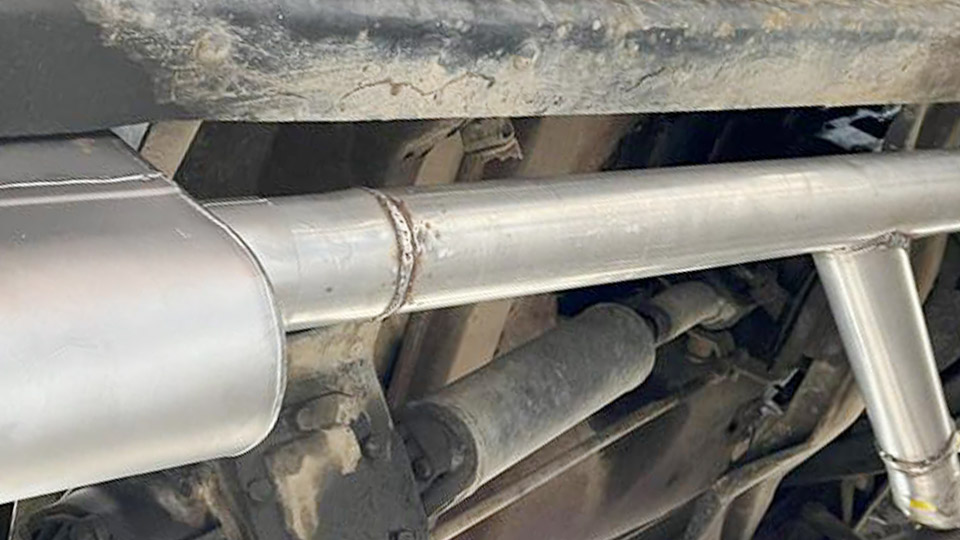
Cutting a hole in a header pipe and welding a branch directly creates a stress concentration that often fails ASME reinforcement calculations, especially on high-pressure or cyclic lines.
A standard reducing tee may not exist in the required size combination or may not fit the available space.
This is exactly where a Weldolet solves the problem. A Weldolet is a forged, self-reinforced branch connection fitting that is butt-welded to the run pipe and then to the branch pipe, providing both the outlet and the necessary reinforcement in one piece.
Understanding its design, selection criteria, and welding requirements prevents under-reinforced joints, excessive fabrication time, and code non-compliance on process, power, and pipeline systems.
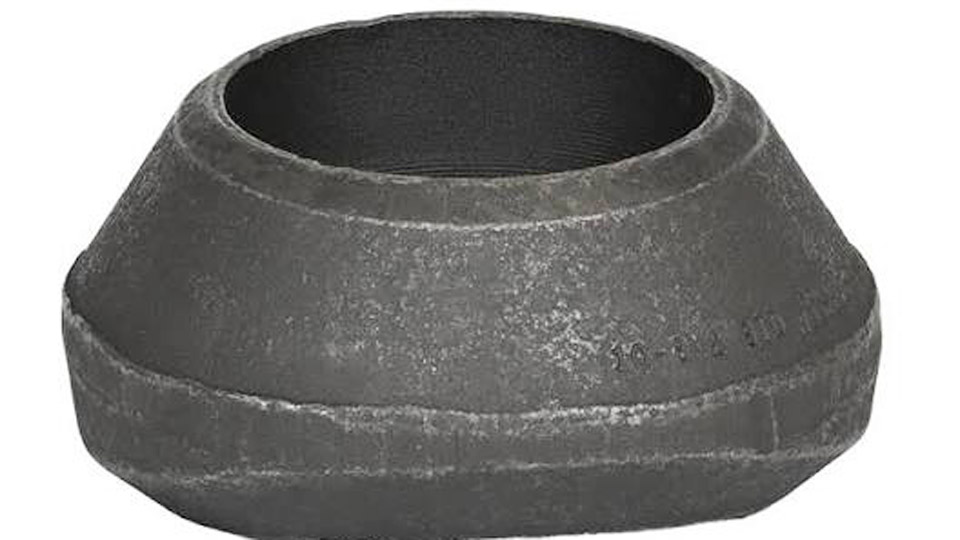
Image by bonneyforge
When Standard Tees and Stub-Ins Cannot Meet Design Requirements
Size Combinations and Space Constraints That Force an Alternative
Reducing tees are limited by manufacturing ranges. On a 16-inch header, a standard tee may only go down to a 6-inch or 8-inch branch. Smaller outlets require custom fabrication or a different fitting. Weldolets cover reducing sizes down to ½-inch or smaller on large headers and occupy far less envelope than a full tee.
In congested pipe racks or equipment nozzles, the compact height of a Weldolet often makes the difference between a workable layout and a redesign.
Reinforcement Area Calculations and Why Pads Are Not Always Practical
ASME B31.3 and B31.1 require that the material removed by the branch opening be replaced by reinforcement within a defined zone. A welded-on pad can supply that area, but it adds two extra welds, inspection time, and potential for residual stress.
A Weldolet is designed so that its forged contour and wall thickness already satisfy the reinforcement rules for most size and schedule combinations under MSS SP-97, eliminating the pad while still meeting the code area replacement formula.
How the Contoured Shape and Forged Hub Provide Integral Reinforcement
Stress Distribution at the Branch Junction
The saddle-shaped base of a Weldolet matches the curvature of the run pipe. This geometry spreads the load from internal pressure and external moments over a larger area than a simple set-on or set-in branch.
Finite-element studies and code experience show lower peak stresses at the crotch compared with an unreinforced or lightly reinforced stub-in. The tapered hub further transitions thickness so that the change in section is gradual rather than abrupt.
Full-Size Versus Reducing Weldolets and Schedule Matching
A full-size (size-on-size) Weldolet has the same nominal diameter on the branch end as the run pipe. A reducing Weldolet has a smaller branch outlet. In both cases the fitting schedule or class must equal or exceed the run-pipe schedule so that the reinforcement thickness remains adequate.
Common ratings are Standard Weight, Extra Strong, and Schedule 160 / XXS. Material must also match or be compatible with the run pipe—ASTM A105 for carbon steel, A182 grades for stainless and alloy, A350 for low-temperature service.
Choosing Between Weldolet, Sockolet, and Threadolet for the Specific Service
Pressure, Temperature, and Inspectability Drive the Decision
Weldolets use full-penetration butt welds on both the run and branch sides. They are the default for high-pressure, high-temperature, or cyclic service where radiographic or ultrasonic examination of the branch connection is required.
Sockolets use a socket-weld fillet on the branch side and are limited to smaller diameters (typically ≤ 2–4 inch) and moderate pressures (Class 3000 / 6000). Threadolets rely on NPT threads and are restricted to low-pressure utility or instrument lines where welding is impractical or disassembly is needed.
Size Limits and Installation Speed Trade-Offs
| Fitting | Branch Connection | Typical Size Range | Pressure Capability | Primary Use Case |
|---|---|---|---|---|
| Weldolet | Butt weld | ½” – 48″+ | Full schedule range | Critical process & power piping |
| Sockolet | Socket weld | ½” – 4″ | Class 3000/6000 | Small instrument or utility lines |
| Threadolet | Threaded | ½” – 4″ | Class 3000/6000 | Non-welded low-pressure service |
When the branch is larger than 2 inches or the design pressure exceeds the socket-weld class limits, the Weldolet is the only code-acceptable choice among the three.
Critical Dimensions and Preparation Requirements Before Welding
Hole Size, Bevel Geometry, and Root Gap
The opening cut in the run pipe must match the inside diameter of the Weldolet at the branch end so that the fitting sits correctly. Excessively large holes reduce the available reinforcement ligament.
Both the run-pipe hole edge and the Weldolet crotch bevel are prepared to ASME B16.25 geometry—typically a 30–37.5° bevel with a 1/16-inch root face.
A controlled root gap (commonly 1/16 inch or as specified in the WPS) is maintained by temporary spacers so that full penetration can be achieved without burn-through or lack of fusion.
Material Traceability and Marking
MSS SP-97 requires permanent marking of size, material grade, heat number or manufacturer’s identification, and pressure class or schedule. Heat numbers must be transferred to the weld joint documentation so that the material test reports remain linked to the installed fitting.
Mismatched material or undocumented heat treatment voids the reinforcement credit and can reject the joint during hydrostatic or NDE review.
Welding Sequence and Profile That Satisfy Code Reinforcement Rules
Full-Penetration Groove Weld to the Outer Edge of the Bevel
The primary weld between the Weldolet and the run pipe is a full-penetration groove weld that reaches the outer edge of the manufacturer’s bevel. Incomplete penetration leaves an unfused plane that acts as a crack starter under cyclic loading.
After the groove is filled, a cover fillet (or reinforcing fillet) is added. ASME codes limit the fillet leg size—often the smaller of 0.7 times the branch nominal wall or 6 mm—to avoid excessive weld metal that creates its own stress concentration.
Sequence That Controls Distortion and Ensures Fusion
Tack welds are placed at four quadrants after the root gap is verified. The root pass is deposited with a technique that produces a consistent internal reinforcement or back-bead. Fill passes follow, maintaining interpass temperature limits for the material.
The final cover pass is contoured so that the transition from the Weldolet skirt to the run-pipe surface is smooth. Excess convexity or undercut at the toe is ground or repaired before NDE.
Inspection and Acceptance Criteria Specific to Branch Connections
Visual, Dimensional, and Volumetric Examination
Visual inspection confirms that the weld profile meets the required fillet size and that no undercut exceeds code limits. Dimensional checks verify that the branch centerline is square to the run within the project tolerance (often 1° or less).
For critical service, radiography or ultrasonic testing is applied to the groove weld; the geometry of the saddle can make interpretation more difficult than a simple butt weld, so experienced technicians and calibrated procedures are required. Hydrostatic testing of the completed system remains the final proof of integrity.
Common Rejection Causes and How They Are Avoided
Lack of fusion at the root, incomplete penetration to the bevel edge, and excessive or insufficient cover fillet are the most frequent causes of rejection. Pre-weld fit-up verification, proper spacer use, and adherence to a qualified WPS prevent the majority of these defects. Welders must be qualified specifically for the pipe-to-fitting configuration and the material group.
Wrapping Up
Selecting a Weldolet is a design decision that balances reinforcement requirements, available space, pressure-temperature rating, and inspectability. When the branch size or service conditions exceed the practical limits of a tee or a sockolet, the contoured, self-reinforced Weldolet supplies both the outlet and the code-required area replacement in a single forged component.
Advanced practice further optimizes the joint by matching the exact schedule and material grade to the run pipe, controlling the root gap to the millimeter, and documenting the full-penetration weld profile so that the connection remains reliable under the highest design loads and cyclic conditions.
FAQs
What is the difference between a Weldolet and a Sockolet?
A Weldolet uses butt-weld preparation on the branch end for full-penetration welding and is preferred for high-pressure service. A Sockolet has a socket into which the branch pipe is inserted and fillet-welded; it is limited to smaller sizes and moderate pressure classes.
Can a Weldolet be used on the same size as the run pipe?
Yes. Full-size or size-on-size Weldolets match the nominal diameter of the run pipe and are available in the same schedules. Reducing Weldolets are used when the branch is smaller.
What standard covers Weldolet dimensions and strength?
MSS SP-97 specifies the essential dimensions, material, marking, and minimum strength requirements for integrally reinforced branch outlet fittings, including Weldolets. Installation and reinforcement rules are governed by the applicable ASME B31 code section.
Does a Weldolet always eliminate the need for a reinforcing pad?
In most standard size and schedule combinations the forged contour already satisfies the ASME area-replacement calculation, so a separate pad is unnecessary. The designer must still verify the calculation for non-standard conditions or extreme loading.