Many high-strength aluminum alloys crack or lose properties when arc-welded because fusion melting creates solidification defects and softens the heat-affected zone.
What is friction stir welding? It is a solid-state joining process that uses a rotating non-consumable tool to generate frictional heat and plastic deformation, forging the materials together below their melting point.
This approach eliminates porosity, hot cracking, and much of the distortion that plague fusion methods on 2xxx and 7xxx series alloys.
For shops working structural aluminum, aerospace components, or dissimilar metals, understanding the process parameters and material limits determines whether the joint meets strength and fatigue requirements without post-weld heat treatment or extensive rework.
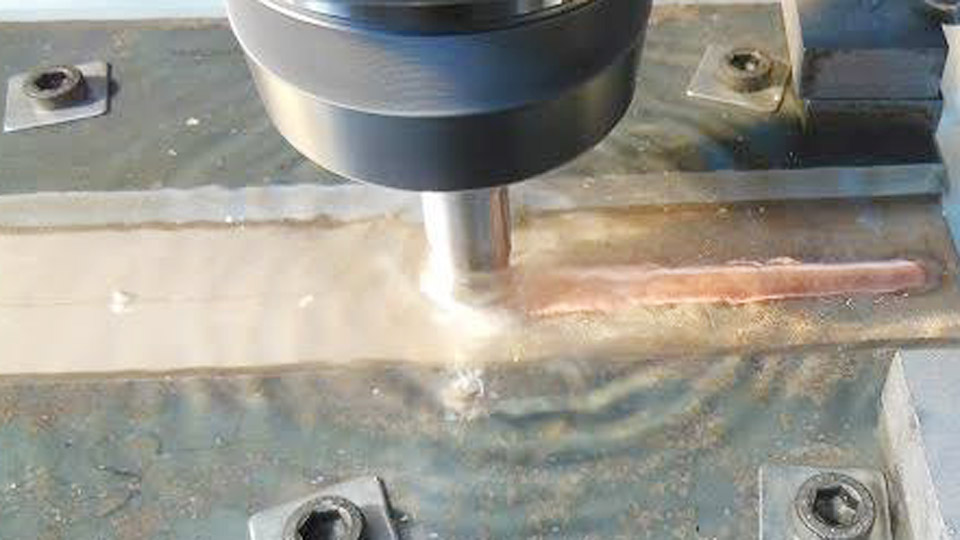
Image by kikukawa
How Friction Stir Welding Creates a Continuous Solid-State Bond
Friction stir welding relies on controlled mechanical working rather than a molten pool. A cylindrical tool consisting of a shoulder and a protruding pin rotates and plunges into the joint line until the shoulder contacts the surface.
Friction at the shoulder–workpiece interface and severe plastic strain around the pin raise the local temperature into the hot-working range, typically 440–550 °C for aluminum alloys.
The plasticized metal is then stirred and forged behind the advancing tool, consolidating into a continuous solid-state joint as it cools under the shoulder pressure.
Tool Geometry and Material Flow Mechanics
The shoulder generates most of the heat and applies the forging force that consolidates the joint. Shoulder diameters commonly range from 10–25 mm for plate thicknesses up to about 12 mm; larger shoulders increase heat input and process force.
The pin, usually threaded, tapered, or fluted, drives vertical and circumferential material flow. Threaded or tri-flute pins improve mixing through thickness and reduce the chance of root defects.
Pin length is set slightly less than plate thickness so the tip does not contact the backing bar while still disrupting the root interface. Material flows from the advancing side (where tool rotation and travel direction coincide) to the retreating side, creating an asymmetric stir zone.
Temperature and Microstructure Zones Formed
Peak temperatures stay below the solidus, so solidification-related defects never form. The resulting microstructure contains four distinct regions: the stir zone (nugget) with fine recrystallized grains, the thermo-mechanically affected zone (TMAZ) showing deformed but not fully recrystallized grains, the heat-affected zone (HAZ) with only thermal alteration of precipitates or grains, and the unaffected base metal.
In precipitation-hardened aluminum, the HAZ often softens relative to the base metal, yet joint efficiencies of 80–95 % of base-metal strength are routinely achieved when parameters are optimized. The refined grain structure in the stir zone improves toughness and fatigue resistance compared with fusion-welded microstructures.
Critical Process Parameters That Decide Weld Integrity
Four primary variables—rotational speed, traverse speed, axial force (or plunge depth), and tool tilt—control heat input, material flow, and forging pressure. Incorrect combinations produce voids, lack of consolidation, or excessive flash.
Rotational Speed Versus Traverse Speed Balance
Rotational speed typically ranges from 300–1500 rpm for aluminum alloys and lower (100–500 rpm) for steels or titanium when polycrystalline cubic boron nitride or tungsten-based tools are used. Higher rotation increases heat and softens the material, improving flow but risking excessive flash or tool wear.
Traverse speed (welding speed) usually falls between 50–400 mm/min for aluminum plate; slower speeds raise heat input while faster speeds reduce it. The ratio of rotational speed to traverse speed determines the “weld pitch” (distance traveled per revolution).
Values around 0.3–0.8 mm/rev often produce balanced heat for 3–6 mm aluminum. Too high a pitch (cold weld) leaves tunnel voids; too low a pitch (hot weld) causes surface galling and HAZ softening.
Axial Force, Plunge Depth, and Tilt Angle Effects
Axial force or controlled plunge depth keeps the shoulder in firm contact and generates the forging pressure needed for consolidation. Insufficient force produces surface lack of fill or internal voids; excessive force creates heavy flash and thins the joint.
Tool tilt of 0–3° (trailing edge lower) improves material flow under the shoulder and helps eliminate root defects.
Position-controlled machines rely on precise plunge depth; force-controlled systems maintain constant load and better tolerate thickness variation. Both approaches require rigid fixturing because process forces can exceed several kilonewtons.
Materials and Joint Types That Favor Friction Stir Welding
FSW succeeds on alloys that resist conventional fusion welding and on combinations that form brittle intermetallics when melted.
Aluminum Alloys That Challenge Fusion Processes
All commercial aluminum series can be joined, including the 2xxx and 7xxx alloys previously labeled non-weldable by arc methods. Joint efficiencies exceed those of MIG or TIG welds because the absence of a liquid phase prevents hot cracking and porosity.
Thicknesses from thin sheet to 50 mm or more are practical in a single pass when tool and machine capacity match the section.
Butt, lap, T, and fillet configurations are all feasible; butt joints dominate production because they allow full-thickness stirring with minimal preparation beyond clean, square edges.
Expanding Beyond Aluminum – Steels, Dissimilar Metals, and Polymers
Magnesium and copper alloys respond well under adjusted speeds and tool materials. Steels and titanium require high-temperature tool materials such as PCBN or tungsten-rhenium and lower rotational speeds; tool life remains a cost driver.
Dissimilar joints (aluminum to steel, aluminum to magnesium, copper to aluminum) are possible when intermetallic formation is limited by the solid-state temperature and by tool offset strategies that minimize mixing of the higher-melting metal.
Thermoplastics and some polymer composites can also be joined, though process windows differ markedly from metals.
Performance Differences Versus Conventional Arc Welding
Choosing FSW versus MIG, TIG, or laser depends on required mechanical properties, distortion tolerance, and production volume.
Strength, Distortion, and Defect Comparison
FSW joints typically retain higher tensile and fatigue strength than fusion welds in the same aluminum alloy because the refined stir-zone microstructure and lower residual stresses outweigh the modest HAZ softening.
Distortion is substantially lower due to the absence of solidification shrinkage and the more uniform heat input. Porosity, solidification cracking, and incomplete fusion defects common in arc welding do not occur.
Surface finish after FSW may show tool marks or slight flash that require light machining for aesthetic or sealing applications, but the internal joint is usually free of volumetric defects when parameters are correct.
When FSW Becomes the Better Economic Choice
Capital cost for a dedicated FSW machine is higher than for an arc system, and rigid clamping fixtures add expense. Consumable cost is lower—no filler wire or shielding gas is required for aluminum—and operator skill requirements shift from manual dexterity to process monitoring.
For long, straight seams on aluminum extrusions, panels, or tanks, the single-pass capability, reduced distortion, and higher joint efficiency often offset the equipment investment. Complex three-dimensional paths or frequent thickness changes still favor flexible arc processes.
Defect Formation and the Parameter Adjustments That Prevent Them
Even solid-state welds can contain defects if heat input or material flow is inadequate.
Tunnel Voids and Insufficient Heat Input
Tunnel or wormhole defects form when the plasticized material fails to refill the cavity behind the pin, usually on the advancing side. Causes include excessive traverse speed, insufficient rotational speed, or inadequate axial force.
Raising heat input (higher rpm or lower travel speed) or increasing forging pressure normally closes the void. Surface flash or excessive thinning indicates the opposite condition—too much heat or force.
Kissing Bonds and Lack of Penetration Issues
A kissing bond is an incomplete metallurgical bond that appears continuous on radiographs yet fails under load. It arises from insufficient disruption of oxide layers or inadequate forging pressure at the root. Lack of penetration occurs when pin length is too short or plunge depth insufficient.
Both defects are avoided by verifying pin penetration reaches within 0.1–0.3 mm of the root, using a slight tool tilt, and confirming adequate axial load.
Exit holes left when the tool is withdrawn are design features rather than defects; run-off tabs or friction-plug repairs eliminate them when continuous strength is required.
Equipment and Fixturing Constraints That Affect Shop Adoption
FSW machines range from modified milling centers to purpose-built gantry or robotic systems capable of multi-axis paths. Stiffness is critical because deflection under load alters plunge depth and heat generation. Backing bars or anvils must support the full process force without deflection.
Tool materials for aluminum are commonly hardened tool steels (H13 or similar); harder workpieces demand PCBN or refractory alloys whose cost and wear rate influence process economics.
Process monitoring—spindle torque, axial force, and temperature—provides real-time indicators of joint quality and allows adaptive control on production equipment.
Wrapping Up
Selecting friction stir welding requires matching the process window to alloy, thickness, joint geometry, and production volume. When the priority is high joint efficiency on heat-treatable or non-weldable aluminum, minimal distortion, and freedom from fusion defects, the solid-state route delivers measurable advantages over arc processes.
Advanced practitioners further refine performance by combining tailored pin profiles with adaptive force control and post-weld aging schedules that restore precipitate strengthening in the HAZ, pushing joint efficiency closer to base-metal levels on critical structural components.
FAQs
Is friction stir welding stronger than TIG on aluminum?
Yes, for most structural aluminum alloys. Joint efficiencies commonly reach 80–95 % of base-metal strength, higher than typical TIG welds, because solid-state processing avoids porosity and solidification cracks while refining the grain structure.
Can friction stir welding join steel or titanium?
It can, but requires specialized high-temperature tools (PCBN or tungsten alloys) and lower rotational speeds. Tool wear and equipment cost remain higher than for aluminum, limiting widespread production use.
What causes tunnel defects in friction stir welding?
Tunnel voids form when heat input is too low or forging pressure insufficient, leaving unfilled cavities behind the pin. Increasing rotational speed, reducing traverse speed, or raising axial force usually eliminates them.
Does friction stir welding need shielding gas or filler metal?
No. For aluminum and most non-ferrous alloys the process is self-shielded and requires neither filler nor gas, reducing consumable cost and eliminating related defects.