MIG welding is widely used in fabrication, automotive repair, and metal manufacturing because it offers high welding speed and relatively easy operation. However, understanding the advantages and disadvantages of MIG welding is essential before choosing it for a specific job.
Its continuous wire feed and stable shielding gas coverage can produce clean, consistent welds with less downtime than many manual welding processes.
On the other hand, equipment costs, sensitivity to wind, metal preparation requirements, and difficulty maintaining proper settings can limit its effectiveness in certain conditions.
Material thickness, joint position, base metal type, and working environment all influence whether MIG welding is the most practical option. Evaluating its strengths and limitations helps welders select the right process, control production costs, reduce weld defects, and achieve reliable results in real fabrication work.
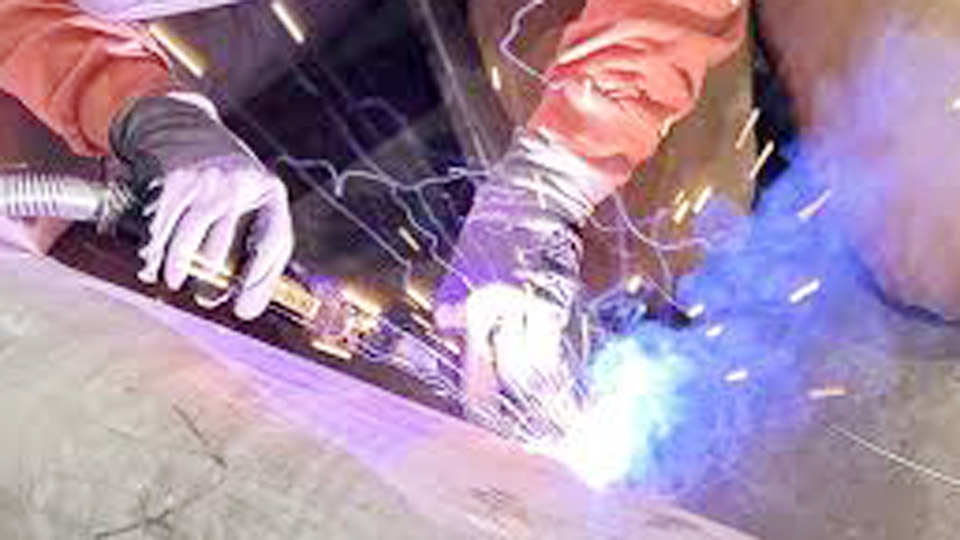
Image by gsmindustrial
When Continuous Wire Feed Produces Higher Deposition Than Stick
MIG’s continuous electrode eliminates the stub loss and frequent stops of SMAW. Solid ER70S-6 wire achieves deposition efficiencies of 93–98 percent, compared with roughly 60–65 percent for coated stick electrodes.
Practical deposition rates for 0.035-inch wire in short-circuit transfer typically range from 3–8 lb/hr; spray transfer on thicker plate with 0.045-inch wire can reach 8–12 lb/hr under production conditions.
Flat and Horizontal Production Rates
On clean mild steel in the flat position, short-circuit MIG at 150–180 A and 18–21 V with 0.035-inch wire lays consistent fillets at travel speeds of 10–18 ipm. Spray transfer at 250–300 A and 26–29 V deposits metal faster with lower spatter, allowing multi-pass grooves on ⅜-inch and thicker plate to finish in fewer total hours than equivalent stick welding.
Comparison Against Stick Electrode Consumption
A 1/8-inch E7018 electrode leaves 1–2 inches of stub waste per rod. Over a full day of continuous fillet welding, that loss compounds. MIG wire feeds without interruption, so the same linear footage of weld requires less total filler metal and less operator time spent changing consumables.
How Shielding Gas Restricts Outdoor and Drafty Environments
External gas shielding is both MIG’s strength and its primary limitation. Argon-CO₂ mixes (commonly 75/25) or pure CO₂ protect the arc and puddle, producing low-hydrogen deposits with minimal slag. Any disruption of the gas envelope immediately creates porosity.
Wind Thresholds That Destroy Shielding
Air movement above 5 mph routinely blows shielding gas away from the nozzle. Even shop drafts from open doors or fans produce worm-hole porosity that fails visual or radiographic inspection. Stick welding remains viable under the same conditions because flux generates its own protective atmosphere.
Indoor Gas Flow and Nozzle Considerations
Typical flow rates of 25–35 cfh work in still air. Higher flow does not compensate for wind; it only increases turbulence and gas consumption. Gas lenses and larger nozzles help in mild drafts, but they cannot replace a windbreak or enclosure for outdoor work.
Equipment Cost, Portability, and Maintenance Demands
A functional MIG setup requires a constant-voltage power source, wire feeder, gas cylinder, regulator, and torch. Entry-level 140–200 A machines start higher than basic stick welders, and the ongoing cost of shielding gas and contact tips adds operating expense.
Cylinder Handling and Site Logistics
A full argon-CO₂ cylinder weighs more than 100 lb and must be secured upright. Moving the bottle, hose, and machine across a jobsite or onto scaffolding is slower and more hazardous than carrying a stick electrode holder and a handful of rods. Battery-powered or engine-driven multiprocess units improve mobility, yet gas still remains the limiting factor.
Consumable Wear and Feed-System Reliability
Contact tips erode under high amperage and must be replaced regularly. Drive rolls, liners, and nozzles require periodic cleaning or replacement. Bird-nesting from incorrect tension or worn liners stops production until the feeder is cleared. Stick welding has fewer mechanical failure points.
Surface Cleanliness Requirements Versus Stick Forgiveness
MIG demands cleaner base metal than flux-shielded processes. Mill scale, rust, oil, paint, and moisture generate porosity, lack of fusion, or inclusions because there is no flux to scavenge contaminants.
Preparation Standards for Sound Welds
Light mill scale can sometimes be burned through with higher amperage and CO₂-rich gas, but heavy scale or coatings must be removed by grinding or chemical cleaning. Stick electrodes such as E6010 or E7018 tolerate more surface contamination and still produce acceptable structural welds.
Aluminum and Stainless Implications
Aluminum requires near-perfect cleanliness and often a spool gun or push-pull system to feed soft wire without bird-nesting. Stainless benefits from precise gas control (tri-mix or argon-CO₂) to maintain corrosion resistance. Both metals expose MIG’s sensitivity more than mild steel does.
Positional Capability and Transfer Mode Restrictions
Standard short-circuit transfer works in all positions because the low heat input freezes the puddle quickly. Globular and axial spray transfer are largely limited to flat and horizontal positions due to the large, fluid droplet or continuous stream of molten metal.
Vertical and Overhead Practical Limits
Vertical-up short-circuit MIG is common with 0.030- or 0.035-inch wire at reduced voltage and wire speed, often combined with a slight weave. Overhead remains possible but demands tight arc length and controlled travel to prevent dripping. Spray transfer is rarely used out of position without pulsed-wave equipment that lowers average heat input.
Pulse and Advanced Waveforms
Modern inverter machines with pulse or modified short-circuit modes expand out-of-position capability and reduce spatter. These features raise the equipment cost and complexity but narrow the gap between MIG and processes traditionally preferred for vertical or overhead work.
Thickness Range Where MIG Gains or Loses Advantage
MIG covers a wide thickness band, yet the optimal transfer mode and wire diameter shift with material size.
Thin-Gauge Performance (24 ga to 1/8 inch)
Short-circuit transfer with 0.023- or 0.030-inch wire at 14–18 V and 80–180 ipm wire speed controls heat input and minimizes burn-through on sheet metal and automotive panels. Heat-affected zone size stays smaller than with stick, reducing distortion.
Medium to Heavy Plate (3/16 to 1/2 inch and Beyond)
Spray or pulsed spray with 0.035- or 0.045-inch wire delivers higher deposition and deeper penetration. Multi-pass techniques remain necessary for thick sections, and distortion control becomes more critical than with submerged-arc processes.
Stick or flux-cored often proves more economical for heavy structural work when portability or outdoor conditions dominate.
Decision Matrix for Selecting MIG Over Competing Processes
| Factor | MIG Advantage | MIG Limitation | Prefer Instead When… |
|---|---|---|---|
| Deposition rate | High (continuous wire) | Lower than SAW on heavy plate | Thick plate production runs |
| Outdoor / windy conditions | Poor | Gas blown away | Stick or self-shielded flux-cored |
| Thin material (< 1/8″) | Excellent heat control | Risk of burn-through if settings high | TIG for ultimate precision |
| Surface cleanliness | Requires clean metal | Porosity from contaminants | Stick on rusty or painted steel |
| Learning curve | Short | Still needs parameter dialing | Absolute beginners starting with stick |
| Portability | Moderate to low | Cylinder and feeder bulk | Field repair with stick |
| Weld appearance / cleanup | Minimal slag, light spatter | Spatter possible without pulse | TIG for critical cosmetics |
Wrapping Up
Choose MIG when the work is primarily indoor, clean mild steel or stainless, thickness from sheet to medium plate, and production speed matters. Switch processes when wind, heavy contamination, extreme thickness, or ultra-precise thin-gauge aesthetics dominate the requirements.
Matching transfer mode, wire diameter, and gas mix to the joint geometry extracts the maximum advantage from MIG while avoiding its documented limits.
Advanced operators further refine performance by combining pulsed waveforms with precise stick-out control (⅜–½ inch) to stabilize the arc and reduce spatter without sacrificing deposition rate.
FAQs
Is MIG welding faster than stick welding?
Yes. Continuous wire feed and higher deposition efficiency allow MIG to complete the same linear footage of weld in less time, especially on long or repetitive joints indoors.
Why does MIG welding fail outdoors?
Shielding gas is easily disrupted by wind above approximately 5 mph, producing porosity. Stick or self-shielded flux-cored processes do not rely on external gas and remain usable.
Can MIG weld thick steel effectively?
Yes, with spray or pulsed spray transfer and multi-pass technique. Deposition rates remain competitive up to roughly ½ inch; beyond that, submerged arc or flux-cored often become more economical for heavy production.
Does MIG require cleaner metal than stick?
Yes. Contaminants that stick electrodes can tolerate through flux action routinely cause porosity or lack of fusion in gas-shielded MIG.